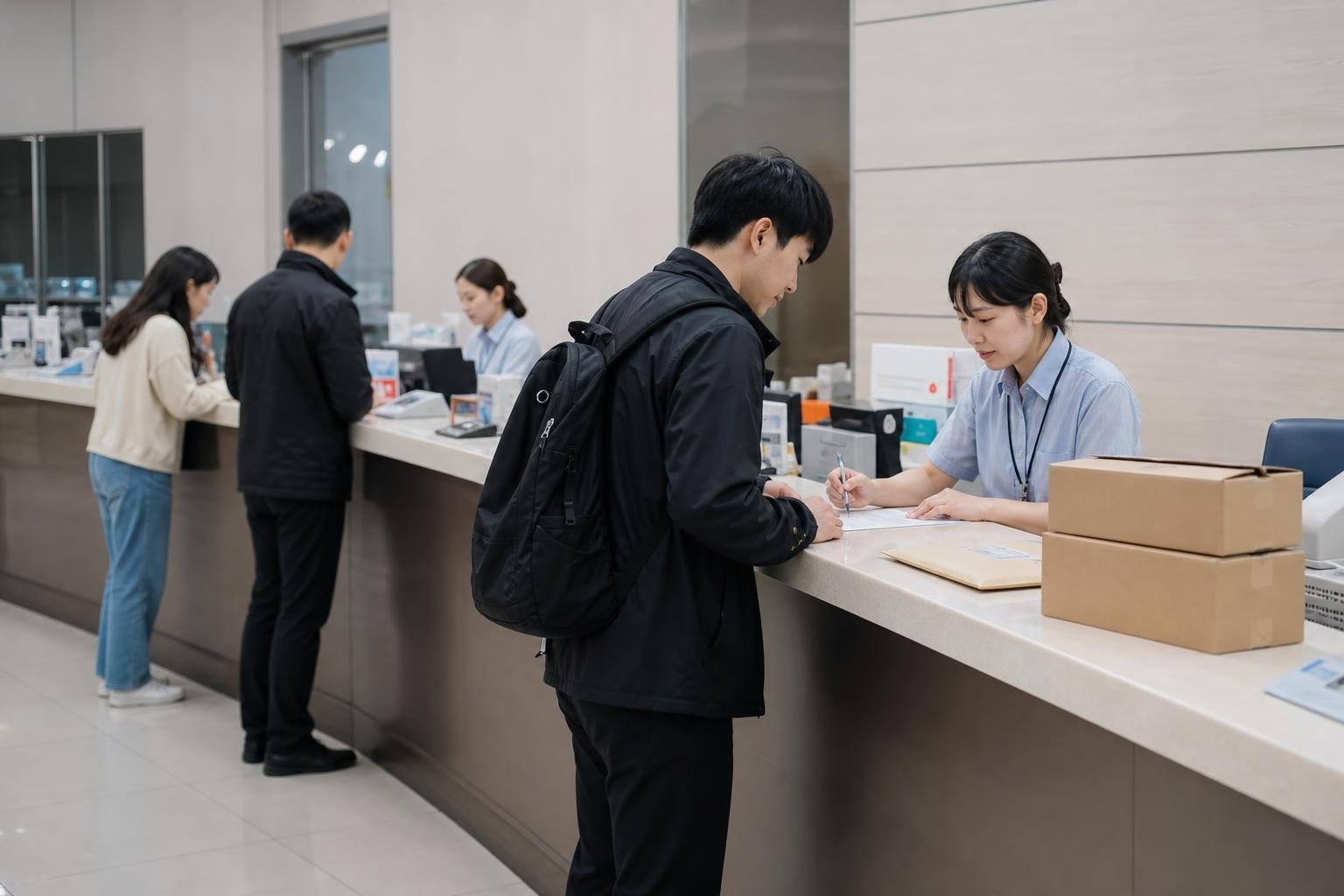
A Korean post office is called a 우체국 (ucheguk). To send a parcel, bring the recipient’s complete address and phone number, place the package on the counter scale, explain where it is going, and keep the receipt after paying. For international shipments, you will also need an accurate English description and value for every item inside.
Korea Post is a practical choice if you are learning how to send a package from Korea. You do not need to memorize every service name: tell the clerk the destination and whether cost, speed, or tracking matters most. The clerk can then confirm which services are currently available.
Post office hours and counters
Korea Post’s standard postal-counter hours are 9 a.m. to 6 p.m., Monday through Friday, excluding public holidays. Financial counters normally serve customers from 9 a.m. to 4:30 p.m. Some branches may limit service during lunch under regional rules, and the final acceptance time for mail departing that day varies by branch. Check the specific location in Korea Post’s branch finder if timing matters. source
At a larger branch, look for 우편 (mail/postal services). The counters marked 예금 and 보험 handle savings and insurance. Take a queue ticket if the branch uses numbered service.
What to bring
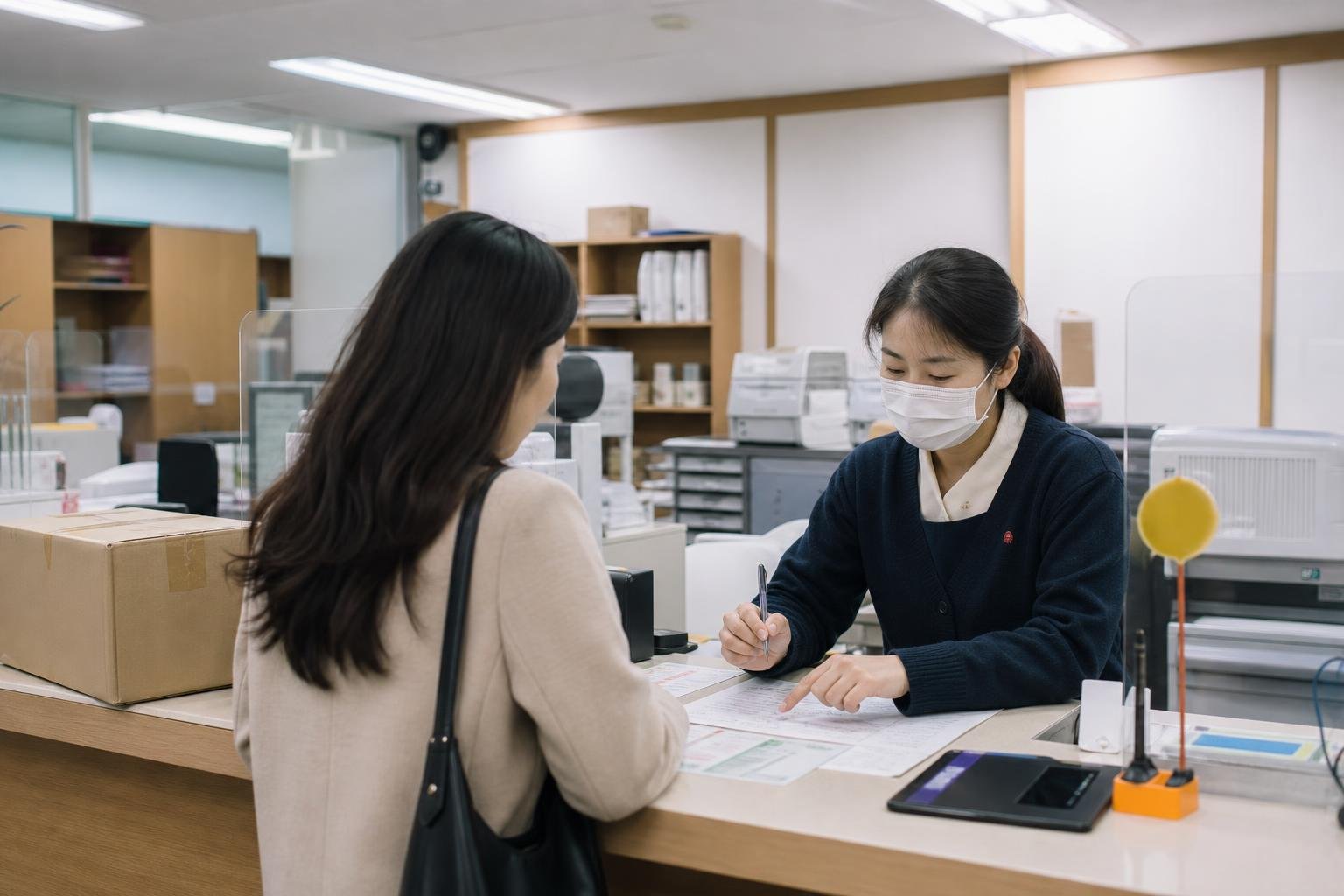
Prepare the package before you go whenever possible. Use a sturdy box, sufficient padding, and strong packing tape. Avoid decorative wrapping that may tear or cover the shipping label. Korea Post may ask you to open an international parcel if the stated contents are unclear or appear inconsistent with what is inside. source
Bring the following information:
- The sender’s name, address, postal code, and telephone number
- The recipient’s full name, address, postal or ZIP code, and telephone number
- A clear list of the contents for an international shipment
- The quantity and realistic value of each international item
- Any invoice, permit, safety document, or customs information required for restricted goods
Korea Post recommends placing a second copy of the sender’s and recipient’s addresses inside an international parcel in case the exterior label is damaged. source
Sending a parcel within South Korea
For domestic delivery, bring the recipient’s Korean road-name address and five-digit postal code. A Korean mobile number is also important because it allows the carrier to contact the recipient about access or delivery problems.
A domestic address may be written like this:
서울특별시 마포구 월드컵로 00
101동 1001호 김민지
04000
In an apartment address, 동 identifies the building and 호 identifies the unit. Do not omit or reverse them. Korea Post’s recommended format places the road address first, the detailed building and unit information on the next line, and the postal code separately. source
At the counter, ask to send a 국내 소포 (domestic parcel). Domestic counter parcels are charged according to weight and size categories. The general maximum is 30 kilograms; the sum of length, width, and height must not exceed 160 centimeters, and the longest side must be no more than 100 centimeters. The applicable charge is based on whichever category—weight or size—is higher. source
Sending an international package
Write international address information clearly in Roman letters and Arabic numerals. Korea Post says the address may also appear in the destination country’s local script. Write the city or region and destination country in capital letters, and include the postal code whenever available. source
A basic label should contain:
JANE SMITH
123 EXAMPLE STREET, APT 4B
CHICAGO, IL 60600
U.S.A.
Tel: +1 000 000 0000
For goods, complete the customs information in English. List each type of item separately with its quantity and realistic value in U.S. dollars. Avoid descriptions such as “personal items,” “present,” or “miscellaneous.” Better entries include “2 used cotton shirts,” “3 paperback books,” or “4 sealed tea packages.” Korea Post specifically requests accurate English descriptions and USD values to help customs processing. source
If the purpose is a gift, mark it as a gift while still describing the contents item by item:
Contents: 2 used cotton T-shirts
Quantity: 2
Value: USD 20
Purpose: Gift
A gift is not automatically exempt from import tax. The destination country’s customs authority decides whether the recipient must pay duties, taxes, or handling fees.
You can also enter domestic parcel or international shipment information in advance through Korea Post’s online or mobile pre-acceptance service, then visit the counter to pay and hand over the item. This can reduce the amount of information you need to enter at the branch, but it is not necessary for an ordinary walk-in visit. source
Choosing an international service
Available services depend on the destination, current transport conditions, dimensions, weight, and contents. Confirm the current options instead of relying on an old price chart or delivery estimate.
- EMS: Korea Post’s express international mail service. It is usually the first service to ask about when speed and end-to-end tracking are priorities. The general limit is 30 kilograms, but some destinations have lower limits or different size rules. source
- International parcel: a standard overseas parcel service that may cost less than EMS for a non-urgent box. Availability and transport methods vary by country.
- Registered small packet: an option that may be suitable for lightweight goods when offered for the destination.
- K-Packet: an online service for merchandise weighing up to two kilograms, delivered without collecting the recipient’s signature. It is aimed particularly at online shipments and requires advance online processing, so it should not be treated as a universal walk-in counter option. source
Ask for the final price before paying. International charges may be affected by actual weight, dimensional weight, destination, and surcharges. Customs processing time is also separate from Korea Post’s transport estimate.
What happens at the counter
- Take a postal-service queue number if the branch has a ticket machine.
- Place the parcel on the scale. The clerk may also measure the box.
- State the destination. Say whether it is domestic or international.
- Explain your priority. Ask for the fastest or less expensive suitable service.
- Confirm the contents. For international mail, answer accurately if the clerk asks what is inside.
- Complete or confirm the label and customs data.
- Pay and keep the receipt. The receipt contains the mailing number used for tracking when the selected service is trackable.
Photograph the receipt before putting it away. It is your proof of posting and will be useful if the parcel is delayed, returned, damaged, or lost.
Check restricted items before packing
International postal restrictions and destination-country import rules are separate. An item accepted for export from Korea may still be restricted by the receiving country.
Common problem items include perfume, aerosols, nail products, alcohol, medicines, food, seeds, cosmetics, unidentified liquids or powders, and electronics containing batteries. Korea Post currently prohibits perfume and rechargeable lithium batteries—including devices containing those batteries—from ordinary international postal carriage. Some cosmetics are accepted only when they have no dangerous-goods marking; samples may require a material safety data sheet. source
Do not guess based on whether an item can be carried on a passenger flight. Postal air-cargo rules are different. Check both Korea Post’s current item guidance and the destination country’s customs or quarantine rules before visiting the branch. If you are uncertain, keep the box easy to open and show the product in its original packaging.
Useful Korean phrases
The polite -요 style is appropriate for an ordinary counter interaction.
- 소포를 보내고 싶어요.
Soporeul bonaego sipeoyo.
I’d like to send a parcel. - 국내로 보내려고요.
Gungnaero bonaeryeogoyo.
I’m sending it within Korea. - 미국으로 보내고 싶어요.
Migug-euro bonaego sipeoyo.
I’d like to send it to the United States. - EMS로 보낼 수 있어요?
EMS-ro bonael su isseoyo?
Can I send it by EMS? - 가장 빠른 방법이 뭐예요?
Gajang ppareun bangbeobi mwoyeyo?
What is the fastest option? - 조금 더 저렴한 방법이 있어요?
Jogeum deo jeoryeomhan bangbeobi isseoyo?
Is there a less expensive option? - 배송 조회를 할 수 있어요?
Baesong johoereul hal su isseoyo?
Can I track the shipment? - 상자를 살 수 있어요?
Sangjareul sal su isseoyo?
Can I buy a box? - 포장 테이프를 써도 될까요?
Pojang teipeureul sseodo doelkkayo?
May I use some packing tape? - 안에는 옷 두 벌하고 책 세 권이 있어요.
Aneneun ot du beolhago chaek se gwoni isseoyo.
There are two items of clothing and three books inside. - 도착하는 데 얼마나 걸려요?
Dochakaneun de eolmana geollyeoyo?
How long will it take to arrive? - 카드로 결제할게요.
Kadeuro gyeoljehalgeyo.
I’ll pay by card.
After you post the parcel
Use the mailing number on the receipt in Korea Post’s tracking system. For international mail, scan frequency and detail can change after the parcel is transferred to the destination postal operator. Several days without an update may reflect export processing, transport schedules, weekends, or customs inspection rather than a lost parcel.
Send the tracking number to the recipient and make sure their telephone number remains active. International recipients should also watch for messages from their postal operator or customs authority. A clear address, honest customs declaration, reachable recipient, and saved receipt will prevent more problems than knowing every Korean postal term.