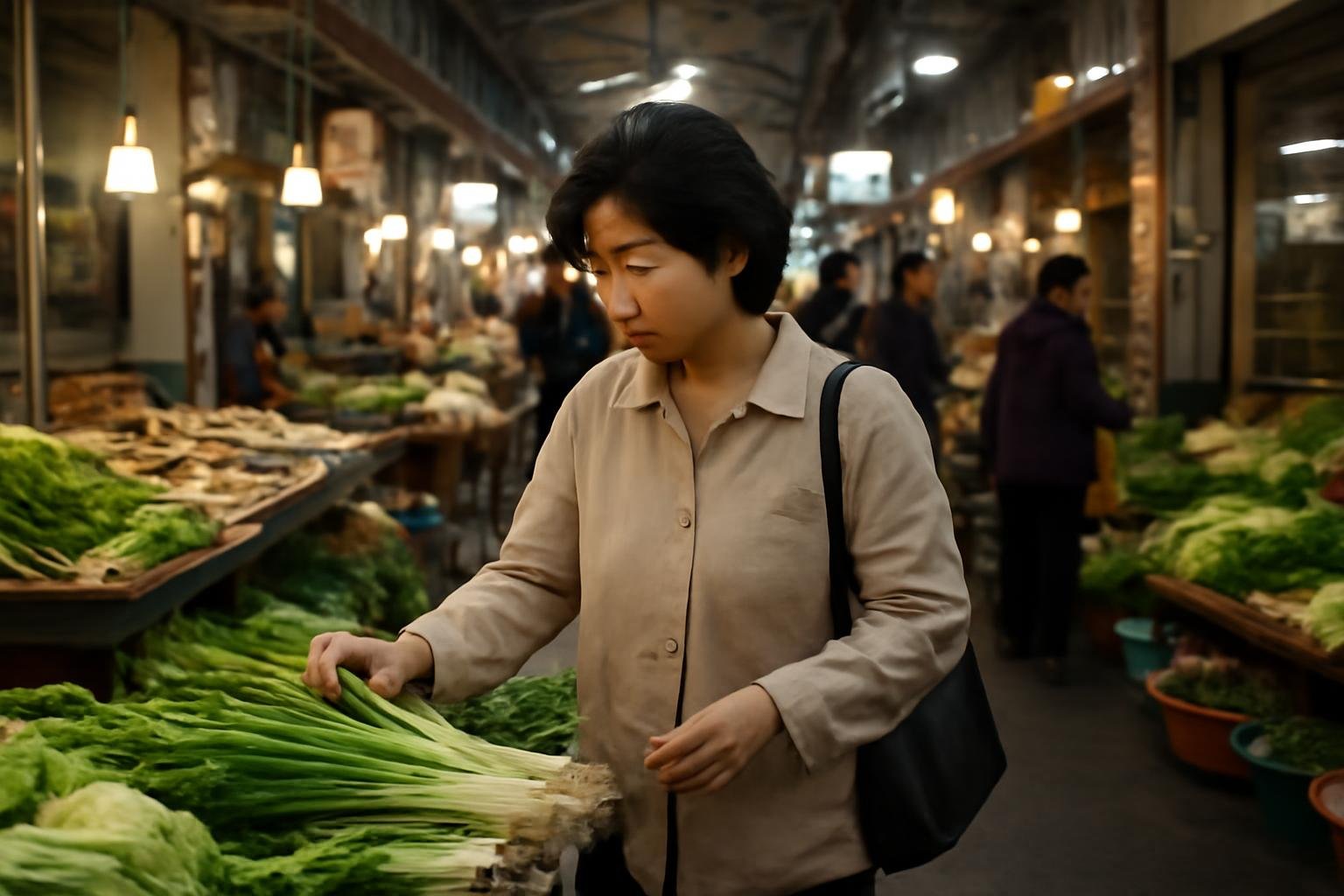
Shopping at a Korean traditional market is easiest when you treat each stall as a separate small business. One vendor may sell fixed-price snacks, another may weigh produce, and a third may negotiate over clothing or souvenirs. Prices, payment methods, portions, packaging, and return policies can change from stall to stall.
The practical formula is simple: walk through once, check how the price is calculated, confirm the amount you are buying, and ask about payment before the transaction is prepared. Carry some cash, but do not assume every market is cash-only or that bargaining is expected.
Check whether the price is displayed or calculated
Some stalls show clear prices on signs, menus, tags, or digital scales. Others quote a price only after you point to an item or specify a quantity. A displayed amount may refer to one piece, one tray, one bag, one serving, or a weight such as 100 grams or one kilogram.
Before the vendor weighs or prepares anything, confirm what the number covers. This matters especially for fruit, seafood, meat, side dishes, nuts, dried goods, and handmade products sold in bundles.
- 이거 얼마예요? (igeo eolmayeyo?) — How much is this?
- 한 개에 얼마예요? (han gaee eolmayeyo?) — How much is one?
- 이 가격이 전체 가격이에요? (i gagyeogi jeonche gag-ieyo?) — Is this the total price?
- 몇 개예요? (myeot gaeyeyo?) — How many pieces is it?
If a price is clearly displayed, paying that amount is normally the least complicated approach. If no price is visible, asking before touching or carrying an item to the counter avoids confusion. At a busy stall, pointing at the item and showing a calculator or phone number can be more effective than trying to explain a complicated request.
Understand weighing, portions, and minimum purchases
Fresh ingredients are often sold by weight, while prepared foods may be priced by container, plate, skewer, serving, or bundle. A vendor may select the item, trim it, place it on a scale, and quote the final amount. That process is routine, but you can still ask for a smaller quantity before the item is packed.
For a small amount, say 조금만 주세요 (jogeumman juseyo, “Please give me just a little”) or point to the amount you want and say 이만큼 주세요 (imankeum juseyo, “Please give me this much”). If you need a specific number, use a simple quantity such as 두 개 (du gae, two pieces) or 한 봉지 (han bongji, one bag).
Do not assume that a vendor will sell a single piece when goods are bundled or prepared in batches. Ask whether you can buy less before the vendor opens a package or starts cooking. For foods sold by weight, watch the scale and confirm the final total if you are unsure. Traditional units may appear in some markets, but their use and interpretation can vary by product; ask the vendor rather than guessing.
When bargaining is appropriate—and when it is not
Negotiation is not a universal feature of Korean traditional markets. It is more plausible for clothing, accessories, household goods, souvenirs, or a larger purchase. It is usually less appropriate for a clearly priced meal, a small snack, ordinary groceries, or an item sold at a fixed menu price.
If you want to try, ask once and accept the answer:
- 조금 깎아 주실 수 있어요? (jogeum kkakka jusil su isseoyo?) — Could you lower the price a little?
- 여러 개 사면 할인돼요? (yeoreo gae samyeon halindwaeyo?) — Is there a discount if I buy several?
Asking about a bundle price is often more natural than demanding a discount. Bargaining over a very small amount can create more friction than benefit, particularly at a stall serving many customers quickly. A seller who declines is not necessarily being unfriendly; the price may simply be fixed or the margin too small.
Payment: carry cash, then confirm the stall’s method
Card payments and mobile payment options are widespread in South Korea, including at many traditional markets. However, acceptance varies by vendor. Small stalls, temporary stands, and inexpensive food counters may prefer cash, while permanent shops may accept cards or other methods.
Bring Korean won in smaller denominations, especially if you plan to buy inexpensive snacks or shop during a busy period. Do not wait until the food is cooked or the goods are packed to discover that your preferred payment method is unavailable.
- 카드 돼요? (kadeu dwaeyo?) — Can I pay by card?
- 현금만 돼요? (hyeongeum-man dwaeyo?) — Is it cash only?
- 영수증 주세요. (yeongsujeung juseyo) — Please give me a receipt.
If a card terminal is present, it still does not guarantee that every foreign card will work. A declined transaction may result from the card, terminal, network, or payment settings. Having enough cash for the purchase is the simplest backup. Market-wide payment campaigns or local vouchers may also have separate rules, so verify them at the individual stall rather than assuming they apply everywhere.
Samples, tasting, and choosing goods
Some food vendors offer samples, particularly for fruit, dried products, sauces, snacks, or regional specialties. Sampling practices differ, so do not open a package or take food without an invitation. You can ask:
- 먹어 봐도 돼요? (meogeo bwado dwaeyo?) — May I try it?
- 시식할 수 있어요? (sisikhal su isseoyo?) — Can I sample it?
If the vendor offers a sample, you are not automatically required to buy a large quantity, but accepting repeated samples while clearly having no intention to purchase can be discourteous. For unpackaged produce and other goods, point to what you want or ask the vendor to select it. Avoid squeezing fruit, handling side dishes, or touching ready-to-eat food unless the stall explicitly allows customers to do so.
Packaging, takeaway, and transporting purchases
Ask how an item will be packed before buying if you are carrying it on public transport, taking it to a hotel, or traveling onward. A vendor may use a plastic bag, sealed container, tray, paper wrapping, ice pack, or leak-resistant packaging depending on the product and stall.
- 포장해 주세요. (pojanghae juseyo) — Please pack it to go.
- 따로 포장해 주세요. (ttaro pojanghae juseyo) — Please pack them separately.
- 봉투 주세요. (bongtu juseyo) — Please give me a bag.
Packaging may not be included in every purchase, and extra containers or bags may not be available at every stall. Liquids, sauces, fermented foods, raw seafood, and hot dishes deserve particular care. Keep cold or perishable foods refrigerated when necessary and avoid buying more than you can safely transport.
Returns, exchanges, and mistakes
Return and exchange policies are usually handled by the individual business, not by the market as a single organization. Food, opened packages, weighed goods, customized items, and discounted products may be difficult or impossible to return. For clothing or household goods, ask about exchanges before paying if size or fit matters.
Keep the receipt, packaging, and payment record when possible. If there is a problem, return promptly and explain it calmly. A photo of the item, price tag, or receipt can help if you need to identify the stall later. Do not assume that a product can be returned simply because you changed your mind; confirm the policy before completing a higher-value purchase.
Stall etiquette that prevents awkward transactions
- Walk through once before committing. Compare similar products, portions, and displayed prices where practical.
- Keep aisles clear. Move to the side while checking your phone, counting money, or deciding.
- Ask before photographing people. Displays are generally less sensitive than close-up images of vendors or customers.
- Follow the stall’s system. Some vendors expect you to order at a counter, take a number, wait for weighing, or pay before sitting.
- Do not treat direct service as automatic hostility. Short instructions may reflect speed and noise rather than personal irritation.
- Check your order before leaving. Confirm the number of packages, change, and any requested separation or packaging.
If the first stall cannot complete your purchase—because it is cash-only, has a minimum quantity, cannot provide the packaging you need, or has no stock—thank the vendor and try another stall. Traditional markets are collections of independent businesses, so the most useful habit is flexibility: compare first, confirm the total, buy an amount you can use, and adapt to the rules of the specific seller.