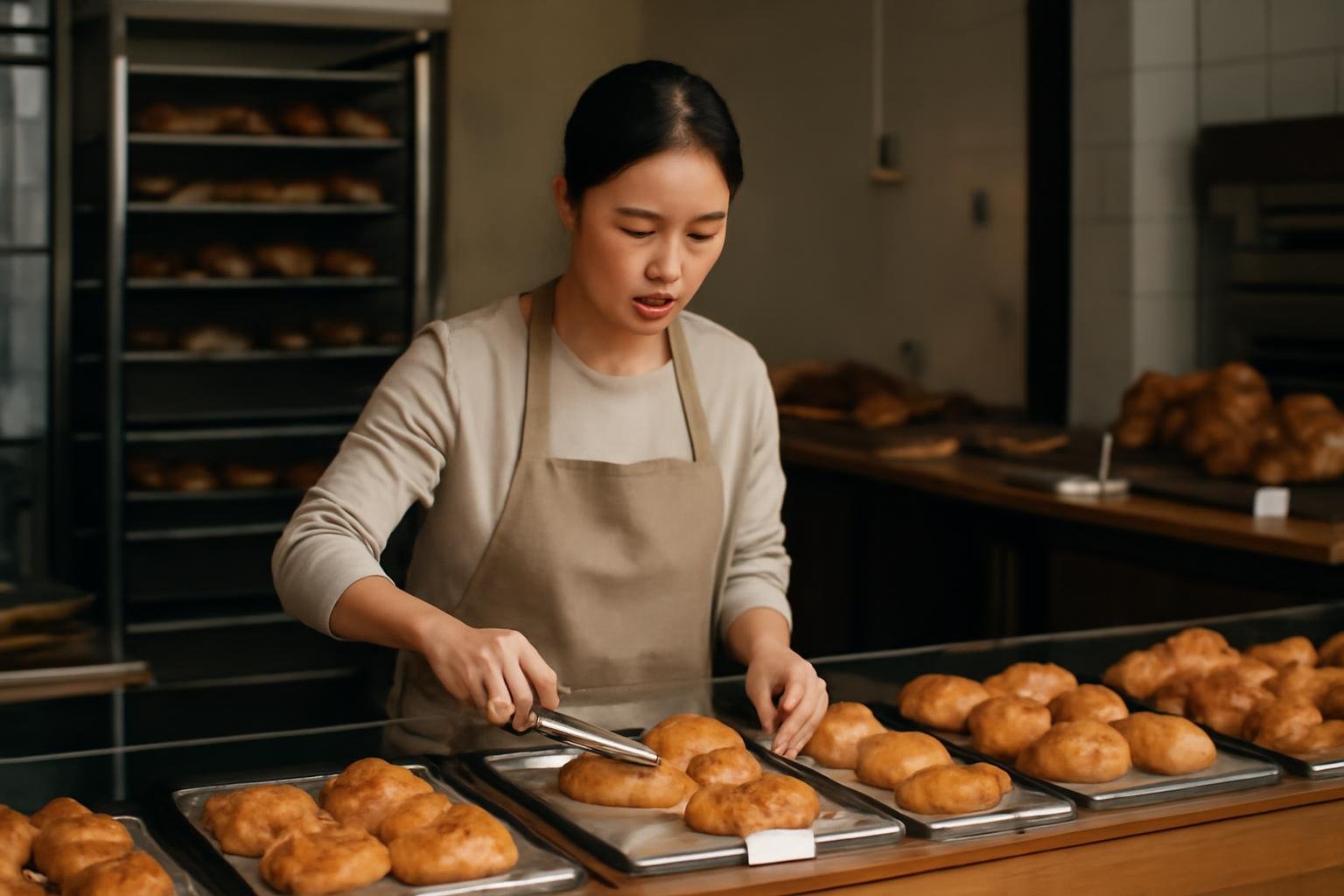
To use a typical Korean bakery, take a tray and tongs, select individual items from the open shelves, and bring everything to the cashier. Staff usually count or scan the products, package them, and take payment. Cakes, drinks, sandwiches, and delicate pastries may follow a separate ordering process.
The exact system varies. A large chain may combine a self-service bread section with a café and cake counter, while a small independent shop may have staff serve every item from behind a counter. Before picking anything up, look for trays, tongs, baskets, menu boards, or a queue at the register.
Start with the shop layout
Many Korean bakeries are designed for browsing rather than table service. Open shelves commonly hold individually priced buns, pastries, sandwiches, and packaged goods. Cakes and refrigerated desserts are often displayed in glass cases. Drinks may be ordered at the cashier, a café counter, or through a kiosk.
At a self-service branch, the usual sequence is:
- Take a tray near the entrance or bread shelves.
- Pick up the provided tongs.
- Use the tongs to place each bread or pastry on the tray.
- Bring the tray to the checkout counter.
- Tell the cashier whether you will eat in or take the food away if asked.
- Pay and collect the packaged items, receipt, and any separate drinks.
Use the tongs even if an item appears individually wrapped or easy to grab. They are part of the shop’s handling system. If you cannot find a tray or tongs, wait briefly and watch another customer, or ask 트레이 어디 있어요? (Teurei eodi isseoyo?)—“Where are the trays?”
Choose between open-display and packaged products
Open-display products are usually selected with tongs and packed at the register. They may include soft buns, croquette-style pastries, garlic bread, salt bread, sandwiches, and filled rolls. Because the appearance does not always reveal the flavor, check the label before choosing.
Packaged products may sit on shelves or in refrigerated cases. These are often easier to identify because the package includes the product name, ingredients, storage information, and a date or best-before information. A packaged item is not necessarily less fresh; it may simply be designed for transport, longer storage, or gifting.
Some common words help decode the display:
- 팥 (pat) means red bean, usually a sweet filling.
- 크림 (keurim) means cream.
- 치즈 (chijeu) means cheese.
- 소시지 (sosiji) means sausage.
- 마늘 (maneul) means garlic.
- 밤 (bam) means chestnut.
- 고구마 (goguma) means sweet potato.
- 소금빵 (sogeum-ppang) means salt bread, generally a buttery roll with a salty finish.
If you are unsure whether a product is sweet or savory, ask 이거 뭐예요? (Igeo mwoyeyo?)—“What is this?” You can also point and ask 달아요? (Darayo?)—“Is it sweet?”
Understand seating, takeaway, and reheating
A bakery with tables may function as both a shop and a café, but seating rules differ by branch. Some locations expect a drink purchase for customers who stay, while others simply provide a place to eat bakery products. If you plan to sit, ask 매장에서 먹어도 돼요? (Maejang-eseo meogeodo dwaeyo?)—“Can I eat here?”
For takeaway, say 포장해 주세요 (Pojanghae juseyo)—“Please pack it to go.” If you are eating in, 매장에서 먹을게요 (Maejang-eseo meogeulgeyo) means “I’ll eat it here.” Staff may ask whether you want 매장 (in-store) or 포장 (takeaway).
Some savory breads taste better warm and may have a label with reheating instructions. Follow the package directions rather than assuming every item should go in a microwave. Cream-filled products, fruit-topped cakes, and delicate pastries generally need refrigeration or careful handling. Ask 데워 주세요 (Deweo juseyo)—“Please warm it up”—only if the shop offers reheating.
Order cakes differently from individual bread
Cakes are often handled separately from the tray-and-tongs section. Look for a refrigerated display, cake catalog, reservation desk, or a staff-only counter. Some cakes are available immediately; others must be reserved, especially larger celebration cakes or customized designs.
Useful questions include:
- 케이크 있어요? (Keikeu isseoyo?) — “Do you have cakes?”
- 오늘 살 수 있어요? (Oneul sal su isseoyo?) — “Can I buy it today?”
- 예약해야 해요? (Yeyakhaeya haeyo?) — “Do I need to reserve it?”
- 초 있어요? (Cho isseoyo?) — “Do you have candles?”
- 문구 넣을 수 있어요? (Mungu neoeul su isseoyo?) — “Can you add a message?”
Check the serving size, storage instructions, pickup time, and whether candles or a message plaque cost extra. A cream cake may need to remain cold during transport, so ask for an insulated bag or cooling pack if the shop provides one.
Read labels and manage allergens carefully
Korean bakery products commonly contain wheat, milk, butter, eggs, soy, nuts, cheese, and sesame. Filled breads may also combine several of these ingredients. Almonds, peanuts, walnuts, and other nuts can appear in toppings, creams, pralines, or decorative pieces.
For a serious allergy, do not rely only on appearance or a translation app. Ask staff to check the ingredient label and explain that the allergy is medically important:
- 알레르기가 있어요. (Allereugiga isseoyo.) — “I have an allergy.”
- 땅콩 들어가요? (Ttangkong deureogayo?) — “Does it contain peanuts?”
- 견과류 들어가요? (Gyeongwaryu deureogayo?) — “Does it contain nuts?”
- 우유 들어가요? (Uyu deureogayo?) — “Does it contain milk?”
- 계란 들어가요? (Gyeran deureogayo?) — “Does it contain egg?”
Even when a product does not list an ingredient as a main component, shared equipment or display areas may create cross-contact. If the staff cannot confirm the ingredients or preparation conditions, choose a clearly labeled packaged product or avoid the item.
Finish at checkout without guessing
At the register, place your tray on the counter and wait while staff transfer the items into bags or boxes. They may ask whether you need separate packaging, a gift box, or a bag. If you want to confirm the quantity, say 이거 하나 주세요 (Igeo hana juseyo)—“One of these, please.”
Payment is usually made after the items are totaled. Many shops accept cards, but payment methods can vary by branch, so keep a backup option when practical. If a kiosk is available, switch the language setting if offered; otherwise, ask staff for help with 도와주세요 (Dowajuseyo)—“Please help me.”
Before leaving, check that you received the right number of items, any cake accessories, and the correct packaging. For a cream cake or filled pastry, confirm whether it should be refrigerated and how soon it is best eaten. Once you know the tray-and-tongs routine, Korean bakeries become straightforward: browse carefully, ask about unfamiliar fillings, separate cake orders from ordinary bread purchases, and let the labels guide decisions about storage and allergens.