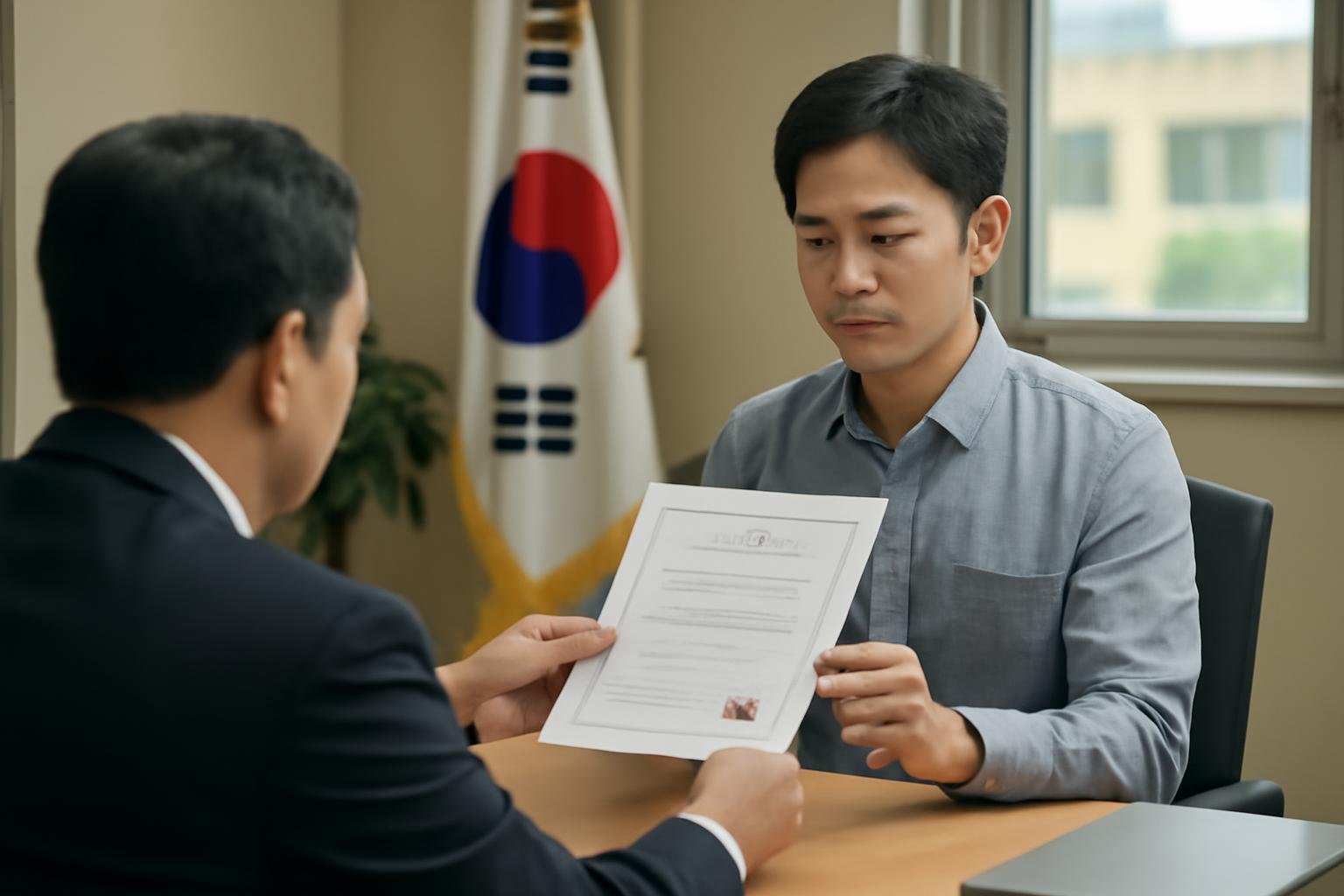
Foreign residents usually cannot obtain a Korean 주민등록등본 (jumin deungnokdeungbon), the resident registration certificate issued to Korean citizens. Instead, the document most organizations want is usually an 외국인등록 사실증명 (oegugin deungnok sasiljeungmyeong, Certificate of Fact on Foreign Resident Registration). It confirms your registered identity and address in Korea and is the closest routine equivalent to a Korean resident registration certificate.
You can request it online through Government24 (정부24) or in person at an immigration office, some local government offices, or an 읍·면·동 주민센터. Government24 currently lists online issuance as free; in-person issuance is listed as 2,000 won per copy. source
First, identify the document you actually need
“Resident registration certificate” can refer to several different documents in English. Before applying, check the exact Korean name requested by your bank, employer, university, landlord, court, or government office.
- 외국인등록 사실증명 (oegugin deungnok sasiljeungmyeong): the standard proof of a foreign resident’s registration details. This is usually the right substitute for a 주민등록등본.
- Residence Card (외국인등록증, formerly often called an Alien Registration Card or ARC): your physical or mobile identity card. It proves your identity and status but may not satisfy a request for a separate certificate.
- 국내거소신고 사실증명 (gungnae geoso singo sasiljeungmyeong): the equivalent document for registered overseas Koreans who hold a domestic residence report.
- 외국인체류확인서 (oegugin chelyu hwaginseo): a different document used mainly to check which foreign residents have reported a particular building or facility as their place of stay. It is not the normal personal substitute for a 주민등록등본. source
If the request simply says “proof of residence,” ask whether the recipient wants your Residence Card, a copy of your 외국인등록 사실증명, or a document showing your current address. Those are not interchangeable in every process.
Option 1: Apply online through Government24
Online issuance is usually the quickest method if you can complete Korean identity verification and access the document electronically or print it yourself.
- Open Government24 and search for 외국인등록 사실증명.
- Select the service titled 외국인등록 사실증명, not a similarly named tax or real-estate document.
- Sign in or complete the identity-verification process requested by the site.
- Enter the requested details, including the purpose or receiving organization if the form asks for them.
- Choose online issuance, then download, print, or view the certificate through your Government24 account.
Government24 lists the online service as free and states that online applications are for the applicant personally; an agent cannot apply online on your behalf. The service may be viewed through MyGOV after processing. source
Common online problems
- No Korean identity-verification method: some Government24 functions require a Korean mobile phone, financial certificate, or another supported authentication method. A foreign-issued phone number may not work.
- Address mismatch: the certificate reflects the address recorded in the immigration system. If you moved but did not report the change, the document may show your previous address.
- Recipient needs a sealed or original paper copy: ask whether a Government24 printout is acceptable before relying on the online version.
- Language difficulty: search using the Korean title rather than an English translation. The Korean service name is the most reliable way to find the correct form.
Option 2: Apply in person
In-person issuance is the practical fallback when online authentication fails or when a receiving organization specifically wants a paper document.
Government24 lists the following possible issuing locations:
- An immigration office, immigration branch office, or foreigner’s office
- A city, county, or district office
- An 읍·면·동 office, commonly called a 주민센터 or 행정복지센터
Because not every local counter handles every foreigner-related service in exactly the same way, calling ahead is sensible—especially outside major cities. Government24 advises applicants to confirm actual reception and processing availability with the selected office. source
What to bring
- Your valid Residence Card
- Your passport, if available or if the office requests additional identification
- The name or Korean wording of the document requested by the recipient
- A payment method for the in-person fee
For a personal application, the official service information requires identification. If someone applies for you, that person generally needs a power of attorney, a copy of your identification, and their own identification. source
You can say:
외국인등록 사실증명 발급받고 싶어요.
Oegugin deungnok sasiljeungmyeong balgeupbatgo sipeoyo.
“I’d like to obtain a Certificate of Fact on Foreign Resident Registration.”
If you need the address included, add:
주소가 나오는 서류가 필요해요.
Jusoga naoneun seoryuga piryohaeyo.
“I need a document that shows my address.”
What the certificate proves—and what it does not
The certificate verifies your foreign-resident registration. It is commonly used for administrative, employment, school, banking, housing, and other procedures that require official confirmation of your registered information.
It does not replace every document connected with living in Korea. For example:
- It is not proof of your visa approval or employment authorization by itself.
- It may not show the detailed information a bank or landlord needs from your contract.
- It does not replace a lease, proof of payment, tax certificate, or family relationship document.
- If your Residence Card address is outdated, obtaining the certificate does not correct the underlying record.
If an institution asks for a “resident registration number,” do not assume your Residence Card number is automatically accepted. Ask whether it wants your foreigner registration number and which document format it requires.
If you need proof of your current address
The most important issue is whether your address has been properly reported to immigration. Foreign residents are generally expected to report changes of residence through the appropriate immigration or local administrative channel. If your certificate shows an old address, first correct the registration, then request a newly issued certificate.
A landlord, university, employer, or bank may also ask for supporting evidence such as:
- A lease agreement
- A confirmation of residence or accommodation document
- A copy of the landlord’s identification or property records in some housing procedures
- Your Residence Card showing the current address
These requirements vary by institution. The safest question is: 외국인등록 사실증명으로 될까요? (Oegugin deungnok sasiljeungmyeong-euro doelkkayo?)—“Will the foreign resident registration certificate be acceptable?”
Mobile Residence Card: useful, but not the same certificate
Registered foreign residents aged 14 or older can also issue a mobile foreigner Residence Card through the Korean mobile identification app, using a compatible personal smartphone. The Ministry of Justice says the mobile card has the same legal effect as the physical identity card for many uses, including public institutions, financial institutions, and hospitals. source
However, a mobile Residence Card is still an identity card, not automatically a substitute for 외국인등록 사실증명. If the recipient specifically asks for a certificate, obtain the certificate as well.
A simple decision guide
- They ask for a copy of your ID: provide your Residence Card, subject to their privacy and submission rules.
- They ask for a Korean 주민등록등본 equivalent: request 외국인등록 사실증명.
- They ask for proof of address: confirm whether they want 외국인등록 사실증명, your Residence Card, a lease, or a separate residence confirmation.
- You are an overseas Korean with domestic residence registration: ask for the corresponding 국내거소신고 사실증명.
- The online application does not work: take your Residence Card to an immigration or suitable local government office and apply in person.
The key is to match the Korean document name to the institution’s actual requirement. For most foreign residents, 외국인등록 사실증명 is the document to request—not a 주민등록등본, which belongs to Korea’s resident-registration system for Korean citizens.