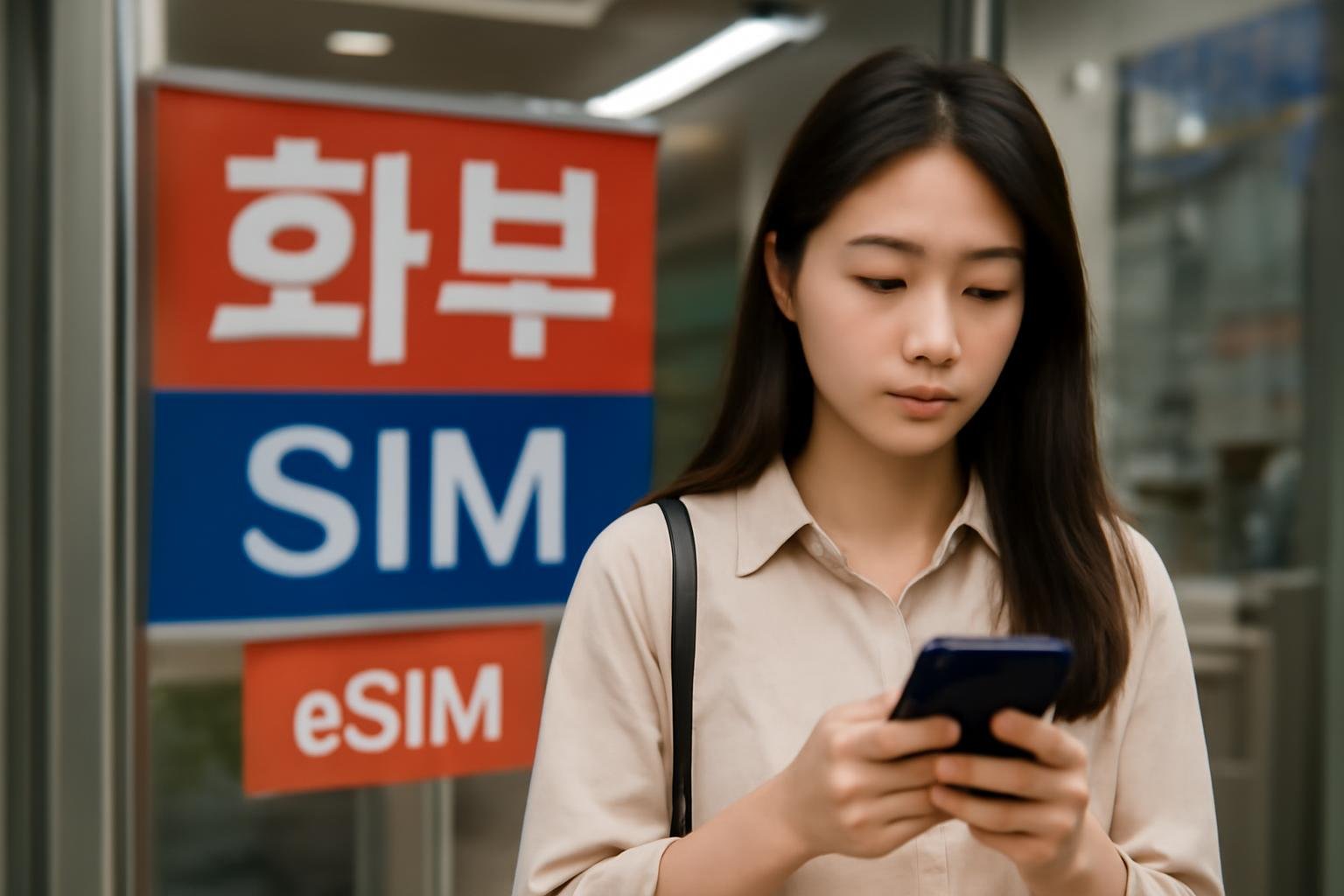
Short answer: if you need Korean phone-number identity verification—called 본인인증 (bonin-injeung, identity verification)—do not choose a data-only tourist eSIM. Get a Korean mobile line registered in your own name with your passport or Residence Card (formerly Alien Registration Card), then complete the carrier’s real-name verification process.
The most reliable option for a foreign resident is usually a postpaid or properly registered prepaid line from a Korean carrier or its official retailer. Short-term visitors can sometimes use a voice-and-SMS prepaid SIM or eSIM, but tourist products are not automatically compatible with every Korean website or app. A number that can receive ordinary text messages is not necessarily a number that can pass Korean 본인인증.
What “identity-verification support” actually means
Korean services commonly ask you to verify your identity by matching several pieces of information:
- Your name exactly as registered with the carrier
- Your date of birth
- Your nationality
- Your Korean mobile number
- Your passport or Residence Card information
When a website sends a one-time code by SMS, that is only one part of the process. The service may also check whether the number is registered under your legal name and whether the carrier’s records match the identity information you entered. This is why a cheap travel eSIM can receive texts yet still fail when you try to use a Korean banking app, government service, delivery platform, or local marketplace.
The three main choices
1. A postpaid line registered with your Residence Card
This is generally the best choice if you live in Korea, have a Residence Card, and expect to use Korean services regularly. Visit a carrier store or official retailer and ask for a mobile line under your legal name. Bring your physical Residence Card and a payment method accepted by the carrier.
Postpaid registration normally gives the carrier a complete resident record to match against identity-verification systems. Some online services may still reject foreign users, but the phone line itself is set up in the way Korean 본인인증 systems expect.
2. A registered prepaid SIM with voice and SMS
Prepaid can work for visitors, students waiting for their Residence Card, or people who do not want a contract. Korean carriers offer foreigner-focused prepaid plans that can be opened with a passport. However, passport-based prepaid service may have shorter validity or more limited verification functions than a line registered to a Residence Card.
For example, KT states that foreigners can subscribe to prepaid service with a standard passport, while postpaid service generally requires a Residence Card or another qualifying document. KT also distinguishes between ordinary prepaid activation and real-name verification, so ask the retailer specifically whether the plan supports 본인인증, not merely calls and SMS.
3. A tourist voice-and-SMS eSIM
This can be useful for a short trip, but it is the least predictable option for Korean identity verification. Some carrier tourist eSIMs provide a Korean 010 number and allow incoming calls or SMS after an entry check at an airport roaming center. That does not mean every Korean service will accept the number for legal-name verification.
Tourist eSIMs are designed primarily for connectivity during a short stay. Data-only eSIMs cannot receive the SMS or voice traffic needed for many verification flows. Even voice-and-SMS products may be limited to carrier-specific or entry-verification procedures rather than full resident-style 본인인증.
What to buy if you are already in Korea
- Check your documents. If you have a Residence Card, use it. If you only have a passport, ask for a prepaid foreigner plan and confirm its identity-verification eligibility before paying.
- Visit an official carrier store or authorized retailer. Major carriers include KT, SK Telecom, and LG U+. Avoid an anonymous online marketplace listing that promises “Korean verification” without explaining whose name the number is registered under.
- Use your exact legal name. Enter your name exactly as it appears on your passport or Residence Card, including spacing where the system permits it. Differences in order, spacing, or spelling are common reasons for failure.
- Ask for a line in your own name. Do not use a friend’s, employer’s, or host’s number. A borrowed number may receive a code but cannot reliably prove that you are the account holder.
- Request real-name verification. Say: 외국인 본인인증 가능한 유심이나 eSIM으로 가입하고 싶어요 (oegugin bonin-injeung ganeunghan yusim-ina eSIM-euro gaiphago sipeoyo, “I want to sign up for a SIM or eSIM that supports identity verification for foreigners”).
- Test the number before leaving. Ask whether the line is registered under your passport or Residence Card and whether the carrier has completed the necessary identity check. If possible, test it with the specific Korean service you need.
What you will usually need
- Residence Card: the normal document for a resident postpaid line
- Passport: often accepted for foreigner prepaid service, especially for short stays
- A Korean mobile phone: bring the device if you are activating an eSIM or need to confirm compatibility
- An unlocked, eSIM-compatible phone: check that the device is not carrier-locked and that it supports Korean cellular bands
- Payment: prepaid top-ups and postpaid billing may have different foreign-card policies
Carrier requirements can depend on visa type, remaining period of stay, age, and the product itself. Some plans require a minimum amount of time remaining on your visa. A store may also refuse activation if your document has expired or if the information cannot be matched.
Why your new number may still fail
Your name does not match
Try the name format printed on your Residence Card rather than the format used by your airline, bank, or passport. If you have a long name, the carrier or website may impose a character limit. Ask the carrier to check the registered spelling instead of repeatedly requesting new verification codes.
The number is data-only
A data eSIM is suitable for maps, messaging apps, and internet access, but it cannot normally receive the carrier SMS used by Korean verification systems. Keep it as a secondary travel eSIM only if you also have a separate Korean voice-and-SMS line.
The line is not registered in your own name
Some travel products use temporary, shared, or differently registered arrangements. They may work for calls and mobile data but fail a legal-name check. Ask whether the service is 본인 명의 (bonin myeongui, under your own name).
The service does not support foreign residents
A Korean phone number is not a guarantee that a website accepts foreign users. Some services match only Korean resident-registration information, require a Korean national ID, or have not built a foreigner-compatible verification flow. In that situation, changing from SIM to eSIM will not solve the problem.
Your carrier record has not updated yet
New activations, number changes, or Residence Card updates may take time to propagate between systems. If verification fails immediately after activation, wait briefly, restart the phone, and contact the carrier before buying another line.
SIM or eSIM: which is better?
Choose a physical SIM if you want the simplest in-person fallback, may change phones, or are unsure whether your device supports eSIM. A store can insert it and check the line directly.
Choose an eSIM if your phone supports it and you want to keep a home-country SIM active for calls or two-factor authentication. Before purchasing, confirm that the eSIM is a voice-and-SMS product registered under your name—not merely a data plan. You may need Wi-Fi to download the eSIM profile, and some activation problems can only be resolved at a carrier store.
Useful Korean questions at the store
- 이 번호로 외국인 본인인증이 가능한가요? (I beonhoro oegugin bonin-injeungi ganeunghan-gayo?) — Can foreigners use identity verification with this number?
- 제 명의로 등록되나요? (Je myeonguiro deungnokdoenayo?) — Will it be registered under my name?
- 문자 인증번호를 받을 수 있나요? (Munja injeungbeonhoreul badeul su innayo?) — Can I receive verification codes by text?
- 외국인등록증으로 개통할 수 있나요? (Oegugin-deungnokjeung-euro gaetonghal su innayo?) — Can I activate it with my Residence Card?
- 여행자용 데이터 eSIM인가요? (Yeohaengjayon data eSIM-ingayo?) — Is this a traveler data eSIM?
The practical rule
If Korean identity verification is important, buy the phone line first and the data plan second. Tell the carrier exactly which service you need to access, bring the document that proves your legal identity, and confirm that the number is registered in your own name. For residents, a carrier line linked to a Residence Card is usually the strongest option. For short-term visitors, a passport-based prepaid voice-and-SMS line may help, but a tourist eSIM should never be assumed to provide full Korean 본인인증.