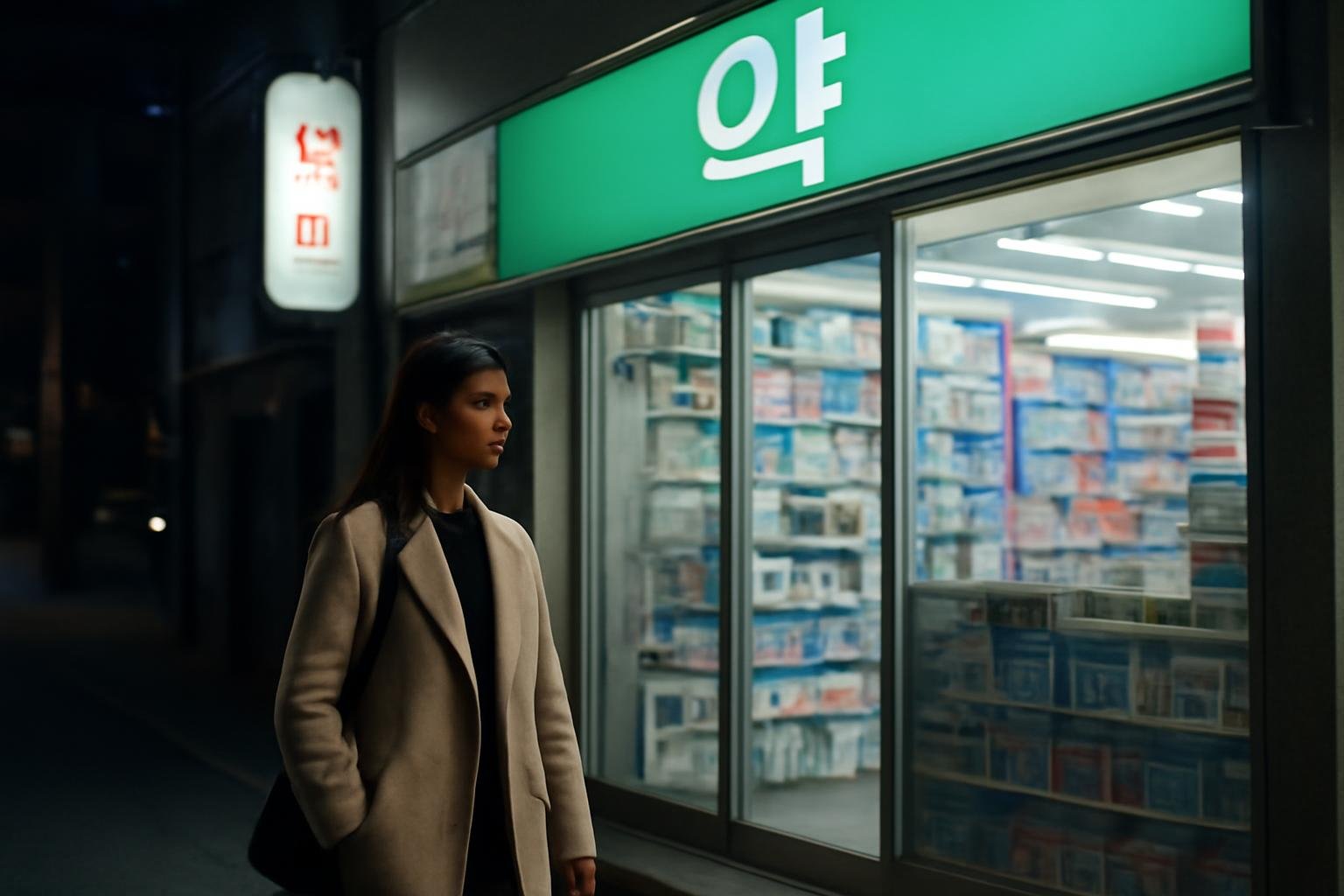
If you need medicine late at night, on a Sunday, or during a Korean public holiday, search for 휴일지킴이약국 (hyuil-jikimi yakguk, “holiday duty pharmacy”) rather than relying on a normal map search. The most useful official directory is Pharm114, where you can search pharmacies by area and check those listed for holiday or after-hours service.
Search results are not a guarantee that a pharmacy is still open, however. Duty schedules can change, and a pharmacy may close early or stop accepting customers before the posted time. Always call before setting off when possible.
The quickest way to find an open pharmacy
- Open the Pharm114 휴일지킴이약국 website on a browser. Its local search service is currently intended for PC web use rather than the discontinued “우리동네약국찾기” app.
- Enter your province or metropolitan city and then your district. Korean administrative areas may appear under names such as 구 (gu), 시 (si), or 군 (gun).
- Search for pharmacies marked as open on the relevant date or during the relevant time period. For a late-night search, look for evening or night operating hours, not simply a pharmacy that is normally open during the day.
- Check the address and telephone number, then call the pharmacy.
- Ask whether it is open now and whether it has the medicine you need before travelling there.
On Naver Map or KakaoMap, you can also search terms such as 야간 약국 (yagan yakguk, night pharmacy), 심야 약국 (simya yakguk, late-night pharmacy), or 24시간 약국 (isipsa-sigan yakguk, 24-hour pharmacy). These map listings are useful for navigation, but the opening information may be less reliable than a current duty-pharmacy listing and a phone call.
Useful Korean searches and phone phrases
Copy one of these phrases into a map app or search engine:
- 휴일지킴이약국 — holiday duty pharmacy
- 야간 약국 — night pharmacy
- 심야 약국 — late-night pharmacy
- 24시간 약국 — 24-hour pharmacy
- 일요일 여는 약국 — pharmacy open on Sunday
- 공휴일 여는 약국 — pharmacy open on a public holiday
When calling, you can say:
“지금 영업하시나요?” (Jigeum yeongeop-hasinayo?) — Are you open now?
“이 약 있나요?” (I yak innayo?) — Do you have this medicine?
“외국인인데 진료 없이 살 수 있나요?” (Oegugin-inde jiryo eopsi sal su innayo?) — I’m a foreigner. Can I buy it without a consultation?
If you have a photo of the package, prescription, or active ingredient, show it to the pharmacist. Brand names can differ between countries, and some medicines that are sold over the counter elsewhere may require a prescription in Korea.
What “24-hour pharmacy” really means
A listing for a 24-hour pharmacy does not necessarily mean every service is available at every moment. Some pharmacies have a late-night window, an intercom, or a limited overnight service. Others may be listed as open but have changed their schedule.
Many Korean pharmacies also close for part of the weekend, on public holidays, or during a pharmacist’s break. A pharmacy near a major hospital may have longer hours than a neighbourhood pharmacy, but it is still important to confirm the current schedule.
Do not assume that a large shopping district will have an open pharmacy after midnight. In Korea, late-night availability varies considerably by city, district, and proximity to hospitals or transport hubs.
If the pharmacy is closed when you arrive
Try these alternatives in order:
- Call another duty pharmacy in the same district. The nearest listing may not be the only one serving that night.
- Ask a nearby hospital emergency department where the closest open pharmacy is. Hospital staff may be able to direct you to a duty pharmacy, although the emergency department is not a substitute for ordinary medication shopping.
- Visit a hospital emergency department if your symptoms may be serious or you need urgent medical assessment. Emergency rooms are for urgent care, not simply for obtaining routine painkillers or cold medicine.
- Check a convenience store for limited over-the-counter products. Some convenience stores sell a restricted range of basic medicines, but they do not function as pharmacies and cannot provide pharmacist advice or prescription medicines.
Convenience-store medicine may include certain basic pain relievers, fever reducers, digestive medicines, cold remedies, or topical products, depending on the store and the product. Availability is limited, and the same brand may not be stocked everywhere. Ask the cashier rather than assuming a particular medicine is available.
When you need a prescription
A pharmacy cannot normally dispense prescription medicine simply because you show a photograph of an old prescription or explain that you take it regularly abroad. You may need to see a doctor in Korea and receive a Korean prescription.
For a non-emergency problem, a nearby clinic may be the practical route. Search for 내과 (naegwa, internal medicine), 이비인후과 (ibiinhugwa, ear, nose, and throat), or another department matching your symptoms. Many clinics operate during the day and may have different weekend schedules, so check before visiting.
Bring the medicine packaging, the generic or active ingredient name, your dosage, and any relevant medical information. A Korean pharmacist or doctor can then suggest an equivalent product or explain whether a consultation is required.
Emergency symptoms: do not wait for a pharmacy
Call 119 for an ambulance in Korea if someone has severe breathing difficulty, chest pain, signs of a stroke, uncontrolled bleeding, loss of consciousness, a serious allergic reaction, or another potentially life-threatening condition. If you are unsure whether the situation is an emergency, explain the symptoms to the 119 operator and follow their instructions.
For less serious symptoms, a pharmacy may be appropriate. But pharmacists cannot replace emergency assessment, and a late-night search should not delay urgent care.
Practical tips before a holiday or late night
- Save Pharm114 before travelling outside a major city.
- Search using the Korean terms above; English searches may miss local listings.
- Check the pharmacy’s telephone number and call before leaving.
- Carry your passport or Alien Registration Card if you have one. Identification or payment requirements can vary by transaction.
- Do not assume a foreign card will work everywhere. Most urban pharmacies accept cards, but a backup payment method is sensible.
- Keep a photo of the medicine box and note the active ingredient, not only the foreign brand name.
- For recurring medication, refill it before a long holiday such as Seollal or Chuseok rather than depending on an overnight pharmacy.
The most reliable formula is simple: search 휴일지킴이약국, verify the listing by phone, and use a clinic or emergency department when the problem requires medical care rather than a retail medicine purchase.