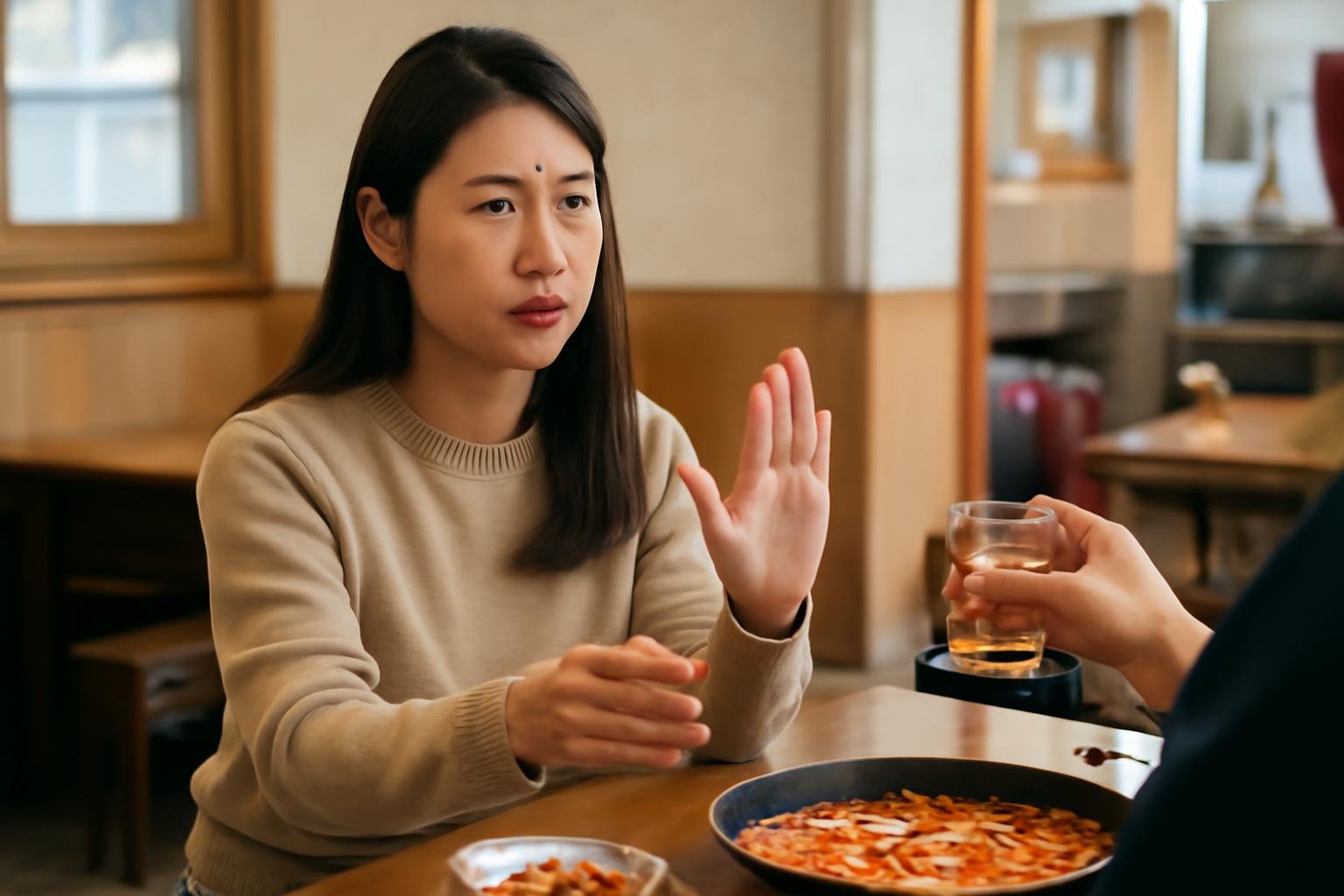
In Korea, refusing an offer of food or alcohol is usually not rude. The important part is to acknowledge the offer warmly, give a brief reason when useful, and make your refusal clear enough that the other person does not keep serving you.
A natural basic response is 괜찮아요 (gwaenchanayo), meaning “I’m okay” or “No, thank you.” For food and drinks, however, it often helps to add a short explanation:
- 배불러요 (baebulleoyo) — “I’m full.”
- 조금만 먹을게요 (jogeumman meogeulgeyo) — “I’ll just have a little.”
- 저는 술을 안 마셔요 (jeoneun sureul an masyeoyo) — “I don’t drink alcohol.”
- 오늘은 안 마실게요 (oneureun an masilgeyo) — “I’m not going to drink today.”
- 감사하지만 괜찮아요 (gamsahajiman gwaenchanayo) — “Thank you, but I’m okay.”
The most useful pattern: appreciation, reason, refusal
When someone offers you another serving, refill, or drink, use this three-part pattern:
- Acknowledge the kindness: 감사해요 or 감사합니다.
- Give a short reason if needed: 배불러요, “I’m full,” or 술을 못 마셔요, “I can’t drink alcohol.”
- Close clearly: 괜찮아요 or 사양할게요, “I’ll pass.”
For example: 감사하지만 배불러요. 괜찮아요. (Gamsahajiman baebulleoyo. Gwaenchanayo.) — “Thank you, but I’m full. I’m okay.”
This sounds considerate without making the refusal unnecessarily elaborate. In many situations, a long explanation can actually make the conversation more awkward.
How to refuse shared food
Shared dishes are common at Korean meals, and people may encourage you to try something, place food in your bowl, or offer another portion. You can decline without criticizing the food.
When you are full
- 배불러요. 정말 맛있었어요. (Baebulleoyo. Jeongmal masisseosseoyo.) — “I’m full. It was really delicious.”
- 많이 먹었어요. 괜찮아요. (Mani meogeosseoyo. Gwaenchanayo.) — “I’ve eaten a lot. I’m okay.”
- 조금만 주세요. (Jogeumman juseyo.) — “Just a little, please.”
If you would like to stop completely, say 이제 괜찮아요 (ije gwaenchanayo), meaning “I’m okay now” or “That’s enough for me now.” The word 이제 helps signal that you do not want another serving.
When you do not eat a particular ingredient
Be direct but neutral:
- 저는 매운 음식을 잘 못 먹어요. (Jeoneun maeun eumsigeul jal mot meogeoyo.) — “I can’t handle spicy food very well.”
- 고기를 안 먹어요. (Gogireul an meogeoyo.) — “I don’t eat meat.”
- 알레르기가 있어요. (Allereugiga isseoyo.) — “I have an allergy.”
- 이건 못 먹어요. (Igeon mot meogeoyo.) — “I can’t eat this.”
Use 알레르기가 있어요 only for a real allergy. If you simply dislike an ingredient, say 제가 이건 잘 안 먹어요 (Jega igeon jal an meogeoyo), “I don’t usually eat this.” That avoids creating unnecessary concern.
If the issue is preference rather than restriction, a softer phrase is 저는 괜찮아요 (Jeoneun gwaenchanayo) — “I’m okay without it.” You do not need to announce that the dish is unpleasant.
How to decline alcohol
Drinking situations can involve more persistence, especially at a company dinner, gathering with older acquaintances, or meal where people are taking turns pouring. Still, you are allowed to refuse alcohol. A clear, calm explanation usually works better than repeatedly saying only “no.”
Simple refusals
- 저는 술을 안 마셔요. (Jeoneun sureul an masyeoyo.) — “I don’t drink.”
- 오늘은 술을 안 마실게요. (Oneureun sureul an masilgeyo.) — “I’m not drinking today.”
- 술을 못 마셔요. (Sureul mot masyeoyo.) — “I can’t drink alcohol.”
- 운전해야 해서 안 마실게요. (Unjeonhaeya haeseo an masilgeyo.) — “I have to drive, so I won’t drink.”
- 약을 먹고 있어서요. (Yageul meokgo isseoseoyo.) — “I’m taking medication.”
술을 안 마셔요 describes a general choice. 오늘은 안 마실게요 is useful when you sometimes drink but have decided not to today. 술을 못 마셔요 can mean that alcohol does not suit you, that you cannot tolerate it, or that you are unable to drink for another reason.
If you want to avoid a long discussion, combine the refusal with appreciation: 권해 주셔서 감사하지만, 오늘은 안 마실게요. (Gwonhae jusyeoseo gamsahajiman, oneureun an masilgeyo.) — “Thank you for offering, but I’m not drinking today.”
When someone keeps refilling your glass
If a person reaches for your glass or bottle, stop the action gently but clearly. Place your hand over the glass, lightly touch the rim, or move it back while saying:
- 괜찮아요, 괜찮아요. — “I’m okay, really.”
- 이제 됐어요. (Ije dwaesseoyo.) — “That’s enough now.”
- 잔은 괜찮아요. (Janeun gwaenchanayo.) — “No more in my glass, please.”
- 저는 안 마실게요. — “I’m not going to drink.”
Body language matters because a quiet verbal refusal can be missed in a noisy group. If you do not want a refill, do not leave your glass tilted toward the person or repeatedly raise it for a toast. Keep it in place and say your refusal before the pour begins.
What to say when you will accept food but not more
Sometimes the most natural answer is to accept a small amount rather than reject the offer completely:
- 조금만 먹어 볼게요. (Jogeumman meogeo bolgeyo.) — “I’ll try just a little.”
- 한 입만 주세요. (Han ipman juseyo.) — “Just one bite, please.”
- 조금만 주시면 감사해요. (Jogeumman jusimyeon gamsahaeyo.) — “I’d appreciate just a little.”
Use this when you are curious about the food but do not want a full serving. It is especially helpful with homemade dishes or regional specialties, where the offer may be intended as hospitality rather than pressure.
Differences by situation
At a restaurant
With restaurant staff, 괜찮습니다 (gwaenchanseumnida) or 이제 됐습니다 (ije dwaetseumnida) is polite and sufficient. If a server is offering more side dishes, you can say 괜찮아요, 충분해요 (Gwaenchanayo, chungbunhaeyo) — “No, thank you, that’s enough.”
At someone’s home
A host may offer food several times as a sign of care. Thank them and mention enjoyment before declining: 정말 맛있었어요. 그런데 배가 불러서 더는 못 먹겠어요. (Jeongmal masisseosseoyo. Geureonde baega bulleoseo deoneun mot meokgesseoyo.) — “It was really delicious, but I’m too full to eat more.”
At work or a group dinner
With colleagues, a brief explanation can prevent repeated offers. Say 저는 원래 술을 안 마셔요 (Jeoneun wollae sureul an masyeoyo) — “I don’t normally drink.” If you are declining for health, medication, religion, pregnancy, driving, or personal reasons, you can state that without apologizing excessively.
If someone outranks you or is older, use polite speech, but do not assume that seniority requires you to accept alcohol. A respectful refusal is still a refusal.
Natural ways to sound firm without sounding cold
The key is not to over-apologize. Korean speakers commonly soften a refusal with a smile, a small nod, or 감사합니다, but they may repeat the same phrase if the offer continues:
감사하지만 괜찮아요. 정말 배불러요.
Gamsahajiman gwaenchanayo. Jeongmal baebulleoyo.
“Thank you, but I’m okay. I’m really full.”
For alcohol:
죄송하지만 저는 술을 안 마셔요. 물로 할게요.
Joesonghajiman jeoneun sureul an masyeoyo. Mullo halgeyo.
“Sorry, but I don’t drink. I’ll have water instead.”
Offering an alternative—water, soda, tea, or a nonalcoholic drink—can make the exchange easy, but it is optional.
Common mistakes to avoid
- Do not say 맛없어요 (maseopseoyo, “It’s not tasty”) unless you intentionally want to criticize the food.
- Do not use 알레르기가 있어요 casually. An allergy suggests a genuine health risk.
- Do not rely only on a vague smile. If you truly want to stop, use words such as 이제 됐어요 or 안 마실게요.
- Do not feel obliged to empty your glass. Leaving alcohol unfinished is generally preferable to drinking beyond your limit.
- Do not confuse politeness with agreement. 괜찮아요 can sometimes be ambiguous, so add a reason or a firm closing when necessary.
The safest all-purpose formula is simple: 감사하지만 괜찮아요. 배불러요 for food, and 감사하지만 오늘은 안 마실게요 for alcohol. Say it warmly, repeat it calmly if needed, and use a small gesture to make your meaning unmistakable.