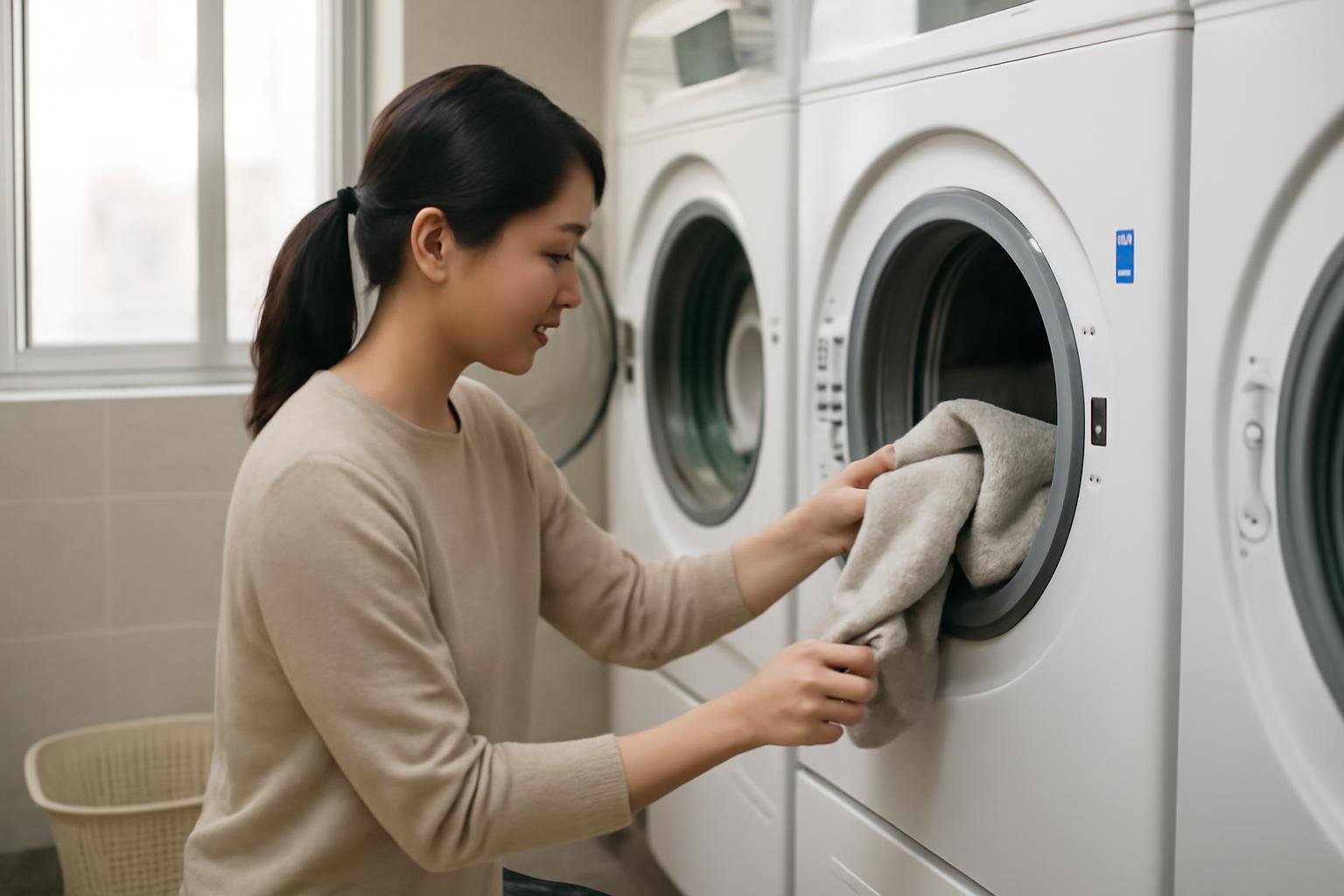
If you need to wash clothes in Korea but do not have a machine at home, the easiest option is usually a coin laundry, called 코인세탁방 (koin setakbang). You will also find shared washing machines in some guesthouses, dormitories, apartment buildings, and officetels. The basic process is simple: sort your clothes, choose a machine, pay, add detergent if necessary, start the cycle, and move your laundry promptly when it finishes.
The main difficulties are not the washing itself. They are figuring out whether detergent is included, understanding the Korean labels, knowing how to pay, and avoiding machines that require a Korean phone number or local payment app.
Where to find a washing machine in Korea
Search Naver Maps or KakaoMap for 코인세탁방, 셀프빨래방 (selpeu ppallaebang, self-service laundry), or 빨래방 (ppallaebang, laundry room). A typical laundromat has large front-loading washers, dryers, folding tables, baskets, and sometimes vending machines for detergent or laundry bags.
In residential buildings, the laundry facilities may be labelled:
- 세탁기 (setakgi) — washing machine
- 건조기 (geonjogi) — dryer
- 세탁실 (setaksil) — laundry room
- 세탁방 (setakbang) — laundry room or laundromat
Before carrying your laundry downstairs, check whether the facility is for residents only, whether it accepts cash or cards, and whether machines can be reserved. A building laundry room may be accessible only with an entry card or building app.
What to bring
- Your laundry, separated into colors and fabrics
- Detergent and fabric softener, unless the machine supplies them automatically
- A laundry bag or basket
- Coins or a payment card, depending on the machine
- A phone to set a timer and translate labels if needed
Many modern Korean laundromats are cashless or use a store-specific payment system. Others still accept ₩500 coins, but do not assume that a foreign bank card will work. Some machines accept international credit cards; others accept only Korean cards, local QR payments, or coins purchased from a change machine.
How to use a Korean washing machine
- Check the drum. Make sure someone has not left clothing inside. Look for coins, tissues, or small objects left in the rubber seal.
- Load the clothes. Do not pack the drum tightly. Clothes need space to move through the water. For a normal wash, filling the drum to roughly two-thirds is safer than forcing in one more item.
- Add detergent. Look for a detergent drawer marked 세제 (seje). Fabric softener is 섬유유연제 (seomyu yuyeonje). Some laundromat machines dispense detergent automatically, so adding more can create excessive suds.
- Select the cycle. The most useful labels are 표준 (pyojun, standard), 강력 (gangnyeok, intensive), 울 (ul, wool), and 이불 (ibul, bedding). For ordinary clothes, 표준 is usually the sensible choice.
- Choose water temperature if the machine allows it. 냉수 means cold water, 온수 means hot water, and 미온수 means lukewarm water. Cold or lukewarm water is the safer default for mixed clothing.
- Pay and press start. Payment may happen before selecting the cycle, after selecting it, or through a central kiosk. Look for 시작 (sijak, start), 정지 (jeongji, stop), and 일시정지 (ilsijeongji, pause).
If you are unsure which buttons to press, look for a touchscreen language option, often marked English or 언어 (eoneo, language). At an unattended laundromat, another customer may be willing to help, but avoid interrupting someone during payment or loading.
Drying your clothes
After washing, transfer the clothes to a dryer marked 건조기. Clean the lint filter if the machine asks you to, then choose a temperature:
- 저온 — low heat
- 중온 — medium heat
- 고온 — high heat
- 송풍 — air circulation with little or no heat
Use low or medium heat for synthetic clothing, knitwear, sportswear, and anything labelled 건조기 사용 금지 (“do not use a dryer”). Korean care labels may use a crossed-out dryer symbol rather than English text. Air-dry delicate items instead.
Do not rely on the shortest dryer setting for a full load. Thick towels, denim, and bedding often need additional time. If a laundromat charges by time, check the clothes before adding another cycle so that you do not over-dry items unnecessarily.
Payment and Korean phone-number issues
There is no single payment system for laundromats in Korea. You may encounter:
- Coins inserted directly into the machine
- A change machine that accepts Korean banknotes
- A card reader attached to each machine
- A central kiosk that assigns or activates a machine
- A building app or resident payment system
Some app-based or building-operated machines require a Korean mobile number, Korean identity verification, or a locally issued payment method. If you are visiting Korea and the machine rejects your foreign card, look for a coin-operated laundromat rather than repeatedly trying the same terminal. A nearby convenience store may be able to provide change, but staff are not required to do so, especially if you are not making a purchase.
In a guesthouse or dormitory, ask the front desk before using the machine. A useful phrase is:
세탁기 어떻게 사용해요?
Setakgi eotteoke sayonghaeyo?
“How do I use the washing machine?”
You can also ask:
세제 넣어야 해요?
Seje neoeoya haeyo?
“Do I need to add detergent?”
Rules in shared laundry rooms
Shared machines operate on an informal but important rule: do not leave finished laundry inside for a long time. Set an alarm for the estimated end of the cycle. If your clothes remain in the machine, another user may move them into a basket or onto a folding table.
That does not mean someone may handle your clothes immediately. Give the cycle a reasonable amount of time to finish, and never remove another person’s laundry while the machine is still running. Keep the room tidy, remove lint, and take your detergent with you.
In an apartment or dormitory, posted notices may prohibit washing shoes, heavily muddy items, rugs, or pet bedding. Large machines marked 이불 are intended for bulky laundry, but check the facility rules before washing bedding or other oversized items.
Common mistakes and what to do instead
Adding detergent when it is already included
Commercial laundromat machines often dispense detergent automatically. Look for a notice such as 세제 자동 투입 (“detergent automatically dispensed”). If you cannot tell, ask staff or choose a machine with a visible detergent tray and instructions.
Using the dryer for everything
Heat can shrink cotton, damage elastic, and ruin printed or technical fabrics. Read the care label before drying. When uncertain, use low heat or hang the item to dry.
Overloading the machine
A machine can start even when it is too full. Overloading leads to poor cleaning, uneven rinsing, and damp clothes after the spin cycle. Split a large load if the drum cannot turn freely.
Expecting a refund after pressing start
Many machines do not offer an automatic refund once the cycle begins. Check the payment amount and selected program before pressing 시작. If the machine malfunctions, photograph the machine number and contact the laundromat operator using the posted phone number or messaging option.
Leaving clothes unattended overnight
In a busy laundromat, this is inconvenient and risks your clothes being moved. In a shared building, it may also violate posted rules. Use a timer and return promptly.
A practical first-time routine
For a normal load, use this sequence: choose a coin-operated or clearly card-compatible laundromat; check the payment method before unloading your bag; select a machine large enough for the load; use 표준 with cold or lukewarm water; confirm whether detergent is automatic; start the cycle; set an alarm; transfer the clothes to a dryer only after checking care labels; and fold or pack everything before leaving the machine area.
If the default method fails, ask a staff member, building manager, host, or front-desk employee rather than guessing at a payment screen. The Korean words 세탁기, 건조기, 세제, 시작, and 정지 will cover most of the vocabulary you need for a successful wash.