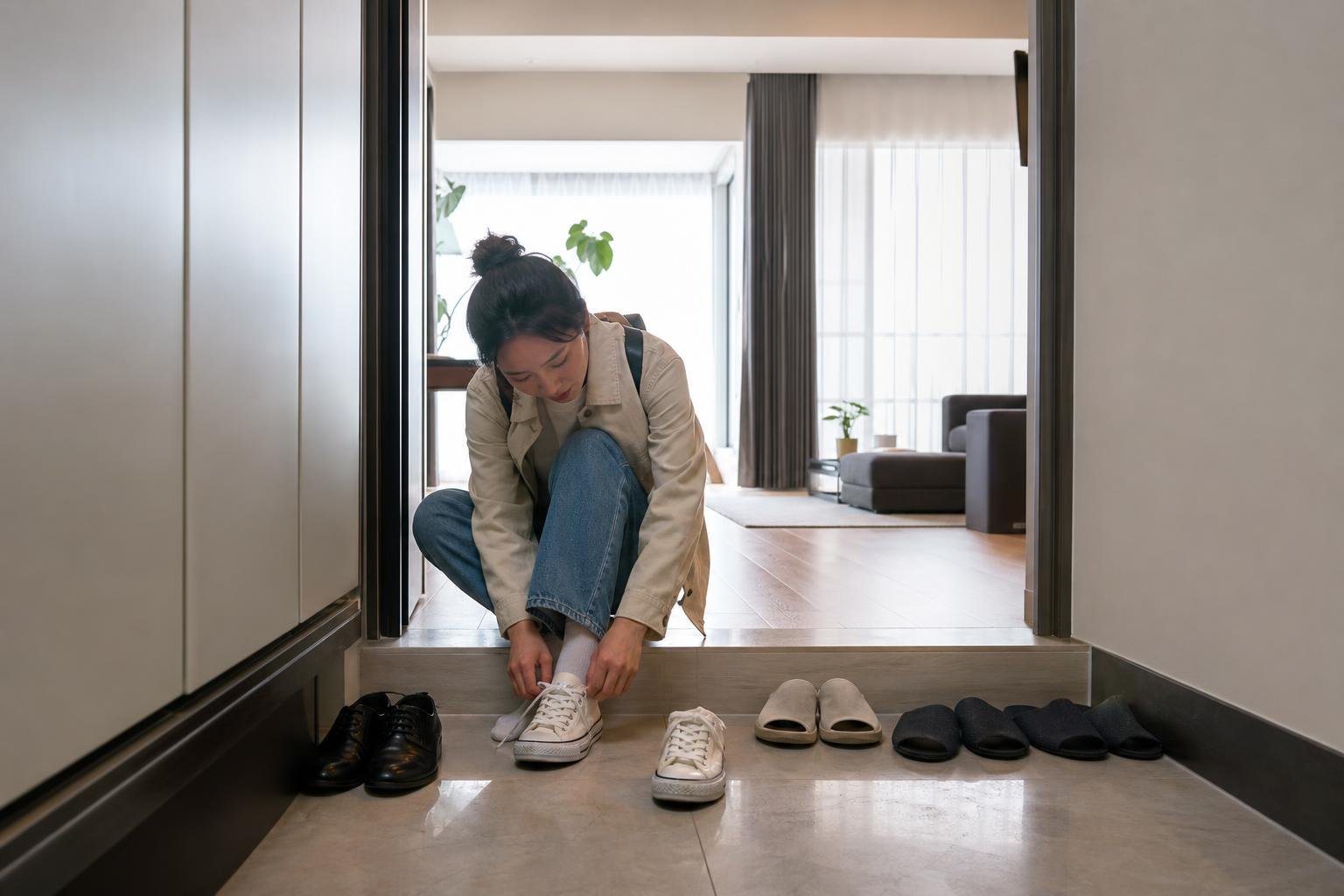
Koreans generally remove outdoor shoes when entering a home because the floor is treated as clean living space. People may sit, stretch, play with children, eat at a low table, or lay out bedding there. Walking across it in shoes worn outside would feel much like putting those shoes on a sofa or bed.
The custom is also connected to 온돌 (ondol), Korea’s underfloor heating tradition. Warm floors encouraged daily activities close to the ground, while Korean architecture developed clear boundaries between outdoor-footwear areas and raised interior spaces. Ondol culture remains influential even in apartments furnished with beds, sofas, and dining tables. source
For a visitor, the main rule is simple: take off your shoes before stepping from a home’s entrance area onto the main floor. Elsewhere, look for a step, shoe rack, slippers, sign, or example from other people rather than assuming that every indoor space in Korea is shoe-free.
The floor is part of the furniture
Traditional Korean rooms were not necessarily assigned one permanent function. The same room could be used for sitting, eating, working, receiving guests, and sleeping. A low table could be brought out for a meal and bedding spread at night, then stored again to open the room during the day.
This made floor cleanliness especially important. Shoes picked up soil, moisture, and street dirt, while the household floor regularly came into contact with hands, clothing, bedding, and food settings. Removing shoes was therefore practical, not simply ceremonial.
Contemporary Korean homes vary considerably. Many households use Western-style beds, chairs, sofas, and tables, and not everyone enjoys sitting on the floor. Mobility, age, health, personal preference, and available space all affect how a household uses it. Even so, children commonly play there, residents may sit or lie down on a heated section, and some meals or gatherings still take place around low tables.
The custom survives because the underlying distinction remains useful: outdoor soles belong near the entrance, while the main floor is kept clean enough for close contact.
Ondol made the floor the warmest place in the room
Traditional ondol heated a masonry floor with hot gases traveling from a fire through channels underneath it before exiting through a flue. Early forms appeared on the Korean Peninsula long ago, but the system changed over centuries. Full-floor ondol developed by the late Goryeo period and expanded substantially during the Joseon era, particularly from the seventeenth century. source
Because heat radiated upward from the floor, sitting and sleeping near it made practical sense during cold winters. Korean houses also incorporated raised wooden flooring called 마루 (maru), designed to provide a cooler, ventilated surface in warm weather. Both ondol rooms and maru were spaces people stepped onto and used directly rather than merely walked through. source
Modern Korean floor heating generally uses hot-water pipes, electric systems, or other contemporary technology instead of smoke channels and heated stone slabs. The architectural technology has changed, but a warm floor remains a familiar feature of Korean housing. Traditional ondol culture was formally designated a National Intangible Cultural Heritage in 2018. source
Ondol is not the sole explanation for shoe removal, nor is the practice unique to Korea. Climate, cleanliness, raised architecture, and floor-centered living developed together. Ondol helps explain why the custom became so durable and why even a newly built apartment may retain a strong clean-floor boundary.
The hyeongwan is inside the door but outside the clean zone
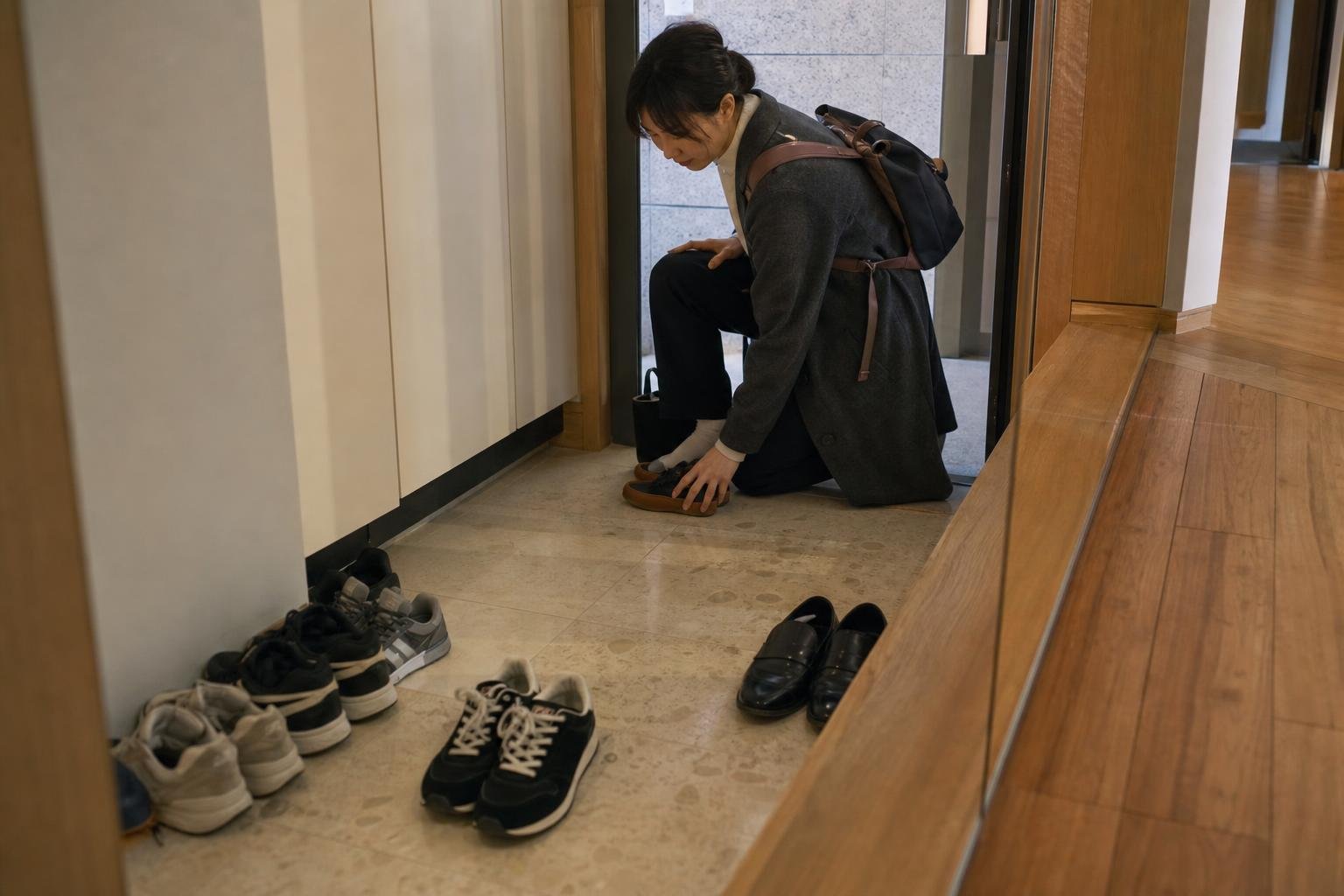
In many Korean homes, the entrance area is called the 현관 (hyeongwan). It is often tiled, positioned below the main interior floor, and equipped with a built-in shoe cabinet. Its design makes the boundary visible: outdoor shoes remain on the entrance side, while socks, bare feet, or house slippers belong on the interior side.
A smooth way to enter is:
- Stand on the entrance tile while removing your first shoe.
- Place that foot directly on the clean interior floor.
- Remove the other shoe without putting your sock back on the entrance tile.
- Leave both shoes neatly where the host indicates.
Visitors sometimes take off their shoes correctly and then step around the tiled entrance in their socks. That defeats the point of the divided space because the tile is where outdoor soles have been. If the entrance is cramped, use the edge as a seat or steady yourself against a wall rather than worrying about performing the movement perfectly.
Host: 신발 벗고 들어오세요.
Sinbal beotgo deureo-oseyo.
Please take off your shoes and come in.Guest: 네, 신발은 여기 두면 돼요?
Ne, sinbareun yeogi dumyeon dwaeyo?
Okay, should I leave my shoes here?
A host may not say anything because the architecture already supplies the instruction. Shoes beside a step, an open shoe cabinet, or slippers waiting on the clean side are usually enough of a cue.
Socks, house slippers, and bathroom slippers
There is no universal rule about indoor footwear after outdoor shoes come off. Some households walk in socks or bare feet; others provide slippers. Follow the host’s example, especially if slippers have been placed at the entrance for guests.
Many homes also keep washable plastic slippers in the bathroom, particularly when the bathroom has a floor that becomes wet during showering or cleaning. Those slippers are intended to remain there. Walking through the home in them can cause an embarrassed reaction because they have crossed from a less-clean area into the living space.
Guests generally do not need to bring indoor shoes, although clean socks are sensible when visiting a home. Someone who requires supportive footwear for health, disability, balance, or pain should not risk discomfort or injury to follow etiquette. Ask whether thoroughly cleaned indoor-only shoes, shoe covers, or another arrangement would work.
Where should visitors remove their shoes?
Private homes: Expect to remove outdoor shoes, including in modern apartments. Wait in the entrance area until you can see where to step.
Hanok stays: At a traditional 한옥 (hanok) guesthouse, shoes usually come off before entering rooms or stepping onto raised wooden areas. Layouts differ, so follow the host’s instructions.
Restaurants and cafés: Keep your shoes on in an ordinary business with standard tables and chairs. Remove them only when entering a raised floor-seating section or when a shoe rack, sign, or staff member directs you to do so. Korea Tourism Organization guidance likewise identifies homes and restaurants with ondol rooms as typical shoe-removal settings. source
Buddhist temples: Shoes normally stay on while walking around outdoor grounds but come off before entering Buddha halls and some other raised interiors. Look for shoes outside the doorway and follow temple staff or worshippers without obstructing the entrance.
Clinics, studios, childcare centers, and workplaces: Policies vary by facility. Some provide slippers or shoe covers; others allow outdoor shoes throughout. A Korean address alone does not tell you the rule.
Visitor: 여기서 신발 벗어요?
Yeogiseo sinbal beoseoyo?
Do we take off our shoes here?Staff member: 네, 신발장에 넣어 주세요.
Ne, sinbaljange neoeo juseyo.
Yes, please put them in the shoe cabinet.
On a sign, 신발을 벗어 주세요 (sinbareul beoseo juseyo) means “Please remove your shoes.” The verb 벗다 means to take off something worn on the body, including shoes. source
What if you accidentally walk in with shoes on?
Entering a Korean home in outdoor shoes will usually cause immediate concern because the cleanliness boundary has been crossed. Depending on the person and situation, it may also appear inattentive or disrespectful, but it is better understood as a practical household mistake than as a grave ritual offense.
If you take a step inside, simply stop, say 죄송해요 (joesonghaeyo, “I’m sorry”), return to the entrance, and remove your shoes. The host may wipe the spot, but a lengthy explanation will usually make the moment more awkward rather than less.
Placing shoes neatly to the side is considerate. Some people turn them toward the exit so they are easy to put on later, but this is a courtesy, not an inflexible national rule. In a crowded hyeongwan, the host may move everyone’s footwear into a cabinet.
The most reliable approach in any unfamiliar building is to look for the spatial boundary. A raised floor, footwear lined up near a doorway, an empty shoe shelf, or indoor slippers communicates more than the fact that you have passed through a front door. When the cues conflict or remain unclear, asking 여기서 신발 벗어요? is entirely natural—and safer than stepping forward and hoping for the best.