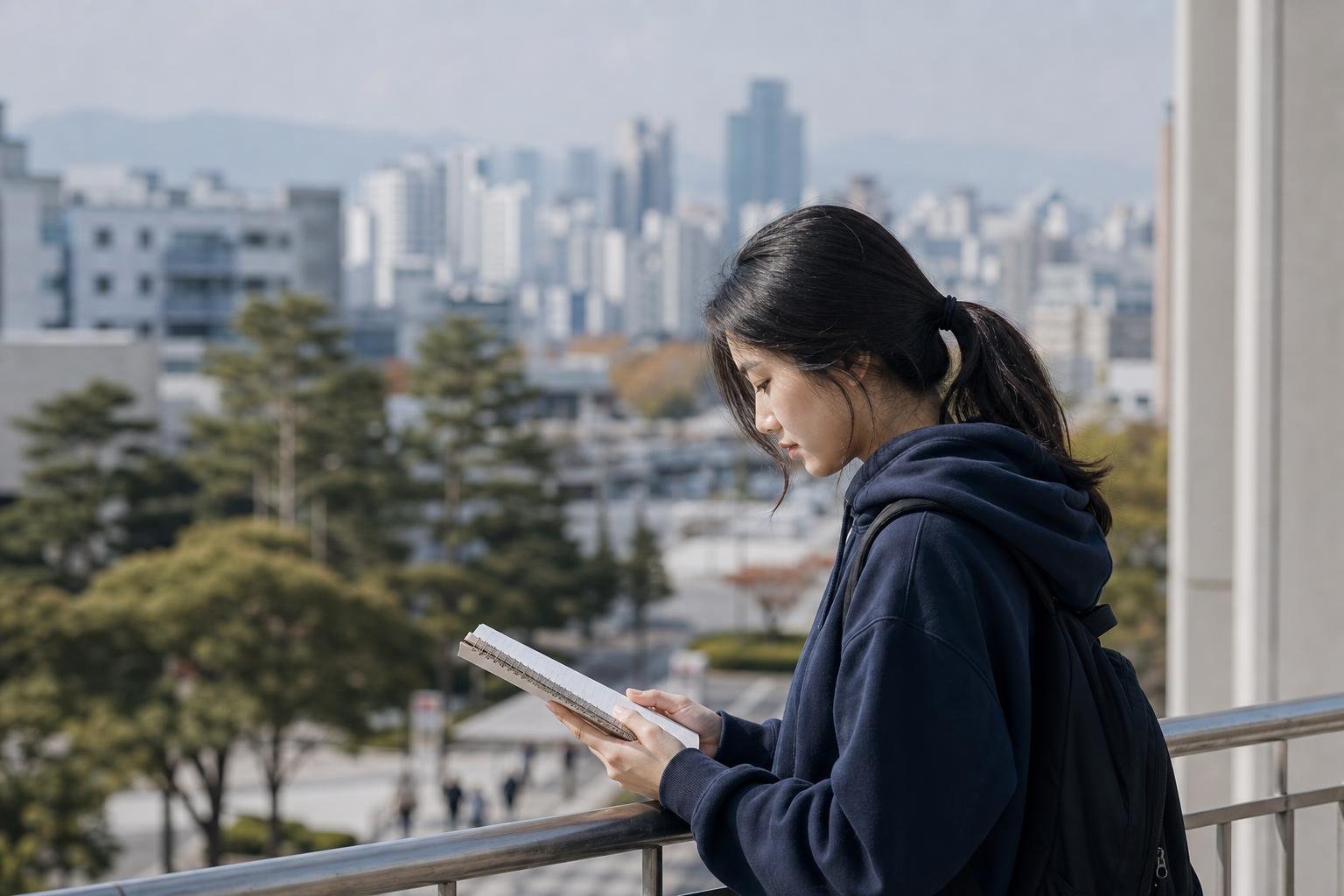
When Koreans say 파이팅 (paiting), they are not telling someone to fight. They are offering encouragement: “You’ve got this,” “Good luck,” “Keep going,” or “Let’s do this.”
The expression comes from English vocabulary, but it functions as a Korean interjection with its own meaning and usage. People say it before exams, presentations, performances, games, workouts, and other situations that call for confidence or shared energy.
What does 파이팅 mean?
파이팅 does not have one fixed English translation. Depending on the moment, it can mean:
- “You can do it!”
- “Good luck!”
- “Keep it up!”
- “Hang in there!”
- “Let’s go!”
- “Let’s do our best!”
It is a compact cheer rather than a complete statement. The speaker’s tone, relationship to the listener, and situation determine the best translation. South Korea’s National Institute of Korean Language classifies 파이팅 as an interjection used by competitors or supporters to encourage a strong effort. source
Before an exam, a friend might say:
시험 잘 봐. 파이팅!
Siheom jal bwa. Paiting!
“Good luck on the exam. You’ve got this!”
At the beginning of a group task, teammates might shout:
우리 모두 파이팅!
Uri modu paiting!
“Let’s do this, everyone!”
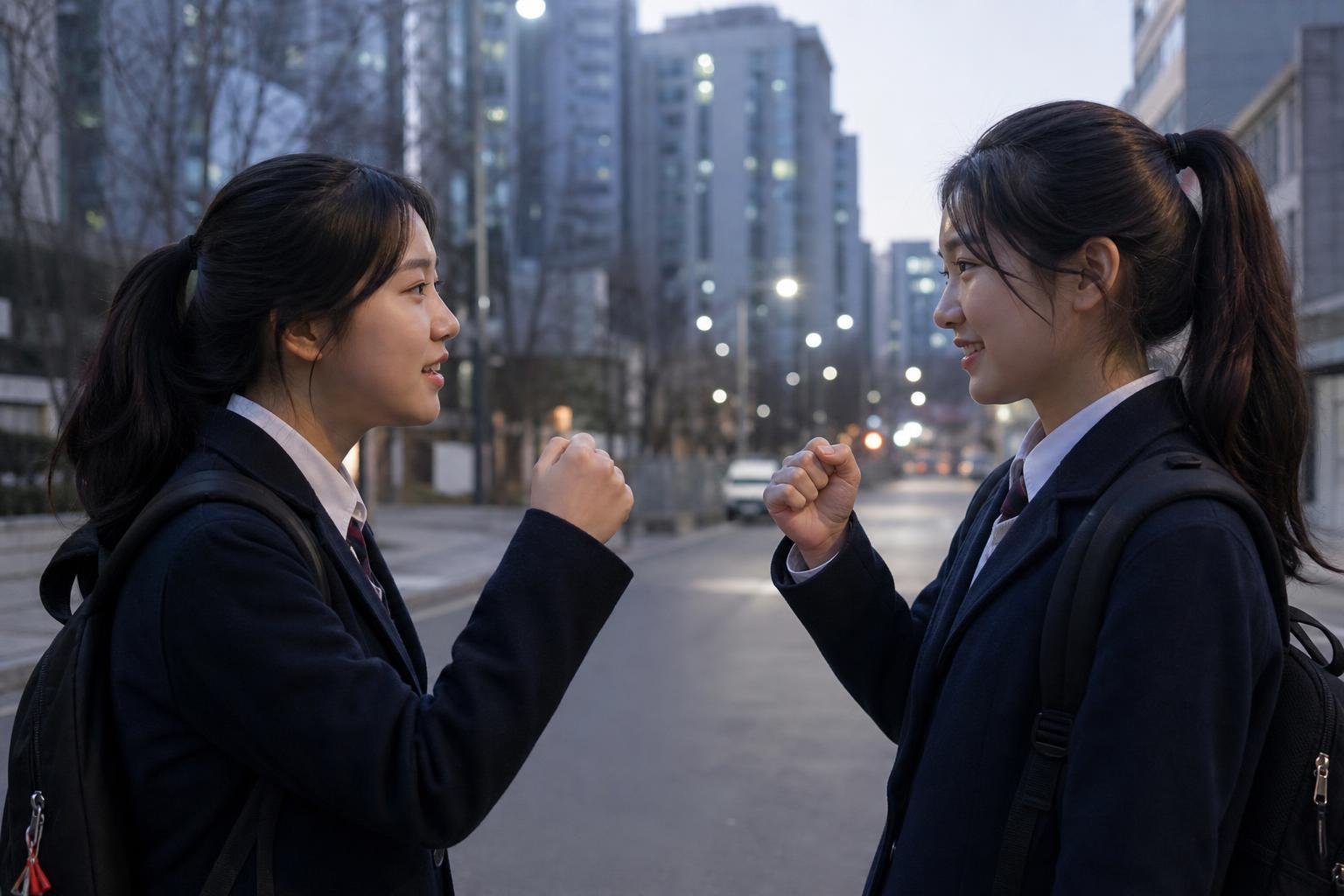
The first example supports one person, while the second builds collective momentum. A raised fist often accompanies the expression, but the gesture is optional.
Is the correct spelling 파이팅 or 화이팅?
You will see and hear both 파이팅 and 화이팅. They have the same practical meaning, but 파이팅 is the standard spelling under South Korea’s official loanword rules. The English f sound before a vowel is represented by ㅍ, which produces 파 rather than 화. The National Institute of Korean Language reaffirmed this rule in November 2024. source
화이팅 is nevertheless a familiar nonstandard variant. It is common in messages, social-media posts, fan content, advertising, and casual speech. It also explains the spelling hwaiting, which many international K-pop and drama fans recognize.
For edited or instructional writing, use 파이팅. When quoting a person, slogan, or title that deliberately uses 화이팅, preserve the original form.
파이팅 has three Korean syllables: 파-이-팅. Saying it approximately like “pie-ting” will usually be understood. The Revised Romanization form is paiting, while hwaiting represents the variant 화이팅 rather than the standard spelling.
How did an English word become a Korean cheer?
The safest answer is that English sports vocabulary was adapted within Korean and gradually acquired a broader encouraging meaning. Its precise path is not fully settled.
One well-supported explanation connects 파이팅 to the English phrase fighting spirit, meaning determination or competitive resolve. Korean newspapers used transliterated forms of that phrase in sports writing by at least the 1920s. A 1926 Dong-A Ilbo article, for example, referred to a baseball club’s 부족한 “파이팅 스피리트”—its lack of fighting spirit. Later examples show the shortened word being used in Korean sporting contexts. source
Some accounts instead emphasize Japanese influence, especially the Japanese cheer faito, which also derives from English “fight.” Korea’s colonial history from 1910 to 1945 makes linguistic contact impossible to exclude. However, the surviving Korean newspaper examples do not support presenting 파이팅 simply as a confirmed Japanese colonial remnant. The more defensible conclusion is that English sports language circulated through interconnected regional contexts and developed a conventional Korean use.
The 2002 FIFA World Cup did not create the expression. It was already established long before the tournament, although South Korea’s highly visible cheering culture helped make expressions such as 파이팅 more recognizable internationally.
Is “fighting” Konglish?
파이팅 is commonly described as Konglish because it uses English-derived material with a meaning that is not standard in ordinary English. A more precise description is “an English-derived Korean interjection.”
Calling it Konglish does not make it incorrect Korean. Loanwords regularly change their pronunciation, meaning, and grammar after entering another language. Within Korean, 파이팅 is conventional and immediately understandable.
The confusion appears when it is transferred unchanged into an English conversation. Someone unfamiliar with Korean culture may interpret a standalone “Fighting!” as a reference to physical conflict. Depending on the context, natural English equivalents include “You’ve got this,” “Good luck,” “Go team,” “Keep going,” and “Let’s do this.”
Among people familiar with Korean entertainment or language, fighting or hwaiting may already be understood as a Korean cheer. In such conversations, the Roman letters are effectively representing a Korean expression rather than ordinary English usage.
When do Koreans use it?
파이팅 works best when someone is preparing for a challenge, continuing through a demanding task, or joining others in a shared effort. Typical situations include:
- Before a test, interview, audition, or presentation
- At the start of a game, rehearsal, or workout
- When a friend expects a difficult day
- During a team meeting or group project
- When performers and fans encourage one another
- When someone needs a brief push to continue
To encourage a colleague before a presentation, you could say:
오늘 발표 잘하세요. 파이팅!
Oneul balpyo jalhaseyo. Paiting!
“Good luck with your presentation today. You’ve got this!”
Two friends beginning a workout might say:
오늘도 열심히 하자. 파이팅!
Oneuldo yeolsimhi haja. Paiting!
“Let’s work hard again today. Let’s go!”
The word itself does not change for politeness. Instead, the surrounding sentence carries the speech level: 잘해! is casual, while 잘하세요! is polite. Because 파이팅 is used in both personal and professional settings, the relationship and workplace hierarchy matter more than age alone.
You can also place a person, group, or occasion before it:
- 민지 파이팅! — “Go, Minji!”
- 우리 팀 파이팅! — “Go, team!”
- 오늘 하루도 파이팅! — “You’ve got this today too!”
When can it sound awkward?
Because 파이팅 is energetic and effort-focused, it does not suit every difficult situation. It may sound too cheerful when someone is grieving, seriously ill, or describing trauma. In those cases, acknowledging the person’s feelings or offering specific help is usually more appropriate.
It can also sound perfunctory when practical support is needed. If a manager gives an overwhelmed employee additional work and offers only 파이팅, the cheer may feel dismissive rather than motivating.
The expression is not inherently rude or overly casual, but it remains an expressive cheer. A solemn ceremony, formal document, or sensitive conversation normally calls for more specific language.
Other ways to encourage someone in Korean
Several Korean expressions overlap with 파이팅, although they are not interchangeable in every context:
- 힘내! (himnae) — “Hang in there” or “Stay strong,” casual.
- 힘내세요. (himnaeseyo) — the polite form of “Keep going” or “Stay strong.”
- 잘할 수 있어. (jalhal su isseo) — “You can do it,” casual.
- 잘할 수 있어요. (jalhal su isseoyo) — “You can do it,” polite.
- 잘하고 와! (jalhago wa) — “Go do well and come back,” often said before an exam, interview, or performance.
- 응원할게. (eungwonhalge) — “I’ll be rooting for you,” casual.
- 가자! (gaja) — “Let’s go!” for creating momentum.
아자! (aja) is another energetic cheer. The National Institute of Korean Language proposed 아자 as a Korean alternative to 파이팅 in 2004 and also lists 힘내자! as a suggested replacement. These were language-planning recommendations, not bans or spelling reforms, and 파이팅 remains an established dictionary word. source
You may also hear 아자 아자 파이팅!, a rhythmic cheer combining both expressions. Preferences vary: some speakers enjoy its lively or nostalgic tone, while others simply say 파이팅, 가자, or something personal to the listener.
Used naturally, 파이팅 is a quick signal that the speaker is on someone’s side. It does not literally call for combat; it recognizes an effort and adds a little energy before the next step.