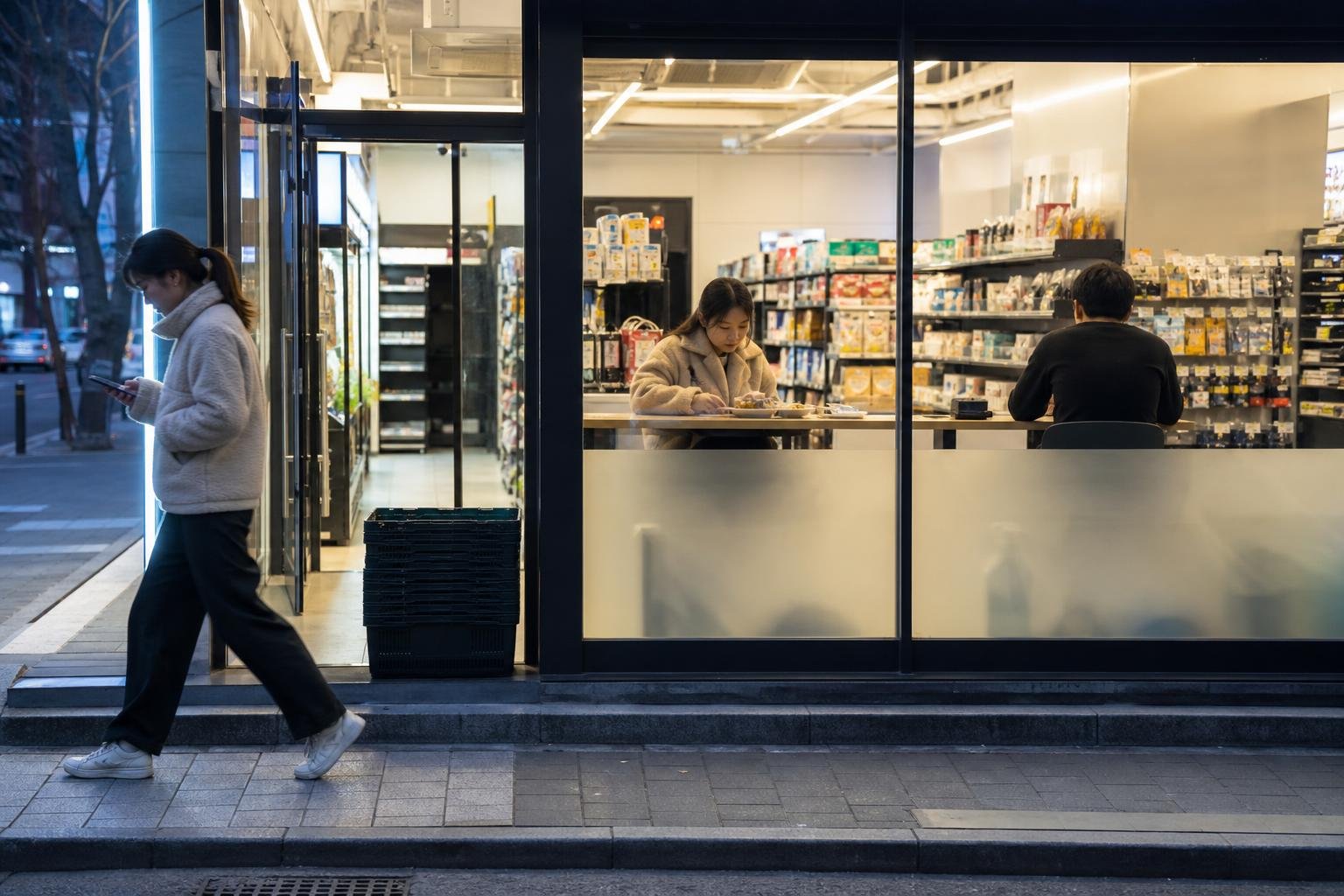
In South Korea, the convenience store is important because it fills small but frequent gaps in daily life. It can provide breakfast before an early commute, dinner after a late shift, an emergency umbrella, parcel shipping, an ATM, or simply somewhere to sit with a cup of noodles. By combining food, retail, and practical services in locations close to homes, schools, offices, and transit, it functions as a piece of neighborhood infrastructure rather than merely a small grocery shop.
The Korean word is 편의점 (pyeonuijeom). The four largest franchises are CU, GS25, 7-Eleven, and Emart24. Individual branches carrying the same brand can still differ in hours, seating, stock, and services because many are operated by franchisees and must adapt to their location.
A dense network built around short stops
Convenience stores fit naturally into Korea’s dense residential and commercial neighborhoods. They are commonly found near apartment entrances, subway stations, universities, hospitals, office buildings, and residential alleys. Most visits require little planning: a customer can buy water during a commute, milk on the way home, or batteries after larger retailers have closed.
The scale is substantial. Statistics Korea’s 2024 Franchise Survey counted 54,780 franchised convenience-store establishments. They represented 17.5 percent of all establishments covered by the survey and generated approximately 28.5 trillion won in annual sales, the largest sales share among its franchise categories. The figure excludes non-franchised shops, but it shows how thoroughly the major networks reach into everyday neighborhoods. source
Location is the main attraction. In a Korea Consumer Agency survey of 1,500 users published in 2022, 54.9 percent said they chose a convenience store because it was nearby. Round-the-clock access came a distant second at 11.1 percent. source
That result also corrects a common assumption: not every Korean convenience store is open 24 hours. Chain store finders list 24-hour operation as a branch-specific feature, alongside options such as parcel kiosks, cash machines, and printers. Overnight hours depend on the building, local demand, staffing, and the operator’s circumstances. source
A practical kitchen for one meal
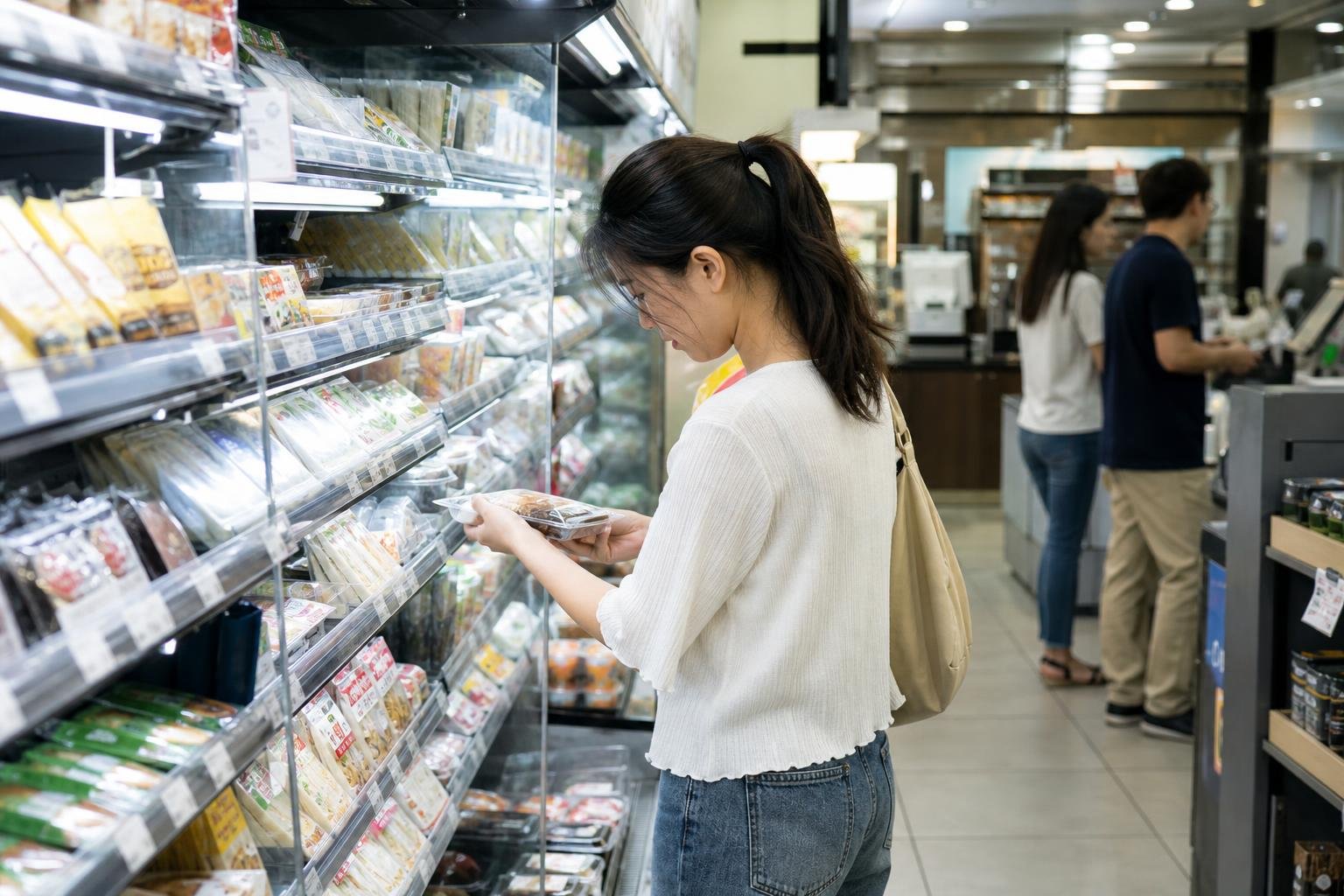
Ready-to-eat food is central to the Korean convenience-store experience. Typical choices include 도시락 (dosirak, boxed meals), 삼각김밥 (samgak gimbap, triangular rice snacks), gimbap rolls, sandwiches, salads, boiled eggs, instant rice, frozen dishes, and 컵라면 (keop ramyeon, cup noodles). Many branches provide microwaves and hot-water dispensers, allowing customers to prepare food immediately.
This suits a country in which household size has steadily decreased. In 2024, South Korea had 8.04 million one-person households, accounting for 36.1 percent of general households. Living alone does not imply dependence on convenience-store meals, but it does create demand for single servings, minimal preparation, and food that does not leave several days of ingredients or leftovers. source
For an office worker leaving late, the attraction is not necessarily that a boxed meal beats every restaurant on price or quality. It is that the entire transaction can take five minutes. A customer might combine rice or gimbap with packaged chicken, eggs, kimchi, fruit, and a drink, heating only what is required.
If staff assistance is needed, a customer can say:
이거 데워 주세요.
Igeo dewo juseyo.
“Please heat this up.”
At many branches, customers use the microwave themselves. Heating instructions are printed on the package, and the recommended time may differ depending on the store’s microwave wattage.
Convenience-store food should not be romanticized as automatically cheap or nutritionally balanced. Cup noodles and many prepared dishes can be high in sodium, while adding several side dishes and drinks quickly raises the price. The main advantage is the combination of portion size, speed, long availability, and predictable preparation.
The store is also a neighborhood service counter
Depending on the branch, a convenience store may offer parcel shipping or collection, an ATM, document printing, transport-card sales or recharging, bill payment, online-order pickup, prepaid services, and locally designated products such as municipal rubbish bags.
These services are not peripheral. In a 2024 Korea Consumer Agency survey of users of the four largest franchises, 62.1 percent reported using a convenience service, up from 41.6 percent in its 2021 survey. Parcel services were used most often, followed by ATMs and transport-card recharging. source
Parcel shipping is particularly visible because the stores already receive regular logistics deliveries. Standard domestic courier services coexist with cheaper store-to-store options. With the latter, the sender leaves a package at a participating branch and the recipient collects it from another branch instead of receiving it at home. CU, for example, officially markets this as CU반값택배 (CU ban-gaps taekbae), or “CU half-price parcel.” Prices, weight limits, eligible destinations, and collection periods can change, so customers should check the specific operator rather than treating 반값택배 as one nationwide system. source
A useful opening phrase is:
택배 보내려고요.
Taekbae bonaeryeogoyo.
“I’d like to send a parcel.”
The employee may then ask 예약하셨어요? (Yeyak-hasyeosseoyo?), meaning “Did you make a reservation?” Customers frequently enter the shipment details through an app or in-store kiosk before taking the printed label and package to the counter. Registration may require a Korean phone number, making the service less straightforward for short-term visitors.
Branch variation matters here. A store may advertise parcel service but lack the kiosk for a particular operator. An ATM may reject an overseas card or charge a fee. A printer can be out of order, and rules for recharging transport cards may differ by card and payment method. The chain sign indicates access to a broader service network, not a promise that every service is available at every location.
Promotions have their own shopping language
Convenience-store price labels commonly display 1+1 or 2+1. A 1+1 offer means that buying one eligible product includes a second; 2+1 means that buying two includes a third. The offer normally applies to identical products, although some promotions allow selected flavors or varieties to be mixed.
A visitor who takes only one bottle from a 1+1 display may hear:
원 플러스 원이에요.
Won peulleoseu won-ieyo.
“It’s one plus one.”
The extra item does not usually appear automatically later: the customer should take all included products to the counter. When eligible, chain apps provide another option. CU’s Pocket CU app, for example, allows users to place an unused promotional item in a digital “keeping” locker and collect it later. The app also supports functions such as inventory searches, pickup, delivery, and advance reservations. source
These offers suit frequent, small purchases, but they are not always savings in practice. Buying three drinks is useful only if the customer wants three drinks, and promotional stock can sell out before the advertised period ends.
New products turn ordinary stores into trend spaces
Major chains continually introduce private-label meals, seasonal desserts, regional foods, character merchandise, and entertainment collaborations. Their large store networks make them useful test markets: an unfamiliar flavor or limited-edition product can be released nationally without requiring a new restaurant or specialist shop.
This helps explain why convenience-store launches spread quickly through Korean social media. Trying a trending drink or dessert is relatively inexpensive, and the nearest participating store may be only a few minutes away. For visitors, the chilled-food and snack aisles can offer a more current picture of popular tastes than a shelf devoted to conventional souvenirs.
However, there is no single “Korean convenience-store experience.” A large branch in a fashionable Seoul district may feature an expanded dessert section, self-service cooking equipment, or collaboration displays. A small residential branch may concentrate on drinks, tobacco, household basics, and parcels. Near a university, inexpensive meals may dominate; in a rural area, the store may be one of the few nearby sources of prepared food. Product selection reflects the neighborhood as much as the brand.
A place to pause—but not a public dining room
Some branches provide window counters, indoor seats, or outdoor tables where customers can eat. These spaces offer an inexpensive place to pause between destinations, especially at hours when cafés are closed. The familiar drama scene of friends eating cup noodles outside a convenience store is plausible precisely because it is ordinary.
It is not universal. Many stores have no seating, while outdoor tables may be restricted because of weather, building rules, or complaints about noise. Customers should clear their table, separate waste according to the labels provided, and avoid treating shop bins as disposal points for unrelated household rubbish.
Bright lighting, staff presence, and security cameras can also make a late-night branch feel safer than a dark street, but an ordinary store is not automatically an emergency facility. Seoul’s formal 안심지킴이집 (ansim jikimi-jip, safety guardian house) program designates particular 24-hour convenience stores as places where someone in danger can seek temporary refuge and help contacting police. Participating locations are identified by official signage; the designation should not be assumed from the brand alone. source
Using a Korean convenience store smoothly
- Search for 편의점 in a Korean map app. Check the listed hours rather than assuming 24-hour operation.
- Read the promotion label. For a 1+1 or 2+1 deal, take the full number of eligible items unless you are deliberately using an app-based keeping service.
- Check before opening food. Confirm that the branch has seating if you intend to eat there.
- Follow the package instructions. Remove any sauce packets, foil, or non-microwave-safe components before heating.
- Ask about branch-specific services. 여기 택배 돼요? (Yeogi taekbae dwaeyo?) means “Can I send a parcel here?”
- Allow time for complex transactions. Parcel registration, bill payments, and app problems can take longer when one employee is handling the counter and other store tasks.
The Korean convenience store works because it is available at the scale of an errand rather than a shopping trip. Its most important moments are usually unremarkable: breakfast before class, a package sent after work, an umbrella bought during a downpour, or hot water added to noodles after the last restaurant meal. Those repeated uses—not any single product or viral trend—are what make pyeonuijeom part of the country’s everyday social and commercial landscape.