The safest approach to Korean drinking etiquette is straightforward: in a formal or unfamiliar group, pour and receive alcohol with two hands, let the host or toast leader set the pace, and turn slightly aside when drinking directly in front of someone you are treating with particular respect. You are always free to decline alcohol.
These are social conventions, not laws or an exact national rulebook. A meal with a partner’s parents or a formal business group may involve more ceremony than drinks among close friends. Age can influence the interaction, but workplace rank, host-and-guest roles, familiarity, and the group’s preferences also matter. Do not use age alone to decide how everyone should behave.
Pouring alcohol for someone else
Follow the table rather than rushing to serve
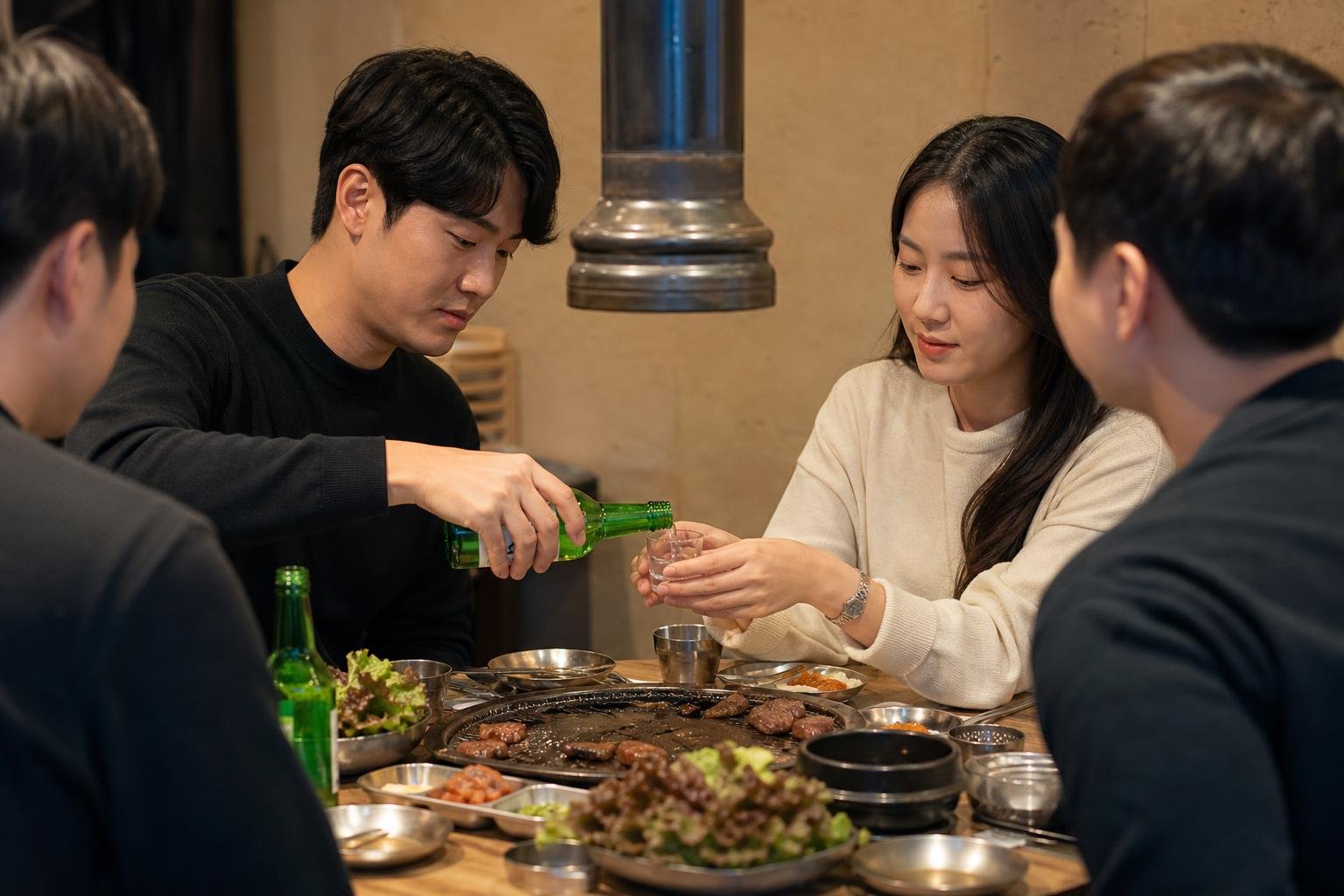
At a conventional gathering, diners often pour alcohol for one another. In a formal setting, a host or another person may begin by serving the guests, while colleagues and friends may take turns later. If a server is managing the drinks, there is no need to seize the bottle or reach across the table whenever a glass becomes empty.
When it is appropriate for you to pour, offer the bottle first to a host, guest of honor, supervisor, client, older relative, or another person being shown deference in that particular group. The point is attentiveness, not identifying the oldest person and repeatedly singling them out.
Use two hands when the relationship is formal
You can hold the bottle with both hands or pour with your right hand while your left hand supports your right wrist, forearm, or the bottle. The traditional gesture developed from older rules about handling clothing and serving neatly; today, its visible meaning is courtesy. Official Korean cultural guidance continues to present two-handed pouring and receiving as the conventional form when interacting with an older person. source
Among close friends and in groups that have clearly relaxed the formality, one-handed pouring is common. If you are unsure, start with two hands and follow the tone set by the people around you.
Ask before refilling
An empty glass is not automatic permission to pour. Someone may be drinking slowly, stopping for the evening, or avoiding alcohol altogether. A useful offer is:
한 잔 드릴까요?
Han jan deurilkkayo?
“May I pour you a drink?”
The phrase can also be understood more broadly as “Would you like a drink?” Pause for the answer instead of beginning to pour while asking.
You may hear that a small soju glass should be emptied before it is refilled. Some groups observe that custom, while others do not. Different drinks are also handled differently. Rather than correcting anyone, ask or watch what the table is doing.
Receiving a drink
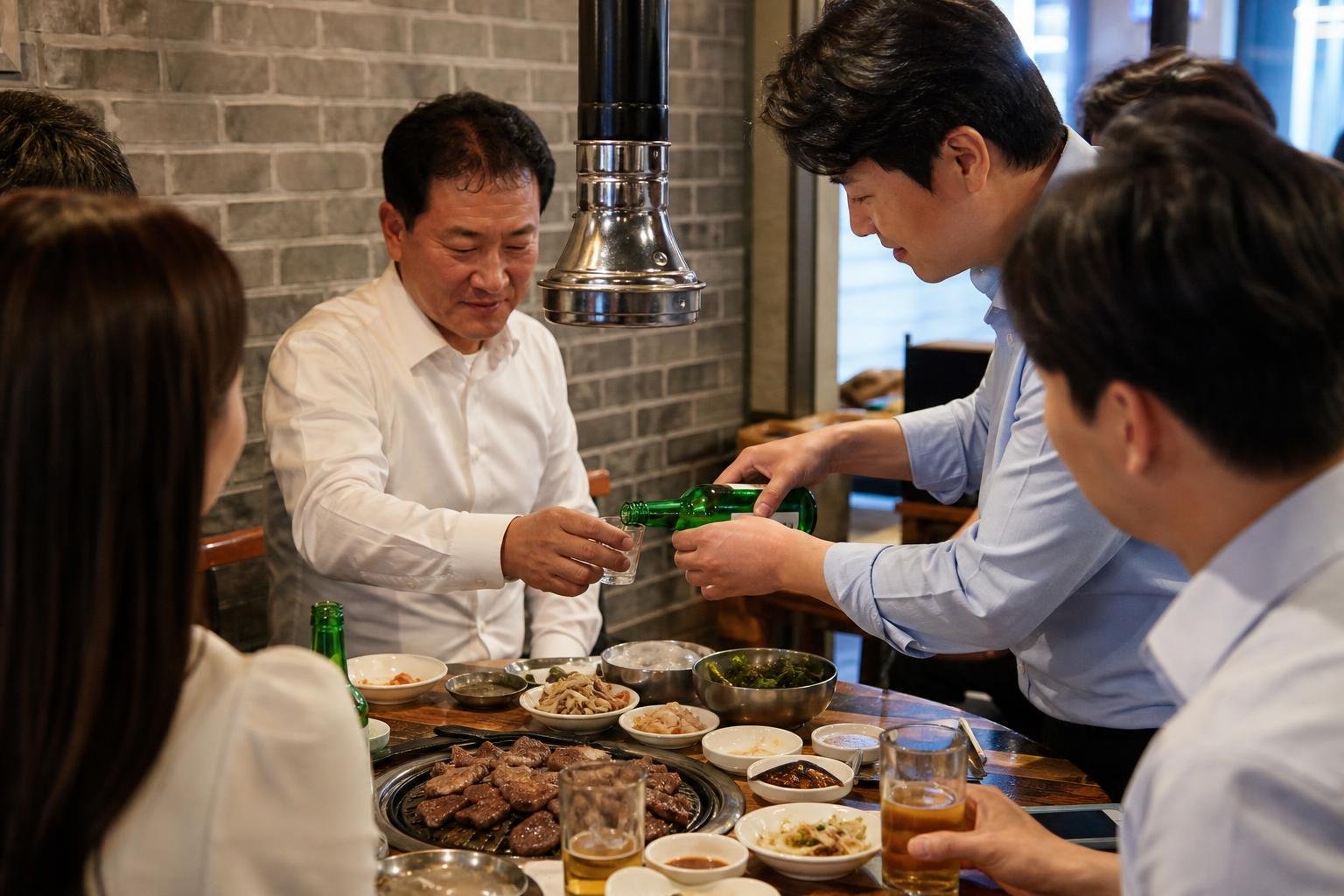
When someone you are treating formally pours for you, lift the glass and hold it with both hands. Another common form is to hold it in your right hand while supporting your wrist or forearm with your left. A small nod is enough; a deep bow or standing up would usually be excessive at an ordinary meal.
You can say:
감사합니다.
Gamsahamnida.
“Thank you.”
Two-handed receiving is especially useful for the first round, introductions, meals with older relatives, and formal work or client dinners. It may become less pronounced as the group relaxes. Korean government cultural materials describe receiving an elder’s drink with both hands and expressing thanks as a traditional sign of respect. source
Receiving the glass does not obligate you to empty it. If you did not have a fair opportunity to refuse before it was poured, you may leave it untouched or explain that you are not drinking.
Toasting and turning aside to drink
건배 (geonbae) is the standard Korean equivalent of “cheers.” At the beginning of a formal dinner, wait briefly for the host, guest of honor, or group leader to initiate the toast rather than raising your glass immediately.
Some people position their glass slightly lower when clinking with someone they are treating as senior. This is a subtle gesture, not a contest to place your glass beneath everyone else’s. It is also not necessary in every group.
When should you turn your head?
A younger or junior participant may turn their head and upper body slightly away while drinking in front of an elder or senior person. Some people loosely shield the glass with their free hand. This long-recognized convention avoids drinking directly face-to-face with the person being shown respect. source
The gesture is most relevant during an early toast at a formal dinner, when meeting a partner’s parents, or when the relationship is clearly hierarchical. Friends, relaxed teams, and family members may omit it. Turn naturally to one side; there is no need for an exaggerated twist or elaborate performance.
A toast does not require a “one-shot”
원샷 (wonsyat, from English “one shot”) is a call to finish the glass at once. It may appear during celebrations or drinking games, but it is not a basic requirement of Korean etiquette. You can take a sip, particularly when the drink is strong or the glass is large.
폭탄주 (poktanju), literally “bomb drink,” usually refers to a mixed combination of liquors, commonly soju and beer. Joining such a round is optional. Korean public-health campaigns have discouraged pressuring others to drink as well as practices such as one-shots and bomb drinks. source
Do not interpret an enthusiastic chant as a command. Friendship, gratitude, and professional cooperation do not need to be demonstrated by rapidly consuming alcohol.
How to decline alcohol politely
You can participate in the meal, eat 안주 (anju, food served with alcohol), and raise a soft drink or another nonalcoholic beverage during a toast. A clear refusal is usually more effective than repeatedly accepting a glass and trying to avoid drinking it.
For a general statement, say:
저는 술 안 마셔요.
Jeoneun sul an masyeoyo.
“I don’t drink alcohol.”
A more formal version is:
죄송하지만 저는 술을 마시지 않습니다.
Joesonghajiman jeoneun sureul masiji anseumnida.
“I’m sorry, but I don’t drink alcohol.”
죄송하지만 softens the refusal; it does not mean you have done anything wrong. You do not owe the group a medical, religious, or personal explanation.
If you are declining only on that occasion:
오늘은 술을 안 마실게요.
Oneureun sureul an masilgeyo.
“I won’t drink today.”
If you have already had enough:
저는 여기까지만 마실게요.
Jeoneun yeogikkajiman masilgeyo.
“I’ll stop here.”
If someone is holding a bottle over your glass, gently cover or move the glass while speaking. The gesture makes your intention clear. Avoid smiling and saying only 괜찮아요 if the other person might interpret your response as “It’s okay—go ahead.” Pair it with an explicit statement that you are not drinking.
Joining the toast without alcohol
You can ask for another beverage in advance and say:
괜찮습니다. 저는 음료로 건배할게요.
Gwaenchanseumnida. Jeoneun eumnyoro geonbaehalgeyo.
“No, thank you. I’ll toast with a soft drink.”
Raising that drink during the toast lets you join the social moment without weakening your boundary.
How to limit your drinking
If you want one drink but not repeated refills, say so early. These phrases are polite but specific:
- 한 잔만 마실게요. Han janman masilgeyo. — “I’ll have just one glass.”
- 조금만 주세요. Jogeumman juseyo. — “Just a little, please.”
- 천천히 마실게요. Cheoncheonhi masilgeyo. — “I’ll drink slowly.”
Keep a nonalcoholic drink nearby and decline each new pour consistently. Leaving some alcohol in the glass may discourage a refill in some groups, but it is less reliable than saying directly that you have finished.
Alcohol pressure at work dinners
A company gathering is called a 회식 (hoesik). The term does not necessarily mean a late-night drinking session: a hoesik may be a meal, lunch, or another group activity. Expectations differ considerably by employer, industry, team, and generation.
Pressure still occurs, but it should not be defended as an unavoidable part of Korean culture. The Ministry of Employment and Labor’s workplace-harassment guidance includes forcing alcohol or attendance at company gatherings against an employee’s wishes among behaviors employers should examine. Whether particular conduct legally qualifies as workplace harassment depends on factors such as an advantage in workplace position or relationship, conduct beyond the proper scope of work, and resulting suffering or deterioration of the work environment. Those elements appear in Article 76-2 of the Labor Standards Act. source
If an initial refusal is ignored, use firmer language:
술은 못 마십니다.
“I cannot drink alcohol.”
You can also tell the organizer beforehand, request a nonalcoholic option before the first toast, or repeat the same refusal without entering a long negotiation.
Customs that are not modern requirements
Historical accounts describe people offering, exchanging, or circulating cups as an expression of hospitality. Such practices may still appear in certain ceremonial or traditional contexts, but sharing a used glass is not required. It is reasonable to keep your own glass or request a clean one. source
Likewise, do not pressure someone to empty a glass, secretly strengthen a mixed drink, turn a refusal into a penalty, or insist that a visitor must drink to experience Korean culture. For an unfamiliar gathering, begin with two hands, follow the host’s lead, turn slightly aside when the setting is clearly formal, and drink only what you choose.