
Korean apartment management fees explained simply: the amount called gwanribi (관리비) on a monthly statement may combine common-area operating costs, household or shared utility charges, and separately classified items such as the long-term repair reserve. Do not assess the bill by its total alone. Check the individual categories, the billing period, and whether your heating or utilities are billed through the management office.
Tenants should pay particular attention to 장기수선충당금 (janggi suseon chungdanggeum). In apartment complexes subject to Korea’s long-term repair-plan rules, the owner is responsible for this reserve. If a tenant pays it on the owner’s behalf, the owner must return that amount. The management office must also issue proof of payment without delay when the resident requests it. source
The three parts commonly combined on one statement
Residents often use 관리비 to mean the entire amount due, but the legal accounting categories are more precise. A statement can contain management costs, usage charges and separately collected reserves or assessments.
Common management costs
The statutory management-cost categories include general management, cleaning, security, disinfection, elevator maintenance, home-network equipment maintenance, heating, hot water, routine repair and maintenance, and an outside management company’s fee. Routine 수선유지비 (suseon yujibi) covers maintenance and repairs outside the long-term repair plan; it is not another name for the long-term repair reserve. source
- 일반관리비 (ilban gwanribi): management-office wages, administration, supplies, communications, training and related operating expenses.
- 청소비·경비비·소독비 (cheongsobi, gyeongbibi, sodokbi): cleaning, security and disinfection.
- 승강기유지비 (seungganggi yujibi): elevator inspection and maintenance costs.
- 수선유지비: ordinary upkeep and repairs not assigned to the long-term repair plan.
- 위탁관리수수료 (witak gwanri susuryo): the fee charged when a professional company manages the complex.
Some common costs are distributed partly or wholly according to a unit’s supply area or another method set by the complex’s management rules. Consequently, households in different-sized units may pay different common charges even when their personal electricity or water use is similar.
Utilities and other usage charges
Electricity, water, gas, district-heating charges, hot water, waste fees, whole-building insurance, resident-representative expenses and the television reception fee are legally classified as 사용료 등—usage charges and related items—rather than the core management-cost categories. Electricity and water may include both household consumption and power or water used for shared facilities. source
The billing route depends on the building. In a district-heated complex, heating and hot water will commonly appear on the apartment statement. A home with an individual gas boiler may receive a separate gas bill instead. Parking, internet, community-center or gym charges may also be separate or limited to residents who use the facility.
Before comparing two apartments, therefore, confirm what each total includes. A ₩200,000 statement covering heating and water is not directly comparable with a ₩150,000 statement that excludes them.
Why 장기수선충당금 matters to tenants
The long-term repair reserve finances planned work on major common assets. Depending on the complex’s long-term plan, that can include elevators, roofs, exterior surfaces, mechanical equipment and other building-wide systems. The reserve must be collected separately from ordinary management costs. source
Not every small residential building is governed in the same way. A statutory long-term repair plan is required for apartment housing with at least 300 households, housing with an elevator, housing using central or district heating, and certain mixed-use buildings constructed under a building permit. source
Where the reserve applies, the management body collects it from the owner. Monthly statements are usually addressed to the occupied unit, however, so a tenant may pay the full statement first. When that happens, the owner has a legal duty to return the reserve paid by the tenant. source
Example: A tenant’s management-office record shows that the tenant paid ₩185,000 in 장기수선충당금 during the lease. The tenant can present that record to the landlord and request reimbursement, commonly as part of the move-out settlement.
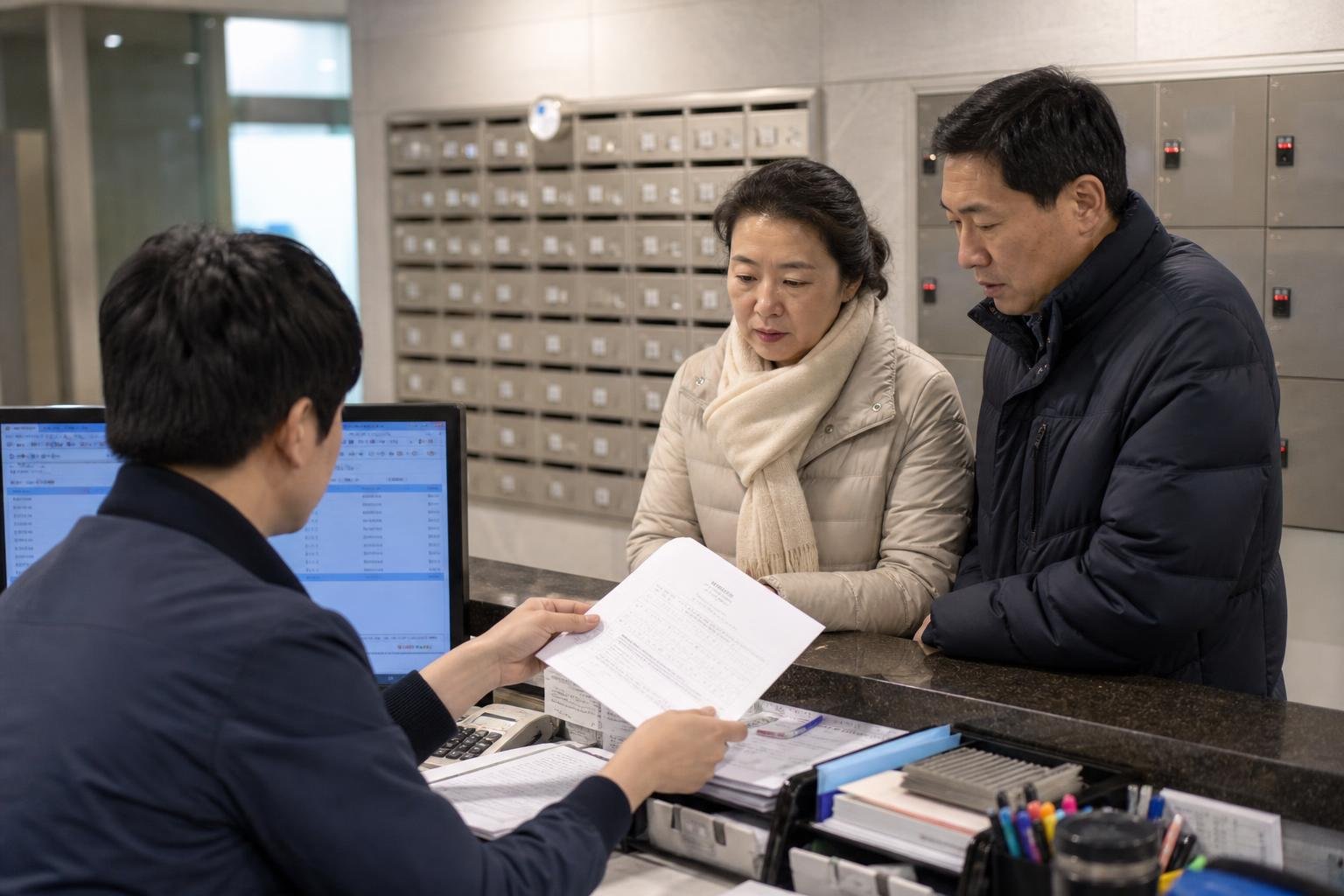
Save the full monthly statements rather than only bank-transfer confirmations. Before moving, ask the management office for a 장기수선충당금 납부확인서, a certificate confirming the reserve paid during your occupancy. The enforcement decree requires the management body to issue the confirmation without delay when a resident requests it. source
A natural question at the management office is:
제가 납부한 장기수선충당금 확인서를 발급해 주실 수 있을까요?
Jega napbuhan janggi suseon chungdanggeum hwaginseoreul balgeuphae jusil su isseulkkayo?
“Could you issue a certificate showing the long-term repair reserve I paid?”
Do not confuse the reserve with 관리비예치금
관리비예치금 (gwanribi yechigeum) is a management-fee deposit or advance used to support the operation of the common areas. It is normally collected from the owner, often as a one-time amount, rather than accumulated as a monthly fund for major planned repairs.
When an owner loses ownership of the unit, the management body must return the deposit after deducting any unpaid management fees, usage charges or long-term repair reserve. This means it commonly becomes relevant during a sale, whereas a tenant’s main concern at move-out is usually reimbursement of 장기수선충당금. source
If an English translation on a lease or statement says only “maintenance deposit” or “repair fee,” ask for the original Korean item name. 관리비예치금, 수선유지비 and 장기수선충당금 have different purposes and should not be treated as interchangeable.
Who normally handles each charge in a rental?
The resident ordinarily handles recurring costs connected with occupying the home, including personal utilities and the building’s regular operating charges, according to the lease and billing arrangement. The long-term repair reserve is different because the legislation assigns it to the owner in covered complexes.
Check the special terms of the lease before signing, particularly in an officetel, villa, small apartment building, serviced residence or mixed-use property. These buildings may use different statement formats, include internet or cleaning in a fixed monthly charge, or lack the detailed accounting familiar from a large apartment complex.
Ask the landlord or agent:
장기수선충당금은 제가 먼저 납부하고 이사할 때 임대인과 정산하면 되나요?
Janggi suseon chungdanggeumeun jega meonje napbuhago isahal ttae imdaeingwa jeongsanhamyeon doenayo?
“Should I pay the long-term repair reserve first and settle it with the landlord when I move?”
Record the answer in writing, but also retain the management-office statements and certificate. A vague promise from an agent is less useful than documentation showing the exact amount paid.
Why the monthly total changes
Seasonal heating and cooling are often the largest sources of variation. District or central heating can produce a steep winter increase, while air-conditioning raises summer electricity use. Changes in staffing, repair work, insurance, security contracts or shared-facility use can also affect the total.
Building characteristics matter as well. Several elevators, underground parking, mechanical ventilation, landscaped grounds, 24-hour security and resident amenities all cost money to operate. A smaller complex may spread fixed staffing or inspection costs across fewer households, while an older complex may require more frequent routine maintenance.
When a bill rises, compare the individual category with the previous month and, where possible, the same month of the previous year. A higher total is not by itself evidence of overcharging; the useful question is which item changed and why.
How to check your complex on K-apt
K-apt, the national apartment-management information system, publishes management-cost data, complex information, tender records and other management disclosures. It can also compare a complex’s figures with averages and median values for similar properties. source
K-apt coverage expanded in October 2024 to include non-mandatory-management apartment complexes with at least 100 households. This is distinct from the broader local disclosure rules that can apply to smaller complexes. A building’s absence from K-apt does not necessarily mean that it is breaking the law; first confirm its size, legal classification and applicable disclosure channel. source
Use comparisons cautiously. Select complexes with a similar number of households, building age, heating method, floor area and level of facilities. The most useful comparison is often your own complex over time rather than a superficially cheaper building with different services.
If one line remains unclear, ask the 관리사무소 (gwanri samuso):
이번 달 관리비에서 이 항목이 오른 이유를 설명해 주실 수 있을까요?
Ibeon dal gwanribieseo i hangmogi oreun iyureul seolmyeonghae jusil su isseulkkayo?
“Could you explain why this item increased on this month’s management statement?”
A practical checklist for residents
- Before signing a lease: request a recent full statement and ask whether heating, water, electricity, parking and internet are included.
- At move-in: record accessible meter readings and confirm the billing cut-off date so you are not charged for the previous occupant’s usage.
- Every month: save the itemized statement and flag 장기수선충당금 separately if you rent.
- After an unexpected increase: compare categories rather than totals and ask the management office for the calculation or reason.
- Before moving out: obtain the long-term repair reserve payment certificate and discuss reimbursement before the rental deposit is settled.
- If you own: review both the monthly reserve and the complex’s long-term repair plan. A low contribution may simply postpone the financial impact of necessary major work.
Statement layouts vary, but the reading method does not: separate ordinary building operations, household or shared usage, and owner-funded long-term repairs. That distinction makes it easier to compare homes, question an unusual charge and complete a rental settlement without leaving reimbursable money behind.