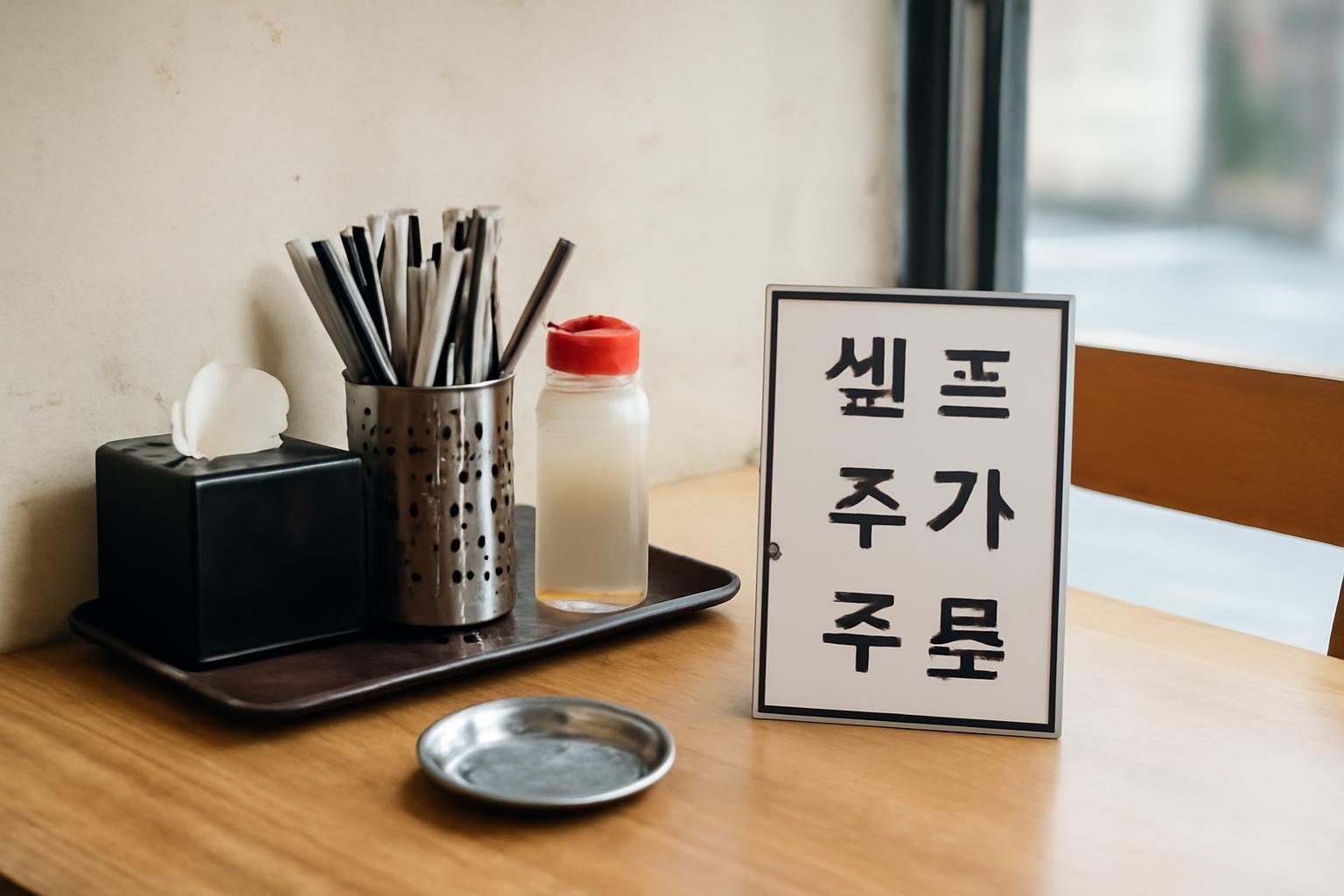
Korean restaurants often place short instructions on tables, walls, condiment containers, and self-service stations. The words are usually simple, but knowing them can make a meal much easier—especially when you need more side dishes, want to find the utensils, or are unsure whether something is included.
This guide covers practical Korean restaurant vocabulary you are likely to see or hear, with pronunciation and explanations of how the signs work in real life.
The most useful restaurant words at a glance
- 셀프 (selpeu) — self-service
- 셀프바 (selpeuba) — self-service bar or station
- 리필 (ripil) — refill
- 추가 (chuga) — additional serving or extra order
- 무료 (muryo) — free of charge
- 유료 (yuryo) — paid; not free
- 반찬 (banchan) — side dishes
- 앞치마 (apchima) — apron
- 수저 (sujeo) — spoon and chopsticks
- 물 (mul) — water
셀프 and 셀프바: when you serve yourself
셀프 is a Korean loanword from English “self.” In restaurants, it usually means that customers should handle that part of the service themselves. You may see it on a sign such as:
물은 셀프입니다.
Mureun selpeuimnida.
Water is self-service.
This does not mean the entire meal is self-service. It may apply only to water, utensils, side dishes, or a particular condiment station.
셀프바 literally means “self bar,” but it normally refers to a self-service counter or station. Depending on the restaurant, it may contain kimchi, lettuce, sauces, pickled vegetables, soup, cups, or serving utensils.
반찬은 셀프바를 이용해 주세요.
Banchaneun selpeubareul iyonghae juseyo.
Please use the self-service bar for side dishes.
이용해 주세요 means “please use.” It is a polite instruction often found on signs, but it does not necessarily mean that staff will explain the system individually.
리필: refills and second servings
리필 means “refill,” and restaurants use it for drinks, side dishes, sauces, and sometimes meat or other menu items. The important question is whether the refill is free.
- 반찬 리필 — refill of side dishes
- 물 리필 — water refill
- 음료 리필 — drink refill
- 무한 리필 (muhan ripil) — unlimited refills
- 리필 가능 (ripil ganeung) — refills available
- 리필 불가 (ripil bulga) — refills not available
무한 리필 means that refills are unlimited within the restaurant’s conditions. It is common in all-you-can-eat barbecue restaurants, buffet-style restaurants, and some places offering unlimited drinks or side dishes. Check the menu or staff instructions for time limits, minimum orders, or restrictions on leftovers.
A sign may say:
반찬은 드실 만큼만 가져가 주세요.
Banchaneun deusil mankeumman gajyeoga juseyo.
Please take only as much side dish as you will eat.
Here, 드실 만큼만 is a respectful way to say “only as much as you will eat.” The sign is usually about reducing waste, not a warning that one refill is forbidden.
무료 and 유료: free versus extra charge
무료 means free of charge, while 유료 means that an additional charge applies. These words are especially useful when a restaurant offers extra rice, side dishes, disposable items, or specialty sauces.
- 무료 제공 (muryo jegong) — provided free of charge
- 유료입니다 (yuryoimnida) — there is a charge
- 추가 요금 (chuga yogeum) — additional fee
- 공깃밥 추가 (gonggitbap chuga) — extra bowl of rice
- 리필은 유료입니다 — refills cost extra
Do not assume that every side dish is free in every setting. Many Korean restaurants provide basic 반찬 at no extra charge, but some restaurants charge for additional portions, premium side dishes, or items taken from a self-service counter. The clearest signs usually pair the item with 무료 or 유료.
추가, 주문, and more food
추가 means “additional” or “extra.” It is one of the most useful words for ordering.
- 밥 추가 — extra rice
- 고기 추가 — extra meat
- 사리 추가 (sari chuga) — extra noodles or other add-on ingredients
- 반찬 추가 — additional side dishes
- 추가 주문 (chuga jumun) — additional order
사리 usually refers to an additional portion of noodles or an ingredient added to a dish, such as ramen noodles, udon, rice cakes, or dumplings. The exact meaning depends on the menu.
주문 (jumun) means “order,” and 주문은 여기서 means “orders here.” If a sign says:
주문은 키오스크에서 해 주세요.
Jumuneun kioskeueseo hae juseyo.
Please place your order at the kiosk.
you should use the touchscreen rather than wait for a server. A receipt or table number may be printed after payment, and staff may bring the food to your table.
Signs about utensils, water, and aprons
Many restaurants keep everyday supplies in drawers, baskets, or stations rather than bringing them automatically.
- 수저 — spoon and chopsticks
- 수저통 (sujeotong) — utensil container
- 물컵 (mulkeop) — water cup
- 앞치마 — apron
- 앞치마는 셀프입니다 — aprons are self-service
- 물은 냉장고에 있습니다 — water is in the refrigerator
- 휴지는 테이블 옆에 있습니다 — tissues are beside the table
수저 is a collective word for the spoon-and-chopsticks set used in Korean meals. A restaurant may provide metal chopsticks and a long-handled spoon in a drawer attached to the table. 수저통 is often the container placed on or beside the table.
앞치마 is particularly common at barbecue, noodle, stew, and spicy-soup restaurants. If the sign says 앞치마는 셀프, look for a rack or basket. Disposable aprons may be labeled 일회용 앞치마 (ilhoeyong apchima), meaning “disposable apron.”
Useful words for side dishes and condiments
반찬 means the side dishes served with a Korean meal. These may include kimchi, seasoned vegetables, fish cake, pickles, or other small dishes. A sign may distinguish between the initial serving and later requests:
- 반찬은 드실 만큼만 — take only what you will eat
- 반찬은 셀프입니다 — side dishes are self-service
- 반찬 추가는 직원에게 말씀해 주세요 — please ask staff for additional side dishes
소스 (soseu) means sauce, and 양념 (yangnyeom) means seasoning or seasoned sauce. You may also see:
- 고추장 — red chili paste
- 쌈장 — thick dipping paste commonly served with wraps or grilled meat
- 참기름 — sesame oil
- 간장 — soy sauce
When a container is labeled 공용 (gongyong), it means “for shared use.” This may appear on communal tongs, scissors, sauces, or serving utensils.
How to ask for a refill politely
You can use short, natural phrases rather than constructing a long sentence.
- 반찬 좀 더 주세요. — Please give us some more side dishes.
- 물 좀 더 주세요. — Please give us some more water.
- 이거 리필돼요? — Can this be refilled?
- 반찬 리필 가능해요? — Are side-dish refills available?
- 추가 요금 있어요? — Is there an extra charge?
좀 softens a request, while 주세요 means “please give [it].” For a more specific request, point to the dish and say 이거 좀 더 주세요—“a little more of this, please.”
If you need staff attention, 저기요 (jeogiyo) is a normal way to say “excuse me” in a restaurant. Use it in a clear but not shouted voice. At a busy restaurant, pressing a table call button may be more effective than calling across the room.
Small signs that affect how you use the restaurant
Some table notices are about procedure rather than food. Common examples include:
- 선불 (seonbul) — pay first
- 후불 (hubul) — pay afterward
- 포장 가능 (pojang ganeung) — takeout available
- 포장 불가 (pojang bulga) — takeout not available
- 잔반은 남기지 말아 주세요 — please do not leave food waste
- 외부 음식 반입 금지 (oebu eumsik banip geumji) — outside food is prohibited
- 주차 (jucha) — parking
- 대기 (daegi) — waiting or queueing
선불 and 후불 are especially important in small restaurants and casual eateries. If you see 선불, pay at the counter before sitting down or before the food is prepared. In some places, ordering through a kiosk automatically means payment is made first.
How to read a sign without overinterpreting it
The key is to identify the noun first, then look for the instruction around it. For example:
- 물 + 셀프 — get your own water
- 반찬 + 추가 — extra side dishes
- 리필 + 무료 — free refills
- 앞치마 + 유료 — aprons cost extra
- 주문 + 키오스크 — order at the kiosk
Restaurant Korean often leaves out subjects and complete sentence endings, so a two- or three-word sign can communicate a full instruction. Once you recognize words such as 셀프, 추가, 무료, and 유료, many unfamiliar signs become much easier to decode.
When in doubt, point to the item and ask 이거 무료예요? (“Is this free?”) or 제가 가져가면 돼요? (“Should I take it myself?”). Those two questions will usually clarify the restaurant’s system without requiring advanced Korean.