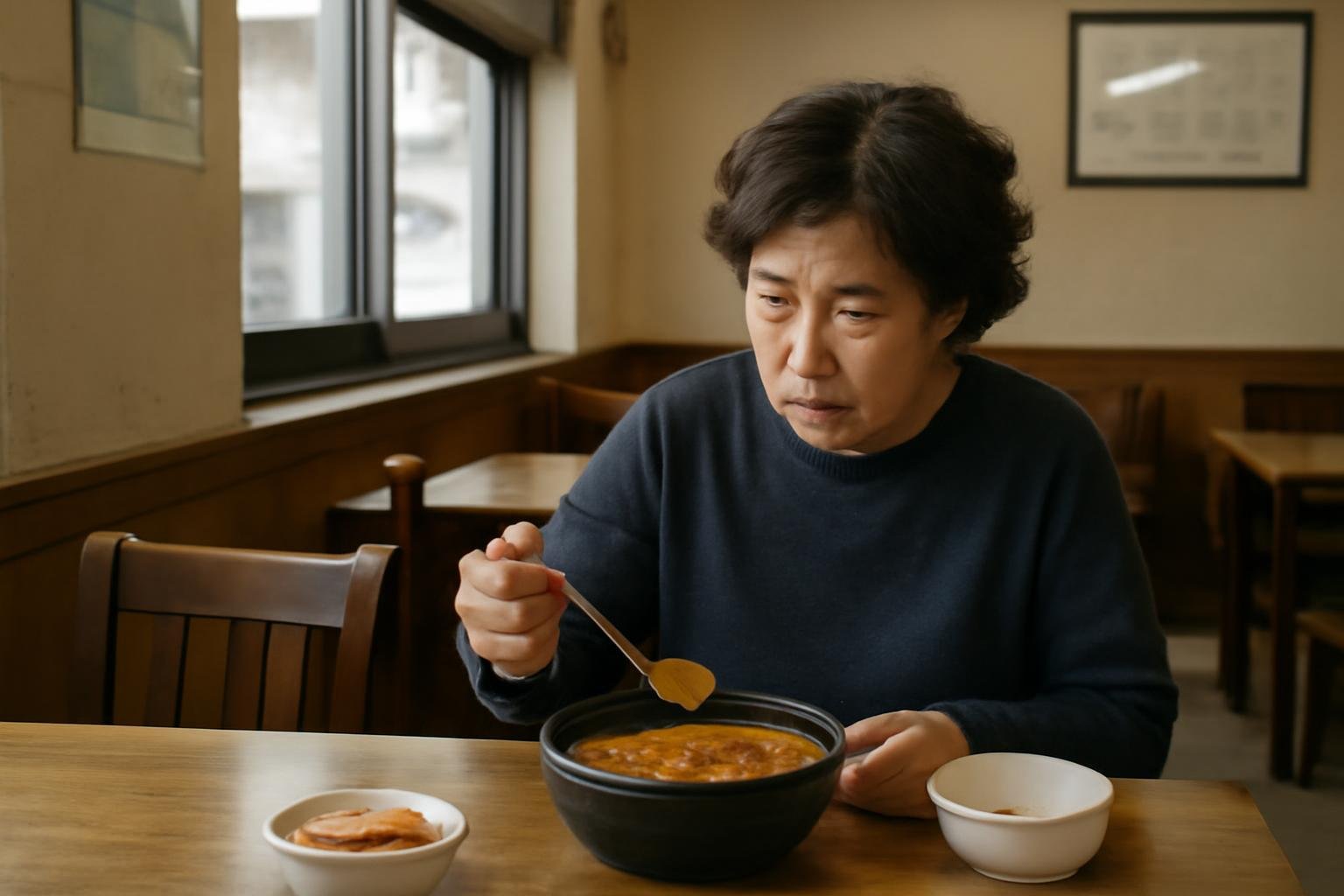
Korean menus often place several hot, savory dishes under the broad English heading “soup,” but Korean diners distinguish among them more precisely. The most useful terms to recognize are 국 (guk), 탕 (tang), 찌개 (jjigae), and 전골 (jeongol). They overlap, and restaurants do not always use the categories rigidly, but each suggests a different balance of broth, ingredients, serving style, and occasion.
As a quick rule, guk is usually a lighter soup served with a meal, tang often indicates a substantial soup or long-simmered broth, jjigae is a more concentrated stew typically served bubbling in a small pot, and jeongol is a communal hot pot designed to be cooked or finished at the table.
국 (guk): the everyday soup alongside rice
Guk is the broadest and often the most everyday category. A bowl of guk commonly arrives as part of a Korean meal, alongside rice and side dishes. The broth may be clear or lightly seasoned, and the dish is often meant to refresh the palate rather than dominate the table.
Examples include:
- 미역국 (miyeok-guk): seaweed soup, commonly associated with birthdays and postpartum meals.
- 콩나물국 (kongnamul-guk): soybean sprout soup, usually light and clean-tasting.
- 된장국 (doenjang-guk): soup seasoned with fermented soybean paste, often containing vegetables or tofu.
- 무국 (mu-guk): radish soup, frequently made with beef or a seafood-based broth.
Guk is not necessarily bland. Garlic, fermented pastes, dried anchovy, kelp, beef, shellfish, or chili can all provide strong flavor. The distinguishing impression is usually that the soup is relatively broth-forward and integrated into a larger meal.
탕 (tang): a substantial soup or broth-based specialty
Tang is also translated as soup, but on a menu it often suggests something more substantial, specialized, or carefully simmered than an everyday guk. Many tang dishes are built around meat, bones, seafood, or a particular regional tradition. The broth may be clear, milky, or intensely seasoned.
Common examples include 설렁탕 (seolleongtang), a milky ox-bone soup; 갈비탕 (galbitang), a clear soup with beef short ribs; and 감자탕 (gamjatang), a spicy pork-backbone stew usually served with potatoes and greens.
The boundaries between tang and other categories are not fixed. 감자탕, for example, is called a tang even though many English-speaking diners would experience it as a stew. In practical terms, tang often signals a dish with a notable broth and a main ingredient that makes it filling enough to order as a meal.
Some restaurants serve tang in a large pot for sharing, while others offer individual bowls. Look at the portion size and menu photos rather than relying on the name alone.
찌개 (jjigae): concentrated stew served bubbling hot
Jjigae is generally thicker, more intensely seasoned, and less broth-heavy than guk. It is commonly served in a small individual earthenware pot called a 뚝배기 (ttukbaegi), often still boiling when it reaches the table. Rice is an essential partner: you typically eat spoonfuls of the stew with rice rather than treating it as a separate first course.
Familiar types include:
- 김치찌개 (kimchi-jjigae): kimchi stew, often made with pork, tofu, or canned tuna.
- 된장찌개 (doenjang-jjigae): fermented soybean-paste stew with tofu, vegetables, and sometimes seafood or meat.
- 순두부찌개 (sundubu-jjigae): spicy soft-tofu stew, frequently served with an egg.
- 부대찌개 (budae-jjigae): a spicy mixed stew associated with postwar Korean foodways and containing ingredients such as sausage, ham, tofu, and noodles.
Jjigae is often ordered for one person, but a restaurant may also offer a larger portion for sharing. Because it is concentrated and salty or spicy, it is usually eaten with plenty of rice and banchan rather than consumed by the bowlful like a Western-style soup.
전골 (jeongol): a communal hot pot for the table
Jeongol is best understood as a shared hot pot rather than simply another kind of soup. Ingredients are arranged in a wide pot—perhaps beef, mushrooms, seafood, dumplings, vegetables, or tofu—then broth is added. The pot may arrive simmering, or staff may turn on a burner at the table and cook it in front of you.
Because jeongol is designed for sharing, it is often ordered by the number of people rather than as a single bowl. The broth develops as the ingredients cook, and restaurants may offer noodles or rice to add later. A dish such as 버섯전골 (beoseot-jeongol, mushroom hot pot) can therefore change in flavor and texture throughout the meal.
Jeongol is not always dramatically spicier or thicker than jjigae. The key distinction is the dining format: a central pot, multiple ingredients, and participation by the table.
What about 국밥, 곰탕, and other menu words?
Several useful terms do not fit neatly into the four-category comparison.
- 국밥 (gukbap) means “soup rice.” Rice is served in, or directly with, a substantial soup. Depending on the restaurant, it may arrive already in the broth or separately.
- 곰탕 (gomtang) is a rich meat-based soup traditionally associated with long simmering. It is often served with rice and sliced meat.
- 해장국 (haejangguk) means “hangover soup,” but people order it for many reasons. The term points to a family of hearty, strongly seasoned soups rather than one fixed recipe.
- 전 (jeon) or noodles may be offered as additions to a hot pot, especially after the main ingredients have been eaten.
Restaurant naming can reflect tradition, regional style, branding, or habit. A dish labeled “tang” at one restaurant may resemble a stew labeled “jjigae” elsewhere. The labels are helpful clues, not a scientific classification system.
How to choose when ordering
If you want something light to accompany rice, start with guk. If you are looking for a filling bowl centered on meat, bones, or a distinctive broth, consider tang, gomtang, or gukbap. For a spicy, concentrated dish in a small bubbling pot, jjigae is usually the right direction. If you are dining with several people and want to cook or share ingredients at the table, choose jeongol.
A few practical questions can prevent surprises:
- Is it individual or for sharing? “1인분” (il-inbun, one serving) usually indicates an individual portion, while larger jeongol or tang options may be priced for two or more people.
- Is rice included? Rice may be included, separately priced, or available as an add-on. With jjigae, rice is normally expected, but the menu may still list it separately.
- How spicy is it? Ask, “많이 매워요?” (mani maewoyo?, “Is it very spicy?”). For a milder version, “덜 맵게 해 주세요” (deol maepge hae juseyo) means “Please make it less spicy,” although customization depends on the restaurant.
- Is the pot shared? If you prefer your own portion, ask whether the dish is served individually: “각자 먹는 거예요?” (gakja meongneun geoyeyo?, “Do we each get our own?”).
Once you know these broad patterns, a Korean menu becomes easier to read. The names tell you not only what may be in the broth, but also how the dish is likely to arrive, how filling it will be, and whether it belongs in the center of the table or beside your rice bowl.