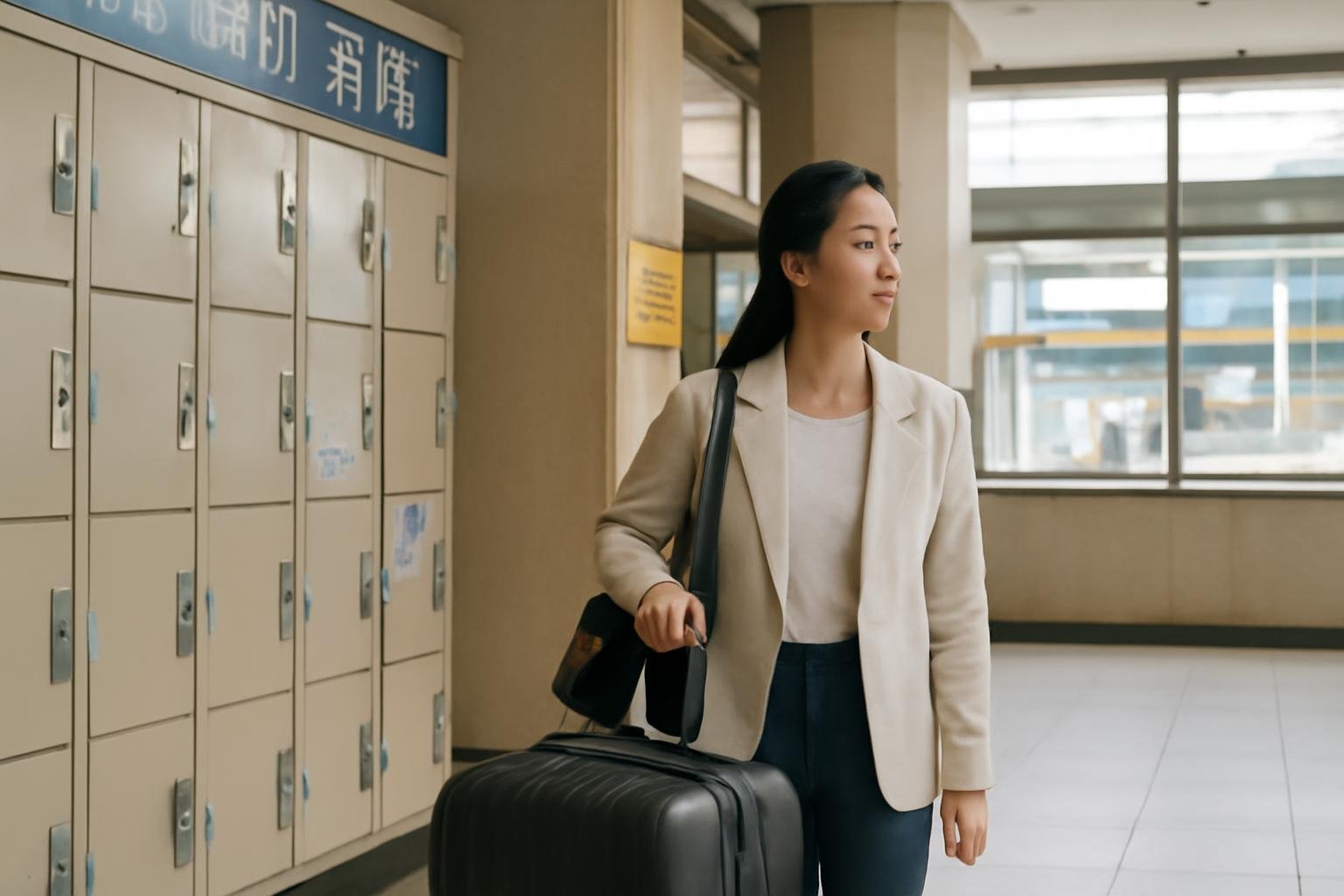
If you need to explore Korea before check-in, after check-out, or between trains, the easiest solution is usually a station locker. In major cities, you can also use staffed luggage counters or same-day delivery services, especially in Seoul.
The practical order is simple: check your accommodation first, then look for a locker at the nearest subway or railway station. If your suitcase is too large, the lockers are full, or you need delivery rather than short-term storage, look for a staffed service such as T-Luggage or a private baggage-storage counter.
Start with the right type of storage
- Station lockers: Best for a few hours near a subway, KTX, or major railway station.
- Staffed luggage storage: Better for large suitcases, valuable items, longer stays, or when you want assistance.
- Same-day delivery: Useful when you are moving between Seoul stations, an airport, and your accommodation.
- Hotel or guesthouse storage: Often the simplest option if you are staying nearby, even before check-in or after check-out.
Do not assume that every tourist attraction has a public locker. Museums, shopping malls, department stores, markets, and cultural sites may have lockers, but availability and access rules vary. A transport hub is usually the most dependable place to begin.
How to find a locker at a Korean station
- Search the station name with 보관함. In Korean, 보관함 (bogwanham) means “storage locker.” Useful searches include 서울역 물품보관함 (Seoul Station luggage lockers) or 부산역 물품보관함 (Busan Station luggage lockers).
- Look near station gates, transfer corridors, and exits. Lockers are often outside the paid area, near customer-service counters, or in underground shopping passages. At large stations, check the station map rather than walking randomly.
- Check the size before unpacking. Lockers are commonly divided into small, medium, and large sizes. A large suitcase may not fit even if the locker looks deep enough, especially if the wheels or handle take up space.
- Read the payment screen. Many lockers accept a bank card or transportation card, and some accept cash. Instructions are often available in English and other languages, but payment methods differ by machine.
- Keep the receipt, code, or QR information. You will need the same method to open the locker. Photograph the locker number if you are in a large station.
Lockers are installed at many subway stations, but not necessarily every station or every exit. Storage fees and maximum storage times depend on the facility. The Korea Tourism Organization notes that prices vary by locker size and that payment options differ by location. source
Using luggage storage at Seoul subway stations
Seoul is the easiest place in Korea to combine transport and luggage storage. In addition to ordinary station lockers, the city has T-Luggage, a staffed service that provides storage and, at participating locations, delivery between stations or between a station and Incheon International Airport.
T-Luggage locations include major tourist-oriented stations such as Seoul Station, Hongik Univ. Station, Myeongdong, Jongno 3-ga, Jamsil, Suseo, and Gimpo International Airport, although the exact service and operating arrangements can change. Check the current service page before travelling to a specific branch. source
This is particularly useful in situations such as:
- Arriving at Seoul Station in the morning before your hotel accepts luggage.
- Staying in Hongdae but spending the afternoon in Myeongdong.
- Leaving Seoul for Incheon Airport and wanting to avoid carrying bags across the city.
- Travelling with a suitcase that will not fit in a standard subway locker.
For short visits, an ordinary locker may be cheaper and faster. For large luggage or a full sightseeing day, a staffed counter can be worth the extra cost because you do not have to gamble on finding a vacant, correctly sized locker.
Finding luggage storage at KTX and major railway stations
At KTX and other large railway stations, search for signs using words such as 물품보관함 (luggage lockers), 짐 보관 (luggage storage), or 여행센터 (travel centre). Lockers may be located inside the station concourse, near the ticket gates, or in an attached shopping area rather than directly beside the platforms.
For a train connection, leave more time than you think you need. At a station such as Seoul, Yongsan, Busan, or Daejeon, the distance between the platforms, ticket gates, and locker area can be substantial. If you are catching a reserved train, store your luggage before buying food or exploring the station.
Railway stations outside Seoul may have lockers but fewer staffed alternatives. If the lockers are full, ask the station information desk:
짐을 맡길 수 있는 곳이 어디예요?
Jimeul matgil su inneun gosi eodiyeyo?
“Where can I leave my luggage?”
You can also show the station name and the word 보관함 on your phone. Staff may direct you to a locker area, an information counter, or a nearby private service.
Storage in tourist areas, malls, and attractions
Popular shopping and sightseeing districts sometimes provide luggage storage in shopping centres, department stores, markets, tourist information centres, or nearby stations. This is most common in dense areas such as Myeongdong, Dongdaemun, Hongdae, and major downtown shopping districts.
However, tourist-area storage is less standardized than station storage. A mall may restrict lockers to customers, close them when the building closes, or prohibit oversized cases. An attraction may require you to store large bags before entering, while small bags are allowed inside. Check the site’s rules before making it your plan for the day.
In Myeongdong, for example, T-Luggage operates in the area around Myeongdong Station and offers storage as well as delivery services. source
If you are visiting a palace, museum, or exhibition, search the attraction’s official page for 물품보관함 or “locker.” Do not leave luggage unattended in a public area while you look for one. Security staff may remove it, and unattended baggage can cause serious disruption.
What foreign visitors should check before using a locker
Card and cash acceptance
Many modern lockers accept credit or debit cards, and some accept a Korean transportation card. Others may accept only certain cards or cash. If your foreign card fails, try a different card, use a staffed counter, or ask at the station information desk. Carrying a small amount of Korean cash remains useful as a backup.
Size and weight
Locker size labels are not perfectly standardized. A “large” locker may fit a medium suitcase but not a large international checked bag. If your suitcase is over roughly the size used for cabin luggage, look for a staffed luggage service first, particularly in Seoul.
Opening hours
A locker may be physically accessible only while the station, mall, or building is open. Subway trains may run late, but that does not guarantee that an underground shopping passage or staffed counter will remain open. Confirm the collection deadline before leaving your luggage.
Storage duration
Some lockers charge by a fixed period and then add an hourly fee. Others may not allow overnight storage or may move uncollected items after a certain period. Read the terms on the screen, especially if you plan to collect your bag the next morning.
What not to store
Do not place passports, medication, electronics, cash, or other irreplaceable items in a locker unless you are comfortable with the service’s conditions. Never store prohibited, dangerous, or perishable goods. For passports and valuables, carrying them with you is safer.
When lockers are full or your suitcase does not fit
Do not keep searching every exit of the same station without a plan. Use this fallback sequence:
- Ask the station information desk about another locker bank or staffed storage counter.
- Check the next major station on your route rather than a small local station.
- Search for 짐 보관, 물품보관, or “luggage storage” in a map app near your destination.
- Ask your hotel or accommodation whether it can hold the bag for the day.
- In Seoul, check T-Luggage or another staffed service that accepts larger bags.
A Korean phrase that works at a hotel or shop is:
체크인 전인데 짐을 맡길 수 있을까요?
Chekeuin jeoninde jimeul matgil su isseulkkayo?
“I have not checked in yet. Could you hold my luggage?”
Planning around your itinerary
The best storage location is usually the place where your route naturally changes: the station where you arrive, the station closest to your hotel, or the station you will use to leave for the airport. Avoid storing luggage at a station that requires a separate trip across the city.
For a same-day train trip, store your bag at the arrival station and collect it before your departure. For a hotel change, consider delivery if it saves you from carrying luggage through multiple transfers. For a few hours of sightseeing, a locker near the first attraction is usually the simplest option.
Before committing, verify three things on the day: locker availability, collection hours, and payment method. Those details matter more than the location listed in an older blog post or map review. If you need help in English, the Korea Travel Hotline can provide multilingual assistance at 1330; station staff can also direct you to the nearest available storage option. source