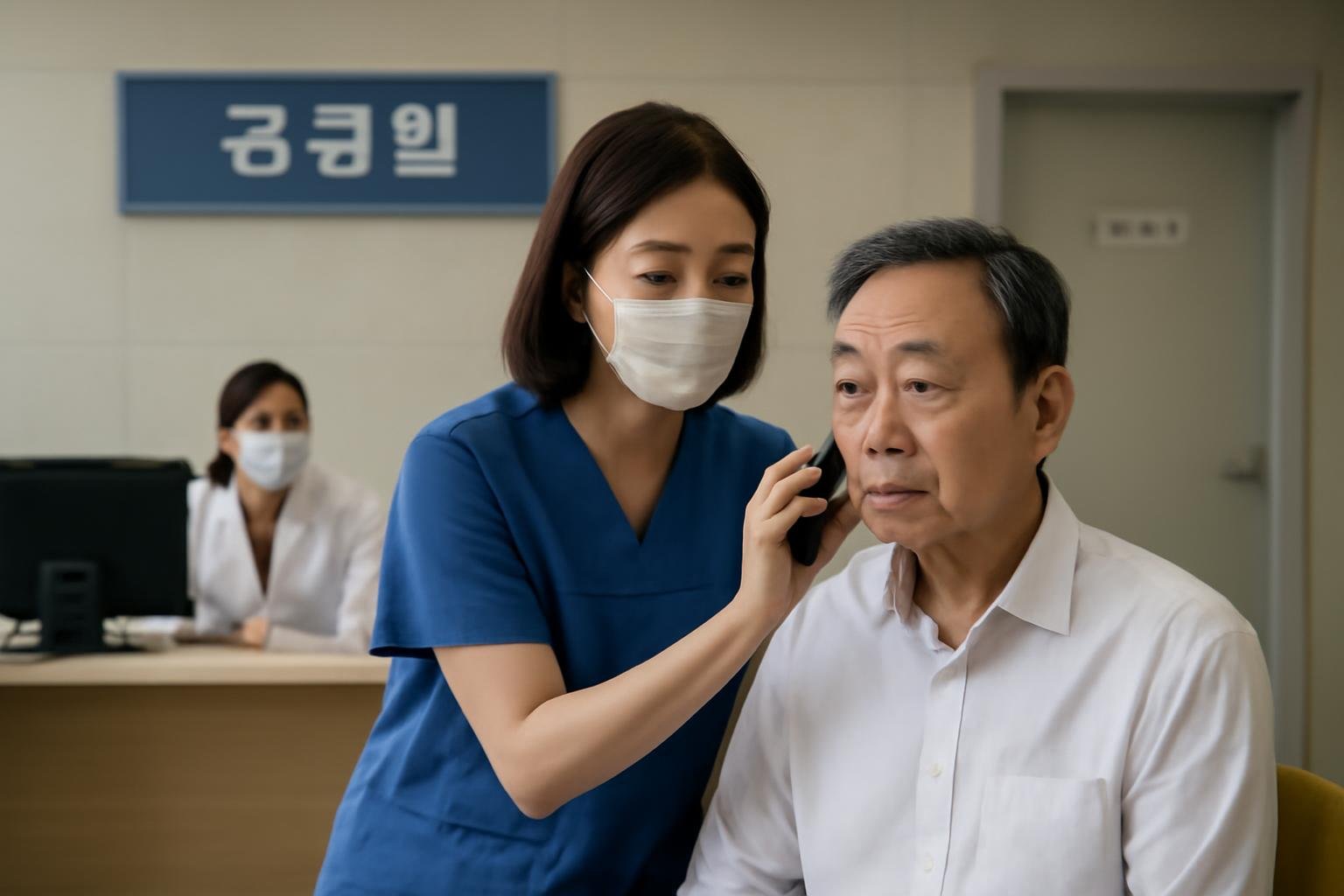
If you are seriously ill or injured in South Korea, call 119. It is the emergency number for fire, rescue, and ambulances, and it is the correct first call for a medical emergency. You do not need to speak Korean: when the operator answers, say “English, please” or “Interpreter, please.” A professional interpreter can be connected to the call.
For a non-life-threatening problem, use a hospital or clinic directly, or ask for help finding appropriate care. The most useful services are 1330, the Korea Travel Helpline; 1577-7129, the Medical Korea Support Center; and, in Seoul, the city’s medical referral service. These services are different from 119: they can help with communication, hospital information, and referrals, but they are not substitutes for an ambulance.
Which number should you call?
- 119 — ambulance and emergency rescue: Call for severe injury, difficulty breathing, chest pain, loss of consciousness, stroke symptoms, serious bleeding, poisoning, or any situation where travelling to a hospital yourself may be unsafe. Interpretation is available when requested.
- 112 — police: Call when the medical problem involves a crime, violence, danger, or a traffic accident requiring police assistance. If someone also needs urgent medical help, tell the operator and call 119 as well, or ask 112 to connect the emergency response.
- 1330 — Korea Travel Helpline: Useful for travelers who need multilingual tourism assistance, general interpretation, or help being connected with relevant services. It can connect callers with 119, but a life-threatening emergency should go straight to 119.
- 1339 — infectious-disease information: This is intended for infectious-disease and related health inquiries rather than ordinary injuries or symptoms. If a person is acutely ill, call 119 instead.
- 1577-7129 — Medical Korea Support Center: A useful option for foreign patients seeking medical-facility information or assistance with communication, especially when arranging planned care.
- 1588-5644 — BBB Korea interpretation: A telephone interpretation service available in multiple languages. It may help with communication in everyday situations, including at a clinic, but it does not dispatch an ambulance or replace emergency services.
What to say when calling 119
Keep the first message short. The operator needs your location and the nature of the emergency before anything else.
“English, please. Ambulance. My location is…”
Then provide:
- Your exact location: building name, street address, hotel name and room, subway station, landmark, or the nearest shop. If you are outdoors, share your smartphone location or describe visible signs.
- What happened: for example, “He fell and hit his head,” “She cannot breathe,” or “I have severe chest pain.”
- How many people need help.
- Whether the person is conscious and breathing.
- Your callback number and any access details, such as a locked building entrance or hotel front desk.
If you do not know the address, do not delay the call while trying to find it. Tell the operator what you can see, use a nearby building or business as a reference, and use your phone’s GPS or map location if possible. Stay on the line and follow the dispatcher’s instructions.
How interpretation works in an emergency
When you call 119, speak slowly and use simple words. Say “Interpreter, please” if you cannot communicate comfortably in Korean. The operator can arrange interpretation during the call. You may need to wait briefly while the interpreter joins, so do not hang up unless instructed.
Interpretation does not mean every ambulance crew member or hospital employee speaks English. The telephone interpreter helps relay essential information, while the emergency team handles assessment and transport. If you have medication allergies, serious medical conditions, or take regular prescriptions, say so clearly and show the information on your phone if speaking is difficult.
For a Korean phrase, you can say:
- 영어 통역 부탁드립니다 (yeongeo tongyeok butakdeurimnida) — “English interpretation, please.”
- 구급차가 필요해요 (gugeupchaga piryohaeyo) — “I need an ambulance.”
- 주소를 모르겠어요 (j소reul moreugesseoyo) — “I don’t know the address.”
In an actual emergency, a simple English request such as “ambulance” or “interpreter” is usually more useful than trying to memorize a long Korean sentence.
What happens after the ambulance arrives?
The emergency crew may ask about symptoms, medications, allergies, and what happened. They may take the patient to a hospital with capacity to provide the necessary treatment, not necessarily the hospital you would have chosen. In a serious emergency, accepting the crew’s recommendation is generally safer than trying to arrange private transport to a preferred hospital.
Bring identification, insurance information, and medication details if they are immediately available, but do not delay an ambulance for paperwork. If you are staying in a hotel, ask the front desk to prepare your passport or residence information and help direct the crew to the room.
Ambulance transport is provided through the public emergency system, but hospital treatment, tests, medication, and admission may still generate costs. Foreign visitors should contact their travel insurer as soon as practical after the patient is stable. Insurance companies may require receipts, medical records, or an incident report.
Finding care when it is not an emergency
For symptoms that are uncomfortable but not immediately dangerous—such as a mild infection, a minor sprain, or a prescription issue—start with a local clinic, hospital, or pharmacy. Large hospitals often have an International Health Care Center or an international-patient desk, but these departments may operate mainly during weekday daytime hours and may require an appointment.
Before travelling across the city, call the hospital and ask:
- Do you treat foreign patients?
- Is an English or other-language interpreter available?
- Do I need an appointment?
- Can you accept my passport and foreign payment card?
- Where should I check in after arriving?
Do not assume that a hospital’s English-language website means every department offers English service at all times. Interpretation may be available only by prior request, through a phone service, or during specified hours. A Korean-speaking friend, hotel employee, employer, university staff member, or local government center can sometimes help with a routine appointment, but they should not be the only plan for a medical emergency.
Using Korea’s medical interpretation services
For planned treatment or help identifying a suitable facility, the Medical Korea Support Center can provide information for foreign patients. In Seoul, the Seoul Metropolitan Government also operates a medical referral service for foreign nationals. These services are particularly useful when you need help comparing facilities, contacting a hospital, or understanding where to seek care.
The 1330 Korea Travel Helpline is another practical fallback for visitors. It provides multilingual tourism assistance and can connect travelers with relevant government or emergency services. Use it when you are unsure whom to contact, but remember that it is not the fastest route for a life-threatening condition.
For face-to-face or telephone interpretation at a clinic, ask the facility whether it can arrange an interpreter before your visit. If the clinic cannot, you can ask 1330, the Medical Korea Support Center, or a local interpretation service for alternatives. Availability depends on language, location, medical specialty, and operating hours; a service that can explain where to go may not be able to provide an interpreter inside the consultation.
Useful preparation before you need help
- Save 119, 112, 1330, and 1577-7129 in your phone.
- Keep your accommodation address written in Korean, including the building name and room number.
- Store a note listing allergies, regular medications, major conditions, emergency contacts, and your preferred interpretation language.
- Carry your passport or Korean residence card when visiting a medical facility.
- Check whether your insurance requires pre-authorization or has a 24-hour assistance number.
- Learn the Korean names of important medications and conditions if you have a chronic illness.
The key distinction is simple: 119 is for immediate danger and ambulance response; interpretation and referral services are for communication and navigation. If you are unsure whether a condition is serious, describe the symptoms to 119 rather than waiting for a non-emergency service to respond. In Korea, a clear location and a direct request for an interpreter are often the two most important pieces of information you can provide.