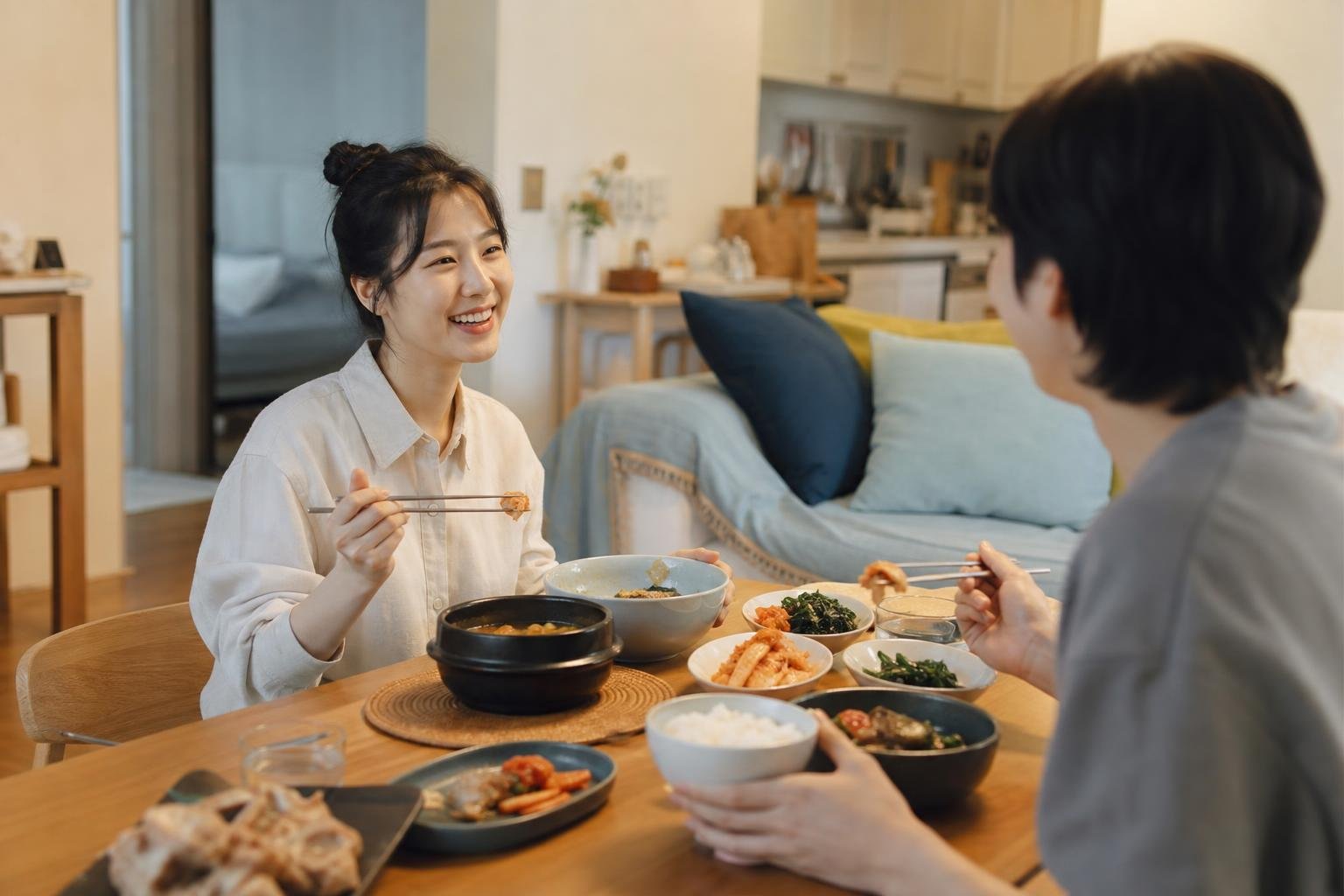
When Koreans ask whether you have eaten, they may be checking on your well-being, opening a conversation, or asking about your actual meal plans. The familiar question 밥 먹었어요? (bap meogeosseoyo?) literally means “Have you eaten?” but can carry the warmth of “How are you doing?” or “Are you taking care of yourself?”
It is not a direct substitute for “hello,” and it is not always figurative. Near lunchtime, the speaker may genuinely want to know whether you are free to eat. The relationship, setting, time of day, and next sentence usually reveal the intention.
밥 can mean rice or an entire meal
밥 (bap) first means cooked rice, but it also commonly means a meal. The National Institute of Korean Language lists both senses, as does its entry for 식사 (siksa, “meal”), which identifies 밥 as a synonym in this context. source
That is why 밥 먹자 (bap meokja, “Let’s eat”) does not guarantee that rice will be served. The speakers might have noodles, pizza, sandwiches, or fried chicken. Other everyday expressions work the same way:
- 밥을 먹다 — to eat a meal
- 밥을 거르다 — to skip a meal
- 밥을 사다 — to buy someone a meal
- 밥 먹으러 가다 — to go out to eat
A meal is also a concrete way to ask how someone is managing. Depending on the situation, “Did you eat?” may imply “Have you had time to look after yourself?” A Korean-language culture article published by the National Institute of Korean Language similarly describes the question as a situational greeting that can convey interest and concern. source

How a meal question expresses care
In some Korean families and close relationships, concern is often communicated through practical attention: offering food, packing something to take home, or reminding someone not to skip meals. This is a common pattern, not a rule about every Korean household. Some families ask constantly; others rarely do.
A phone conversation between a parent and an adult child might sound like this:
부모: 밥은 먹었어?
Babeun meogeosseo? — “Did you eat?”자녀: 응, 먹었어. 걱정하지 마.
Eung, meogeosseo. Geokjeonghaji ma. — “Yes, I did. Don’t worry.”
The topic particle 은 in 밥은 먹었어? can add contrast: “As for food, did you eat?” In the right context, it may sound like “Did you at least manage to eat?” That “at least” nuance comes from the situation rather than from 은 alone. A parent might use it after hearing that the child worked late, traveled all day, or had a difficult morning.
The expression is sometimes explained entirely through Korea’s past experiences of food scarcity, war, and poverty. That history can help modern listeners understand why food carries emotional weight, but it should not be presented as the phrase’s single proven origin. Meal-based greetings appear in other languages and societies as well, and everyday expressions rarely have one traceable starting point.
Is 밥 먹었어요? a greeting or a literal question?
It can be either. Sometimes it performs both functions: the speaker is being sociable but would also respond if you said you had not eaten.
It is probably a light greeting when:
- a friend opens a casual text conversation with it;
- someone asks after the normal lunch or dinner period;
- the question is delivered quickly while passing by;
- the conversation immediately moves to another subject; or
- the speaker does not ask what you ate or suggest getting food.
A brief reciprocal answer is enough:
A: 밥 먹었어요?
Bap meogeosseoyo? — “Have you eaten?”B: 네, 먹었어요. 팀장님은요?
Ne, meogeosseoyo. Timjangnimeunyo? — “Yes, I have. How about you?”
Here, 팀장님은요? is appropriate only if the listener is the speaker’s team leader. Korean commonly uses a person’s name, title, or role where English might use “you.” Learners should avoid using 그쪽은요? as a universal translation of “How about you?” because 그쪽 can sound distancing, confrontational, or otherwise unnatural in many ordinary relationships.
It is more likely to be literal when:
- it is close to breakfast, lunch, or dinner;
- you have arrived after a long trip;
- the speaker is cooking, ordering, or choosing a restaurant;
- you appear tired, ill, or extremely busy; or
- the speaker follows with “What did you eat?” or a concrete proposal.
At noon, a colleague who asks 점심 먹었어요? (jeomsim meogeosseoyo?, “Did you have lunch?”) may be checking whether you are available:
A: 점심 먹었어요?
“Did you have lunch?”B: 아직 안 먹었어요.
“I haven’t eaten yet.”A: 그럼 같이 먹을까요?
“Then shall we eat together?”
The first question by itself is not necessarily an invitation. The final line turns it into one. A time, restaurant, menu suggestion, or phrase such as 같이 먹을까요? makes the intention clearer. The ending -을까요? is commonly used to ask for the listener’s opinion or make a proposal. source
Choosing the right level of politeness
Korean speech level depends on the relationship, setting, familiarity, workplace roles, and the degree of respect the speaker wants to show. Age can influence those choices, but age alone does not determine them.
- 밥 먹었어? (bap meogeosseo?) is casual speech. Use it with close friends, family members, or someone with whom casual speech has been established.
- 밥 먹었어요? (bap meogeosseoyo?) uses the everyday polite -요 style. It works in many friendly or familiar interactions, although it does not honor the eater through the verb itself.
- 밥 드셨어요? (bap deusyeosseoyo?) respectfully asks whether the listener ate. 드시다 honors the person doing the eating.
- 식사하셨어요? (siksahasyeosseoyo?) is a polished, respectful version meaning “Have you had a meal?”
Polite and honorific are related but not identical. The -요 ending marks polite speech toward the listener, while 드시다 or the honorific marker -시- raises the person whose action is being discussed. This distinction is why 밥 드셨어요? may be preferable when speaking to a respected senior, client, teacher, or older relative.
A learner should not copy 밥 먹었어? from a drama and use it with everyone. Without an established casual relationship, the missing polite ending can sound abrupt. At the other extreme, highly respectful wording may feel stiff between close friends.
Natural ways to answer
Unless the speaker asks for details, keep the answer short. You can return the question by using the person’s name or title, or simply by repeating the verb.
- 네, 먹었어요. 민지 씨는요?
“Yes, I ate. How about you, Minji?” - 네, 먹었어요. 드셨어요?
“Yes, I ate. Have you?” — respectful toward the listener - 아직요. (ajigyo)
“Not yet.” - 아직 안 먹었어요.
“I haven’t eaten yet.” - 아직 못 먹었어요.
“I haven’t been able to eat yet.” - 방금 먹었어요. (banggeum meogeosseoyo)
“I just ate.” - 이제 먹으려고요. (ije meogeuryeogoyo)
“I’m about to eat.”
안 먹었어요 simply states that you did not eat. 못 먹었어요 often suggests that circumstances prevented it—you lacked time, felt ill, or could not get food. The Korean Basic Dictionary defines 못 constructions as indicating that an action could not be completed or performed. source That answer may therefore attract more concern than a neutral 아직요.
If you want to turn the exchange into an invitation, say 그럼 같이 먹을까요? (“Then shall we eat together?”). In a more respectful setting, 점심 안 드셨으면 같이 식사하러 갈까요? means “If you haven’t had lunch, shall we go eat together?” The latter closely follows an example given by the Korean Basic Dictionary. source
“Let’s eat sometime” may not be an appointment
A related expression is 다음에 밥 한번 먹어요 (daeume bap hanbeon meogeoyo), or “Let’s have a meal sometime.” It can express a sincere wish to meet again, but it does not establish a plan by itself.
In this use, 한번 need not mean exactly “one time.” It can refer loosely to an opportunity to do something, and the official dictionary includes examples such as meeting, visiting, or contacting someone “sometime.” source An Academy of Korean Studies culture lesson likewise presents “Let’s eat sometime” as a social expression often used when parting. source
Look for specifics. 다음 주 수요일에 점심 어때요? (“How about lunch next Wednesday?”) is a real proposal. 언제 밥 한번 먹어요 (“Let’s eat sometime”) without a date or follow-up may remain a friendly but indefinite gesture—much like “We should catch up” in English.
When visitors should use the expression
안녕하세요 remains the safer general greeting with strangers, customers, new acquaintances, or people in formal professional situations. Asking about a meal feels more natural when some familiarity exists, the time of day makes food relevant, or you genuinely want to check on the person.
Usage varies by family, generation, personality, region, and workplace. A person may use meal questions automatically with parents but rarely with colleagues. Another may ask friends every day. Avoid treating the phrase as something all Koreans say with the same frequency or intention.
When you hear 밥 먹었어요?, answer the surface question first: “Yes,” “Not yet,” or “I’m about to.” Then watch what follows. If the speaker changes the subject, it was probably a warm check-in. If they start naming restaurants, lunch was the real question all along.