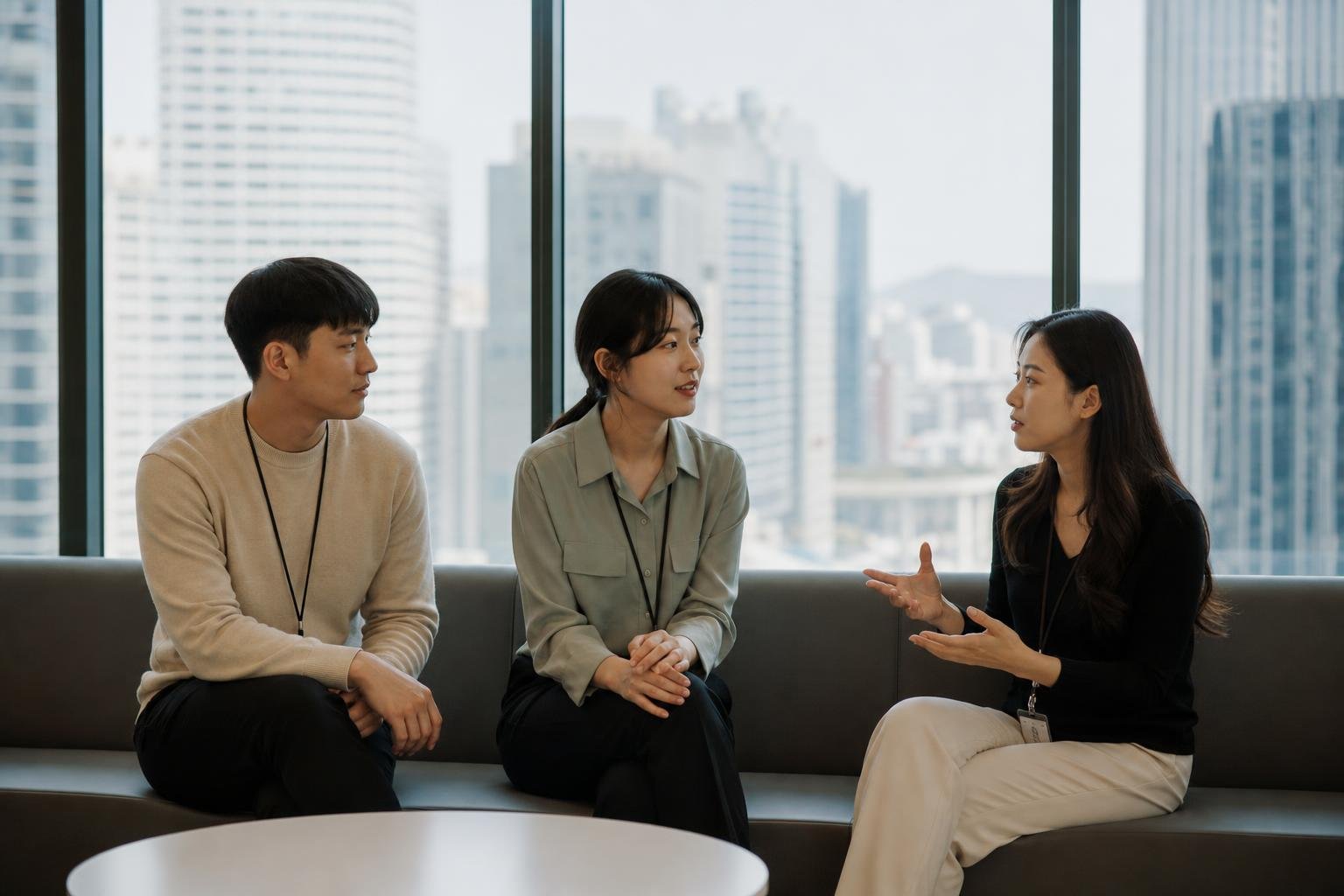
Nunchi (눈치, roughly noon-chee) means the ability to recognize another person’s feelings or understand a situation without being told directly. “Reading the room” is the closest everyday English equivalent, but nunchi also concerns timing and how you respond to what you notice. The National Institute of Korean Language defines it as understanding someone’s mind or a situation even when the other person has said nothing. source
Someone with good nunchi may notice that a joke is no longer welcome, that a host is ready to end an evening, or that a colleague has concerns but is reluctant to speak. Someone described as 눈치가 없다 (nunchiga eopda, “to have no nunchi”) keeps going after the mood has changed or misses a signal that others consider obvious.
Nunchi is sometimes marketed in English as a uniquely Korean secret or social superpower. That overstates the case: people in every culture interpret expressions, pauses, tone, and context. What stands out in Korean is the prominence of the word and the number of ordinary expressions used to evaluate how well someone notices social cues.
Nunchi combines perception with response
Nunchi is not simply intuition or empathy. In practice, it usually involves two related actions:
- Reading the situation: noticing facial expressions, silence, tone, timing, relationships, roles, and changes in the atmosphere.
- Choosing a response: deciding whether to speak, wait, soften a question, offer help, change the subject, or leave.
A person may realize that everyone is uncomfortable yet continue talking. They have detected the mood, but others may still criticize their nunchi because they did not adjust their behavior.
The popular translation “eye-measure” should not be treated as a literal breakdown of the modern word. The first element is related to nun (눈), “eye,” but official historical information traces modern nunchi to the seventeenth-century form 눈츼, probably formed from 눈 and an older suffix, -츼. The current form appears from the nineteenth century. source
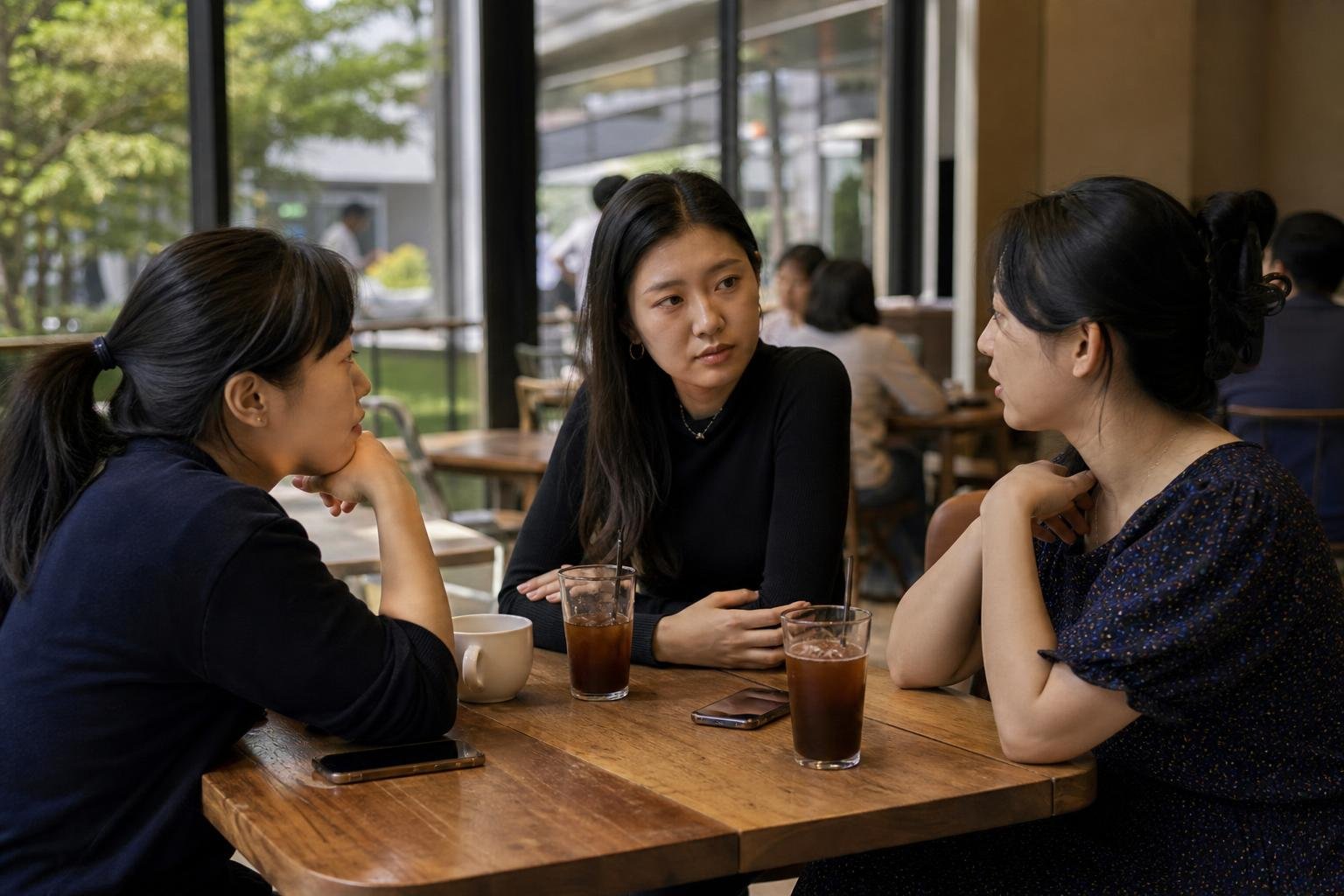
What good nunchi can look like
Good nunchi is often visible in small decisions rather than impressive displays of mind-reading.
Ending a group dinner
Several friends have finished eating. One person keeps checking the time, another has begun gathering belongings, and the conversation is fading. Nobody directly says that the evening should end. A friend might give the group an easy opening:
슬슬 일어날까요?
Seulseul ireonalkkayo?
“Shall we start getting ready to go?”
The speaker has combined several clues and acted without singling anyone out. This does not necessarily mean following the oldest person present. Relevant cues might come from the host, someone worried about the last train, a parent with a tired child, or the group as a whole.
Raising a concern at work
A team leader presents a plan, and the room becomes quiet. Two colleagues exchange doubtful looks. A junior employee may recognize that the silence reflects hesitation rather than agreement and say:
이 부분은 일정을 조금 더 확인해 보면 어떨까요?
I bubuneun iljeongeul jogeum deo hwaginhae bomyeon eotteolkkayo?
“What if we check the schedule a little more carefully for this part?”
The wording introduces a concern without bluntly rejecting the plan. In another workplace, however, a direct objection may be expected. Good nunchi means recognizing the norms of that particular team, not following one supposedly Korean script.
Age alone does not determine the appropriate response. Workplace authority, professional responsibility, familiarity, established speech patterns, and the formality of the occasion may all matter. A younger employee can outrank an older colleague, and people of the same age may use different speech levels depending on their relationship.
Common Korean expressions with nunchi
The differences among common nunchi expressions are important for learners:
- 눈치가 있다 (nunchiga itda): to have tact or social awareness.
- 눈치가 빠르다 (nunchiga ppareuda): to catch on quickly. Usually complimentary.
- 눈치가 없다 (nunchiga eopda): to be oblivious, tactless, or poor at reading cues.
- 눈치를 보다 (nunchireul boda): to watch or gauge someone’s mood and attitude before acting.
- 눈치가 보이다 (nunchiga boida): to feel conscious of another person’s possible reaction or judgment.
- 눈치채다 (nunchichaeda): to notice, realize, or catch on to a situation, feeling, intention, or secret.
These meanings and constructions are recorded separately in the National Institute of Korean Language’s learner dictionary. Nunchiga ppareuda describes quick understanding, while nunchireul boda means monitoring another person’s attitude. Nunchiga boida places the emphasis on feeling constrained or self-conscious because of someone else’s reaction. source
For example:
왜 말을 안 했어?
Wae mareul an haesseo?
“Why didn’t you say anything?”팀장님 눈치 보느라 말하기가 좀 그랬어.
Timjangnim nunchi boneura malhagiga jom geuraesseo.
“I felt awkward bringing it up because I was watching the team leader’s reaction.”
Here, nunchi is not elegant social intelligence. It describes caution produced by another person’s authority or anticipated disapproval.
Why the concept is useful in Korean interactions
The word becomes especially useful when communication depends on shared context. A refusal may be softened, disagreement may first appear as a pause, and an invitation or request may be phrased in a way that leaves room for the other person to decline. The listener has to consider the words alongside the relationship, setting, tone, and reason the subject was raised.
Korean also requires speakers to make frequent choices about speech style, honorifics, and forms of address. Nunchi can help a newcomer observe how people in a particular group address one another before choosing a tone. Again, age is only one possible clue; position, intimacy, setting, and the relationship already established between speakers are often just as important.
It would nevertheless be misleading to label Korean communication as uniformly indirect. Friends may be blunt, managers may give explicit instructions, and many teams prefer clear objections to carefully implied doubts. The socially perceptive response changes with the people and setting.
Nunchi can express care—or pressure
At its best, nunchi resembles practical empathy. It can help someone include a quiet participant, stop a joke before it becomes cruel, recognize that a guest is tired, or offer assistance without forcing another person to explain an embarrassing need.
Having nunchi does not always mean remaining silent or agreeable. The useful response may be to clarify an ambiguous instruction, defend someone who is being ignored, or say what others are avoiding. Research on nunchi has treated it as a multidimensional interpersonal mechanism rather than a single habit of obedience or restraint. source
Nunchi also has a stressful side. Constantly calculating how others may react can encourage self-censorship or make a person reluctant to express reasonable needs. Consider an employee who has finished the day’s work but hesitates to leave because the manager remains at the office. That may be described using nunchireul boda, but it should not automatically be romanticized as cultural sensitivity. It can also indicate unclear expectations or unequal power.
The demand for nunchi can become unfair when someone says, “You should have known,” instead of communicating clearly. New employees, visitors, children, and people who do not share a group’s unspoken conventions can be judged against signals they were never taught. Social awareness has value, but important instructions, boundaries, consent, and workplace expectations should not depend on guessing.
How to practise nunchi without trying to read minds
For newcomers to Korea, the goal is not to uncover every hidden thought. A more useful approach is to observe carefully and confirm your interpretation when the stakes matter.
- Notice whether the mood changes after a subject is raised.
- Watch how people in the same setting address one another rather than selecting speech levels from age alone.
- Pay attention to repeated hesitation or answers that avoid a firm commitment, but do not automatically treat them as refusals.
- Do not assume that silence means agreement.
- Ask a gentle clarifying question instead of presenting your interpretation as fact.
- If you miss a cue, accept the correction and move on. Nunchi is situational, not a measure of personal worth.
A useful phrase is 혹시 불편하시면 말씀해 주세요 (Hoksi bulpyeonhasimyeon malsseumhae juseyo): “Please let me know if this is uncomfortable or inconvenient.” It shows awareness while inviting the other person to communicate directly.
Nunchi helps explain why timing, atmosphere, and what remains unsaid can matter in Korean interactions. It should not become a stereotype applied to every pause or indirect answer. Sometimes a pause is only a pause, and sometimes people mean exactly what they say. The soundest approach is to notice the cues, remain open to being wrong, and ask clearly when guessing is not enough.