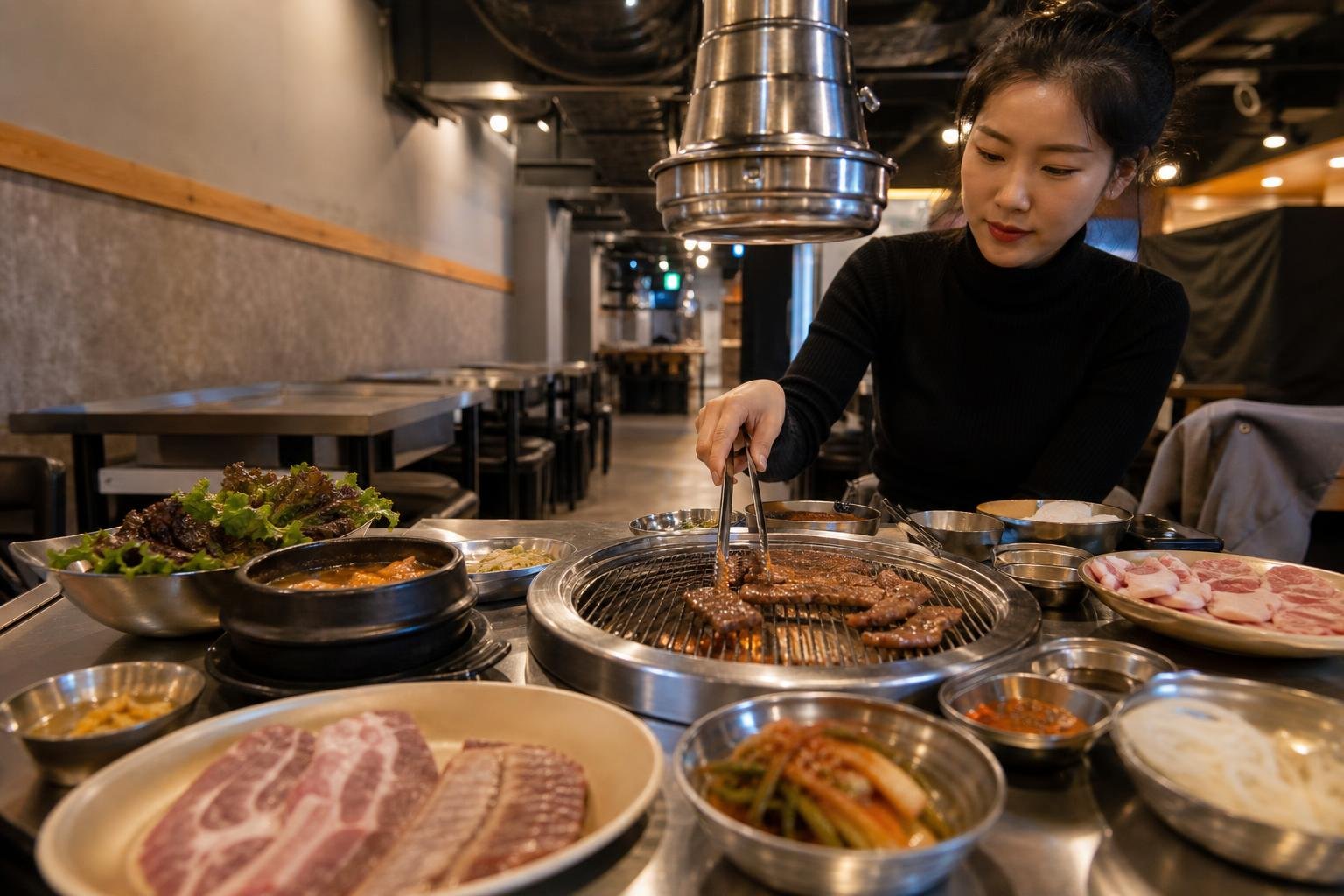
To order Korean barbecue for the first time, check the minimum order and gram weight, choose one or two cuts, and start with the smallest quantity the restaurant permits. For two people, that commonly means two portions of meat in total. You can then add another portion or finish with rice, stew, or noodles.
This guide focuses on tabletop barbecue restaurants in South Korea. Restaurants abroad may use different portion sizes, side-dish policies, service charges, and tipping customs.
Check the restaurant’s ordering system first
Korean barbecue restaurants do not all follow one format. The menu or signs should tell you whether you are ordering individual portions, a set, or an unlimited course.
- À la carte: Each cut has its own price and serving weight.
- Set menu: One price covers a selection of meats and sometimes dishes such as stew or rice. Check how many diners the set is designed for.
- All-you-can-eat: Look for 무한리필 (muhan ripil, unlimited refills). Read the restaurant’s rules for time limits, refill quantities, leftover charges, and whether everyone at the table must choose the same course.
- Butcher restaurant: At some jeongyuk sikdang (정육식당), you select packaged meat from a refrigerated case and pay a separate table-setting charge, or sangcharim (상차림), for the grill and accompaniments. source
Some restaurants cook the meat for you; others expect diners to manage the grill. Do not assume either system until you see what the staff do.
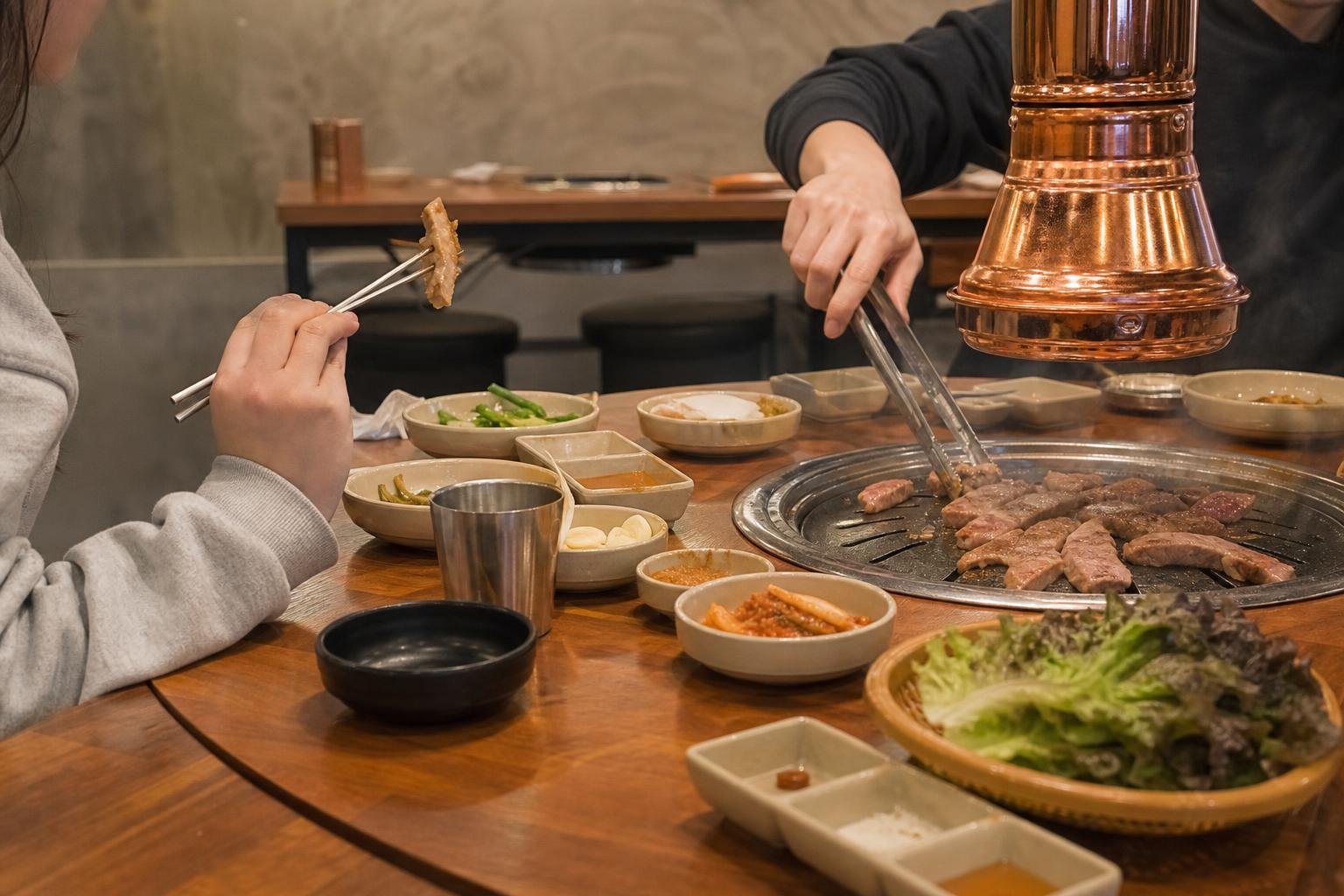
Read portions by weight, not by name alone
Meat is often ordered by 인분 (inbun), a unit based on a portion per person. However, 1인분 does not promise that one serving will be a complete meal for one diner. The National Institute of Korean Language gives examples such as ordering two portions of beef or five portions of pork belly, confirming that the term counts portions rather than entire meals. source
Look for the gram weight printed beside the price. One restaurant’s portion may be substantially larger than another’s, so the weight is more useful than the word inbun alone.
Also check the minimum. Phrases such as 첫 주문 2인분 이상 mean that the initial order must be at least two portions. The restaurant may allow you to combine cuts toward that minimum, but do not count on it—ask or point to the items you want.
삼겹살 2인분 주세요.
Samgyeopsal i-inbun juseyo.
“Two portions of pork belly, please.”
If you would rather point:
이거 2인분 주세요.
Igeo i-inbun juseyo.
“Two portions of this, please.”
For two adults, beginning with the minimum is usually more practical than filling the grill immediately. Meat is only part of the meal; wraps, side dishes, rice, and stew add up quickly.
Choose cuts that can cook well together
A first order does not need five different meats. Choose one cut you know you will enjoy, or pair two cuts with similar cooking needs.
- 삼겹살, samgyeopsal: Pork belly, with distinct layers of meat and fat. It is one of the most familiar choices at Korean meat restaurants. source
- 목살, moksal: Pork shoulder or collar. It is generally leaner and firmer than pork belly. source
- 돼지갈비, dwaeji galbi: Pork rib meat, frequently sold in a sweet-savory marinade. The cut, bone, and preparation vary, so rely on the menu description.
- 소갈비, sogalbi: Beef short ribs. These may be plain or marinated; marinated versions commonly contain soy sauce, sugar, and garlic. source
- 갈비살, galbisal: Boneless beef rib meat, served either salted or marinated. source
- 차돌박이, chadolbagi: Thin, fatty slices from the brisket area. They cook extremely quickly. source
Plain meat normally makes a better first batch than heavily marinated meat. Sugary sauces scorch easily and leave residue on the grill. If you order both, ask the staff which should be cooked first; they may change the grill plate between them.
An easy order for two
Try one portion of samgyeopsal and one of moksal if mixed initial orders are allowed. If not, order two portions of the cut you most want. Wait until you have eaten most of it before deciding whether to add more meat.
Pause before taking control of the grill
When the meat arrives, wait briefly. If an employee places it on the grill, arranges the pieces, or begins cutting them, let that employee continue. At staff-grilled restaurants, moving the meat yourself can interfere with the cooking sequence.
If diners are responsible, use the provided tongs for the meat and scissors for large pieces. Keep utensils used on raw meat away from cooked food and personal plates. Korean food-safety guidance recommends separating tools and containers used for raw and cooked foods and cooking meat thoroughly. source
If you are unsure whether a piece is ready, ask instead of guessing:
이거 먹어도 돼요?
Igeo meogeodo dwaeyo?
“Is this ready to eat?”
If marinade, fat, or burned residue has made the grill plate difficult to use, call an employee:
불판 좀 갈아 주세요.
Bulpan jom gara juseyo.
“Please change the grill plate.”
Know what is included—and what is not
The shared side dishes are 반찬 (banchan). A barbecue table may include kimchi, seasoned scallions, pickled radish, onions, garlic, chilies, and leaves for wrapping, but there is no required lineup.
At ordinary restaurants in South Korea, water and standard side-dish refills are generally provided without an additional charge. Many places direct customers to a self-service station. That does not mean every item on the table is unlimited: steamed egg, cheese, rice, stew, premium vegetables, or specially ordered sides may have separate prices. Check the menu before assuming. source
반찬 좀 더 주세요.
Banchan jom deo juseyo.
“Could we have some more side dishes?”
Steamed rice is often ordered separately at meat restaurants. Look for 공깃밥 (gonggitbap), meaning a bowl of rice.
If you have allergies or dietary restrictions, do not judge only by appearance. Marinades, dipping sauces, kimchi, and seasoned vegetables may contain soy, wheat, sesame, seafood products, or other ingredients, while grill and utensil sharing creates cross-contact risks. Ask the restaurant directly before ordering.
Build a wrap—or skip it
A leaf wrap is called 쌈 (ssam). Place a lettuce or perilla leaf in your hand, add one piece of cooked meat, and use a small amount of 쌈장 (ssamjang), a thick sauce commonly made with fermented soybean and red-pepper pastes. Garlic, scallion salad, kimchi, and rice are optional additions. source
Fold the leaf into a compact parcel and eat it in one bite if comfortable. More importantly, do not make the wrap so large that it falls apart. You are also free to eat the meat plain, with salt, or with the restaurant’s dipping sauce.
Finish with stew, rice, or noodles
Do not order the entire meal at once unless the restaurant requires it. After the meat, common choices include:
- 된장찌개, doenjang jjigae: Soybean paste stew.
- 김치찌개, kimchi jjigae: Kimchi stew.
- 물냉면, mul naengmyeon: Cold noodles served in chilled broth.
- 비빔냉면, bibim naengmyeon: Cold noodles mixed with a spicy sauce.
- 볶음밥, bokkeumbap: Fried rice, when offered.
Stew, rice, noodles, and fried rice are established accompaniments or finishing dishes at many Korean barbecue restaurants, but availability depends on the house. Fried rice is especially associated with meals cooked on a broad pan and is not guaranteed at a charcoal-grill restaurant. source
Call staff and pay without guesswork
Many restaurant tables have a call button, often marked with a bell or 호출 (“call”). Pressing it is normal. If there is no button, 여기요 (yeogiyo) or 저기요 (jeogiyo) is a neutral way to get an employee’s attention; the National Institute of Korean Language identifies both as widely used ways to address service staff. source
Payment may happen at the table, at a kiosk, or at the front counter, so follow the bill slip or staff’s direction. Credit cards are accepted at most restaurants and shops in South Korea, although a backup payment method is useful if a foreign-issued card fails. source
Tipping is not required or expected in South Korea. If you are dining in another country, follow that country’s tax, service-charge, and tipping practices instead. source
A manageable first meal is two portions of compatible meat, followed by one additional dish if needed. Read the gram weight, let the restaurant establish who handles the grill, and add food gradually. That is enough to order confidently without pretending every Korean barbecue restaurant runs the same way.