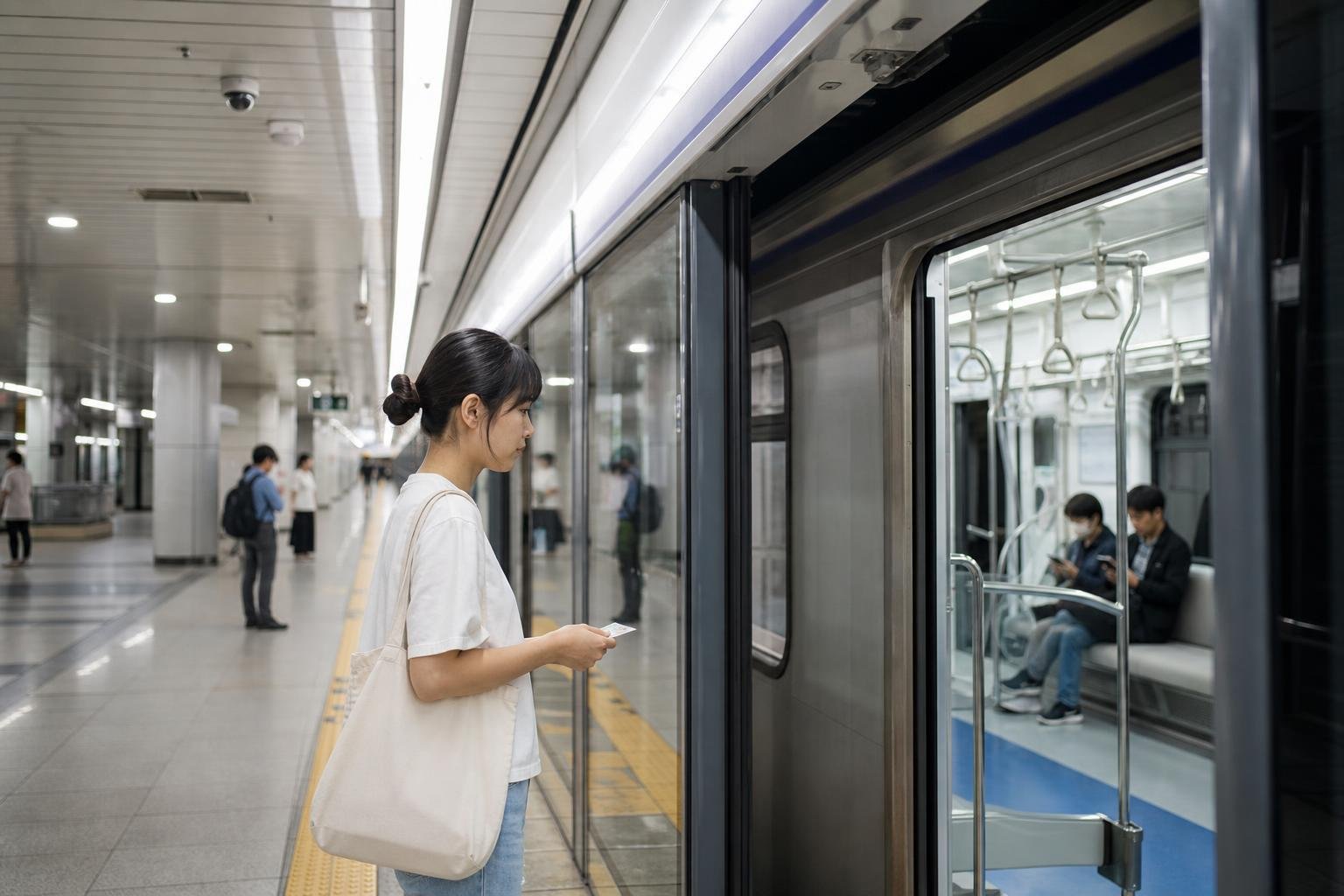
To use the subway in South Korea, buy a rechargeable transportation card, load it with Korean won, and tap it at both the entrance and exit gates. Plan your route with NAVER Map or KakaoMap, check the train’s destination as well as its line, and use the same card when transferring between subways and buses.
South Korea does not have one national subway fare system. Seoul’s metropolitan network—including services extending into Incheon and Gyeonggi Province—and the urban rail systems in Busan, Daegu, Daejeon, and Gwangju set their own fares and transfer conditions. A standard Tmoney card, however, works on participating buses and subways nationwide, so most travelers do not need a different card in each city. source
Get a transportation card before your first ride
For most visitors learning how to use the subway in South Korea, a physical Tmoney card is the simplest option. Other compatible prepaid cards, including Cashbee and Rail+, are also accepted on many networks.
Tmoney cards are sold at major convenience-store chains and some station facilities. The card’s purchase price is separate from the balance you add, and a standard physical card can be used without creating an account or supplying a Korean phone number. Each passenger needs a separate card because subway gates record one person’s entry and exit. source
At a convenience store, you can say:
티머니 카드 주세요. 삼만 원 충전해 주세요.
Tmoney kadeu juseyo. Samman won chungjeonhae juseyo.
“A Tmoney card, please. Please load 30,000 won.”
Cash is still the most reliable way to recharge a standard prepaid card at convenience stores and many subway machines. Do not assume that a foreign-issued bank card will work for an ordinary Tmoney top-up. Seoul introduced machines that accept international cards for single-journey tickets and short-term Climate Card passes in March 2026, but that does not mean every machine or prepaid-card product accepts them. source
Current subway fares in Seoul and Busan
Fares below are current as of September 2026. Other cities charge different amounts, and premium or separately operated lines may add their own fare.
Seoul metropolitan subway
The adult base fare is ₩1,550 with a transportation card or ₩1,650 with a single-journey ticket. The base distance is 10 kilometers; additional distance charges are calculated automatically when you tap out. The card fare for the first ride before 6:30 a.m. receives a 20% early-morning discount. source
Youth and child discounts require the correct passenger category to be registered or an appropriate discounted ticket to be issued. Visitors should not assume that an unregistered general card will automatically charge a lower fare based on the holder’s age.
Seoul’s short-term Climate Card passes can be useful for concentrated sightseeing. One-, two-, three-, five-, and seven-day options remain available, but coverage is not the same as the entire metropolitan subway map. The Sinbundang Line, airport and intercity buses, non-Seoul buses, and many stations outside the designated service area are excluded. Check both your boarding and destination stations before buying a pass. source
Busan urban rail
Busan divides journeys into two fare sections. An adult ride costs ₩1,600 for Section 1 or ₩1,800 for Section 2 with a transportation card. A single-use QR ticket costs ₩1,700 or ₩1,900 respectively. Busan also sells one-day and three-day unlimited mobile tickets for its urban rail system. source
Do not treat a Busan urban rail pass as a general regional transit pass. Buses, the Donghae Line, and the Busan–Gimhae Light Rail are separate services, even though eligible transportation cards can provide integrated transfer discounts between them.
Plan the route before entering the gate
NAVER Map and KakaoMap provide public-transport directions in Korea. NAVER Map offers Korean, English, Chinese, and Japanese interfaces, along with subway routes, arrival information, and boarding guidance. KakaoMap also provides public-transit routing and shows subway and bus information. source
Before entering, note four details in your app:
- the subway line and its color or number;
- the direction or terminal shown for the train;
- the station where you transfer;
- the recommended exit number at your destination.
The line number alone may not be enough. Seoul-area lines can branch, and trains using the same platform may terminate at different stations. This is especially important on Line 1 and other long metropolitan routes. Express trains also skip selected stations, so confirm that your destination appears on the express stopping pattern.
Enter, ride, transfer, and exit
- Find the appropriate entrance. Station entrances are numbered, and entrances at a large station may be several blocks apart.
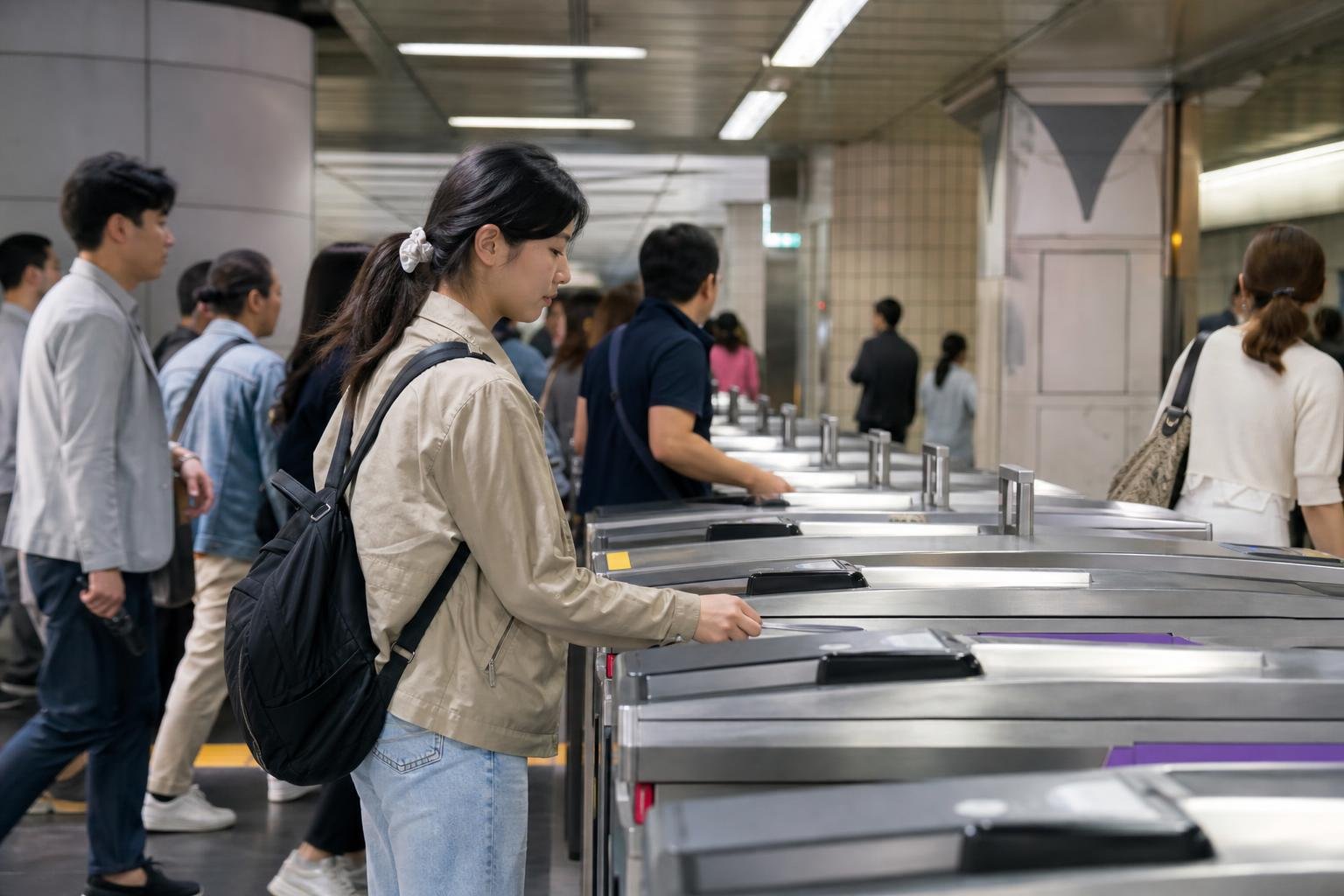
- Tap in. Hold your card flat against the reader until the gate confirms the transaction. If the display shows 잔액 부족 (janaek bujok), your balance is too low.
- Check the platform direction. Signs normally identify the next station, a major station farther along the route, the terminal, or a combination of these. Korean systems do not consistently use labels such as “northbound.”
- Board the correct train. Check the destination displayed on the platform screen or train, particularly on branched lines.
- Follow internal transfer signs. At a transfer station, look for 환승 (hwanseung, transfer), followed by the next line’s number and color.
- Tap out. Use the same card at the final exit gate. Any distance charge is deducted at this point.
Most subway-to-subway transfers take place inside the paid area, so you do not tap out between lines. Some interchanges are long enough to feel like a separate walk, but following the transfer signs keeps the journey open.
If you need help, show the destination in Hangul to station staff or ask:
강남역 가는 쪽이 어디예요?
Gangnam-yeok ganeun jjogi eodiyeyo?
“Which way is it for Gangnam Station?”
How bus and subway transfer discounts work
A subway-to-bus transfer is different from changing subway lines internally. You must tap out of the subway, tap on when boarding the bus, and tap again when leaving the bus. The same principle applies when transferring from a bus to the subway.
In the Seoul metropolitan integrated system, you must normally board the next service within 30 minutes after tapping off. The window is extended to 60 minutes from 9 p.m. to 7 a.m. Up to four transfers are permitted, for a maximum of five linked boardings. The system uses the highest applicable base fare and adds distance or service charges where required, so a “free transfer” does not guarantee that no additional amount will be deducted. source
Busan generally allows up to two transfers within 30 minutes, provided the passenger changes to an eligible different mode or route. Its integrated network includes Busan urban rail, eligible buses, the Busan–Gimhae Light Rail, and the Donghae Line, although some regional combinations have additional restrictions. source
The dependable habit in any city is to use one card throughout the linked journey and tap whenever you board or leave a bus or pass through a subway gate. An unrelated stop or a return to the same bus route may break transfer eligibility.
Using a single-journey ticket
A single-journey ticket makes sense if you are taking only one subway ride or do not have enough cash to recharge a standard card.
In Seoul, select your destination at a multilingual ticket machine. The machine charges the single-ride fare plus a refundable ₩500 deposit. After leaving the subway at your destination, insert the card into a deposit-refund machine to recover the ₩500. A Seoul single-journey card does not provide the integrated discount for an onward bus transfer. source
Busan uses scannable single-use QR tickets instead of Seoul-style deposit cards. Ticket instructions from one city should therefore not be assumed to apply in another.
What to do when something goes wrong
- You entered toward the wrong platform: First look for an internal passage to the opposite side. If none is available, speak to station staff rather than repeatedly tapping at the gates. Seoul has a 15-minute re-entry policy on participating subway services, but conditions and operator coverage matter. source
- You missed your stop: Leave the train at the next station and follow signs to the opposite platform. You usually do not need to exit the paid area.
- The exit gate rejects your card: Use the staffed service gate or fare-adjustment machine. Common causes include insufficient balance or an entry record that was not properly completed.
- You cannot find your destination: Recheck the exit number. At Seoul Station, Gangnam, Express Bus Terminal, or Hongik University, the wrong exit can add a substantial walk or place you across a wide road.
- You are traveling from Incheon Airport: Distinguish between the AREX All-Stop Train and the non-stop Express Train to Seoul Station. The All-Stop service functions as part of the metropolitan rail network, while the Express Train has separate seating and ticketing arrangements. source
Use exits as part of the address
Station signs commonly display Korean and English, and many also include Chinese and Japanese. Station numbers help when names look or sound similar. Save the destination’s Hangul name, station number, and exit number on your phone rather than relying only on an English place name.
For late trips, check the final train for your exact station, direction, and transfer. Last-train times are not uniform across a line, and the last departure from one station may arrive too late for a connecting service.
On the platform, stand clear of the doors until passengers have left the train. Priority areas are marked for passengers who are older, pregnant, disabled, injured, or traveling with infants. Travelers with luggage or limited mobility should check elevator locations because the accessible route may lead to a less convenient exit.
Once you consistently check the train destination, follow 환승 signs, tap at every required point, and treat the exit number as part of your destination, South Korea’s subway networks become much easier to navigate.