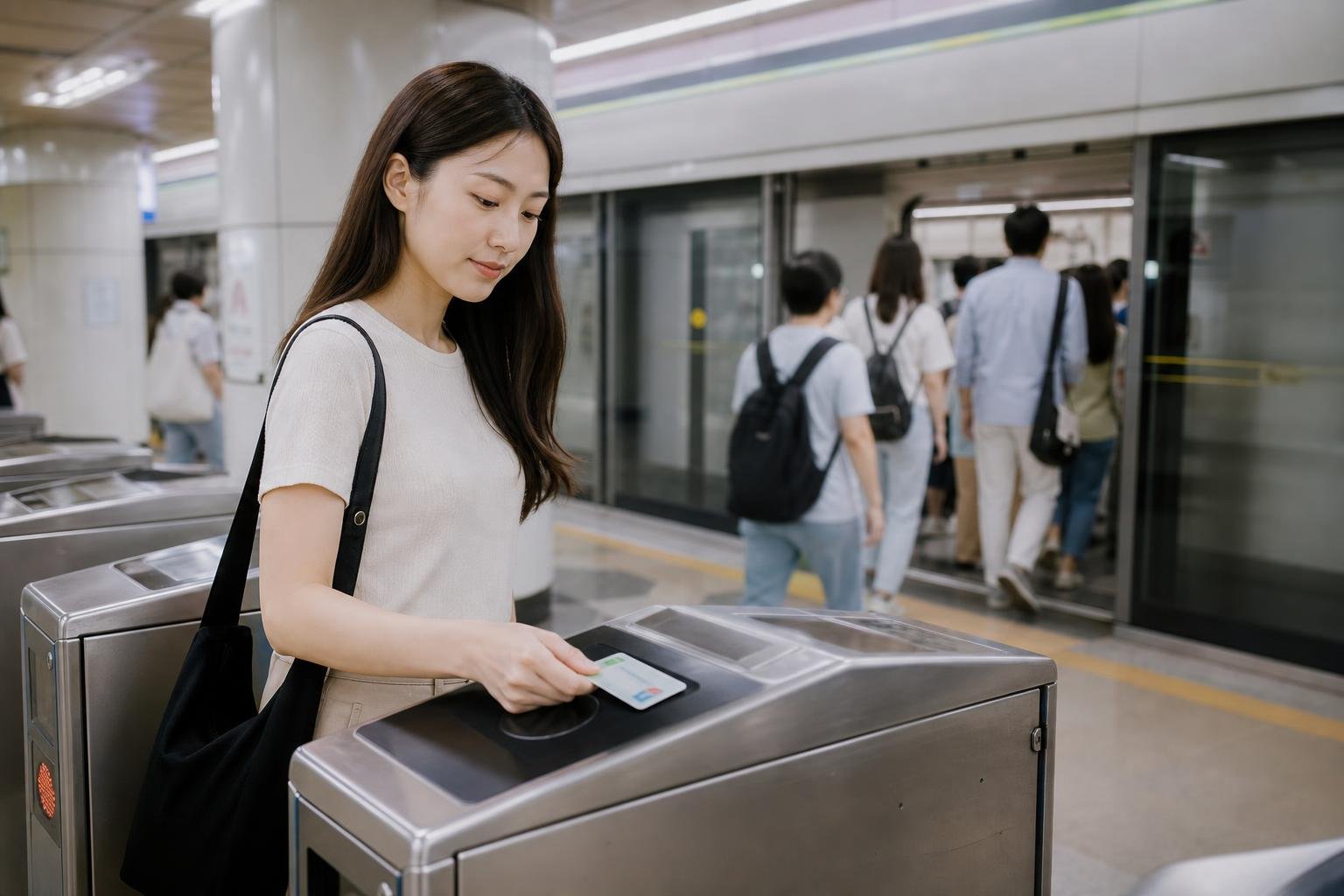
A T-money card (티머니 카드) is a reloadable prepaid card used on buses and subways across South Korea, in taxis with compatible readers, and at participating merchants. For most visitors, learning how to use a T-money card in Korea comes down to three steps: load Korean won, tap when entering, and tap again when leaving buses or passing through subway exit gates.
A standard T-money card is not an unlimited travel pass, a credit card, or a universal ticket for every train and coach. Each eligible fare or purchase is deducted from the balance you loaded in advance. No app, account, or identity registration is required for ordinary use of a standard physical card. source
Buying and loading a physical T-money card
- Buy the card. Look in major convenience-store chains such as CU, GS25, 7-Eleven, and Emart24, or at a subway-station card machine or service point. A basic card commonly costs around ₩3,000, although character cards, accessories, and special designs may cost more. The purchase price does not include transport credit.
- Add a balance. Hand the card to a convenience-store cashier and state the amount, or use a station reload machine. Many station machines offer English, Chinese, and Japanese instructions.
- Carry Korean-won cash. Do not assume a foreign credit or debit card can reload a standard physical T-money card. Cash remains the most dependable option at convenience stores and many subway machines, even though separate products—including some mobile and pass-based cards—have different payment options. source
A useful phrase at the counter is “티머니 충전해 주세요. 만 원이요.” (Timeoni chungjeonhae juseyo. Man won-iyo.): “Please top up my T-money. Ten thousand won.” You can also show the amount on your phone or hand the cashier the cash with the card.
Load a moderate amount first rather than estimating your entire trip. The reader normally displays the fare deducted and remaining balance after a tap, and you can also request a balance check at participating convenience stores or use station facilities. source
On city buses, tap when boarding and alighting
Board an ordinary city bus through the front door and tap the reader near the driver. Before your stop, press the stop bell; then tap the reader near the exit as you leave. On Seoul buses, the exit tap records the end of the ride, supports distance calculations, and preserves eligibility for an integrated transfer fare.
If you forget to tap off, you can lose the transfer benefit and may incur an additional charge during a later journey. Although procedures differ among regions and services, tapping both on and off is the safest routine on local buses throughout your trip. source
Seoul buses can process several passengers on one card if you tell the driver the number of people before tapping. Multi-passenger transfers are tightly restricted: the same group must continue together, the number of passengers must be stated again, and the arrangement does not transfer into the subway. Each traveller should therefore carry a separate card if the itinerary includes rail or if the group may split up. source
Example: Two friends can ask a Seoul bus driver to charge two fares to one card for a simple bus ride. If they later enter the subway, however, they need separate cards because each person must pass through a gate individually.
On subways and urban rail, tap at both gates
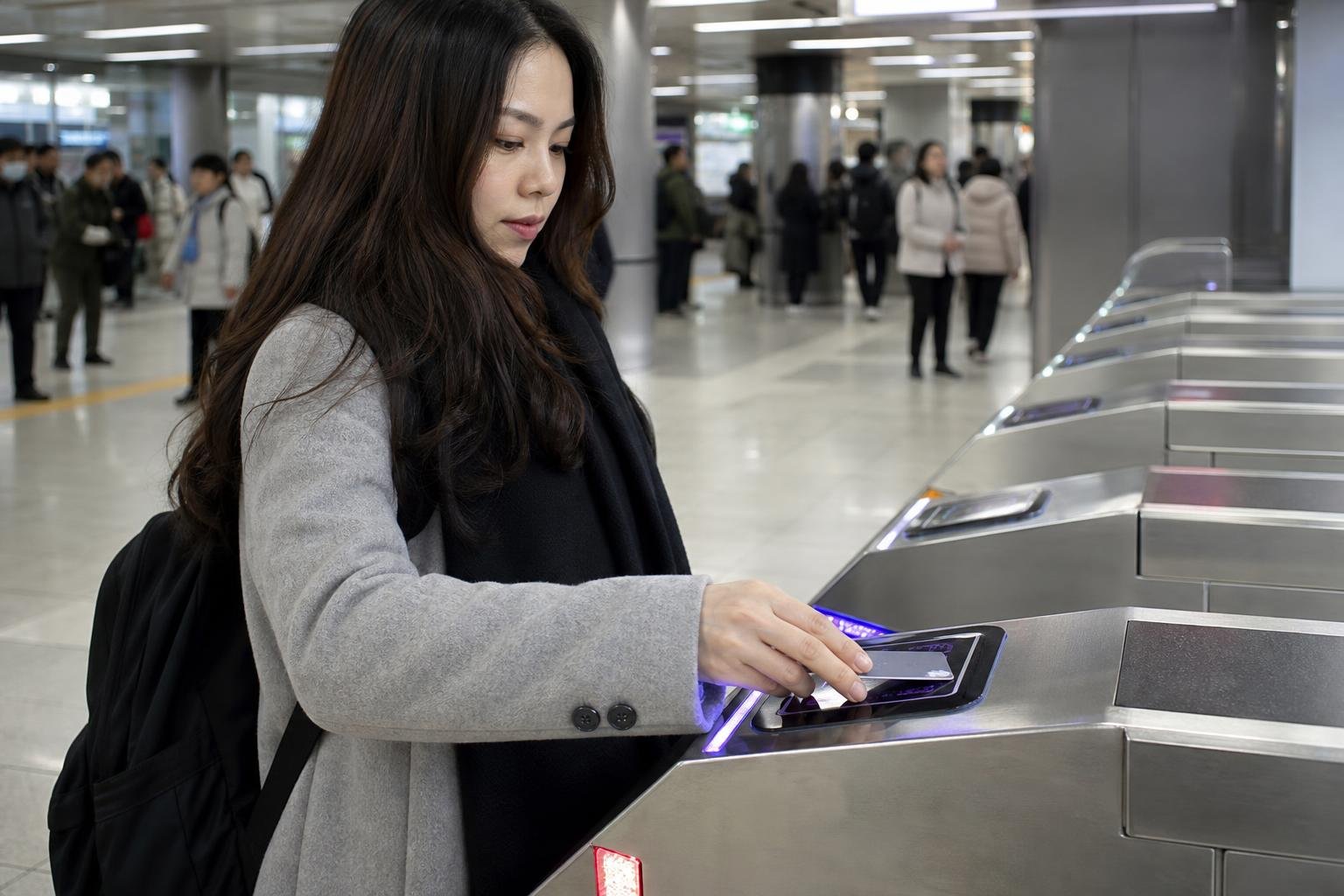
Tap the card at the entry gate, walk through, and use the same card at the exit gate at your destination. The system uses those records to calculate the fare, including any distance charge or qualifying connection to a bus.
Do not pass the card back across a gate for another person. A single card cannot admit a group to the subway, and repeated or incorrect taps can produce a gate error. If the gate does not open, try the nearby fare-adjustment machine or ask staff at the customer service office instead of repeatedly tapping.
T-money works on the Airport Railroad’s regular All-Stop Train, which functions as part of the metropolitan rail network. The separate AREX Express Train runs between Seoul Station and Incheon Airport with assigned seating and its own ticketing system. Buy an Express Train ticket rather than expecting to enter by making a normal T-money transit tap. source
The same distinction applies to KTX and SRT high-speed services: having T-money does not give you a seat or replace the required train ticket. Long-distance rail should be booked or ticketed separately.
How transfer fares work in Seoul
In the Seoul metropolitan area, eligible bus and rail rides can be treated as one connected journey instead of separate trips. The fare is based partly on the modes used and total distance, so “free transfer” is an oversimplification: the next tap may show no new base fare while a distance supplement can still be charged later.
Under Seoul’s current rules, the next eligible service must generally be boarded within 30 minutes of tapping out. The window increases to 60 minutes when the next boarding occurs between 9 p.m. and 7 a.m. Transfers are allowed up to four times, for a maximum of five linked boardings, but returning to the same bus route or vehicle does not qualify. source
These details are specific to the capital-region fare system. Other cities operate their own fares, transfer windows, and route exclusions. Wherever you travel, complete every required exit tap and check local rules if your journey involves airport buses, rural routes, or unusual services.
Using T-money outside Seoul
A card bought in Seoul can be used on participating public transport elsewhere in the country. T-money officially describes its standard card as supporting buses and subways nationwide, and Busan’s transport information specifically lists T-money as compatible with the city’s buses, urban rail, Donghae Line, and light rail. It is therefore useful for itineraries that continue to cities such as Busan, Daegu, Daejeon, or Gwangju, as well as bus travel on Jeju. source
Nationwide compatibility does not mean every form of transportation accepts an unattended tap. Express buses, intercity coaches, airport buses, and trains may involve reservations, assigned seats, operator-specific ticketing, or priority for passengers holding advance tickets. Check the operator’s instructions before a long-distance journey.
Paying in taxis and shops
Many taxis accept prepaid transportation cards through the passenger payment terminal. Confirm that a compatible reader is present before relying on T-money as your only payment method. At the end of the ride, you can say “티머니로 결제할게요” (Timeoni-ro gyeoljehalgeyo), meaning “I’ll pay by T-money,” and follow the driver’s direction to tap.
T-money is also accepted at participating convenience stores, cafés, bakeries, vending machines, and other retail locations. Major convenience-store chains are the most dependable non-transport example, but acceptance can differ by branch, terminal, or checkout type. Look for the T-money logo or ask the cashier before purchasing. source
Using up a small balance: If you have ₩4,200 left on departure day, use it toward snacks or drinks at a participating convenience store. Ask the cashier whether you can pay any difference separately before completing the transaction.
Refunding the balance
Remaining credit can be refunded at designated convenience stores, subway information centers, and other T-money service locations. The physical card’s purchase price is not part of the refundable balance, and a service fee may be deducted. Limits vary by outlet and chain; recent Seoul visitor guidance, for example, lists different maximum refundable balances for CU, Emart24, 7-Eleven, GS25, and subway information centers. source
For most short-term visitors, spending down a small balance is easier than finding the correct refund location. If the balance is substantial, consult the current T-money refund guide before travelling to a service center, since accepted card types, limits, and procedures can change.
A standard physical card can be used anonymously. If you choose not to register or link it to an eligible service, do not assume that a lost card or its stored balance can be recovered. Keep it as carefully as you would cash.
T-money or a short-term Seoul pass?
Standard T-money is the flexible choice if you will travel outside Seoul, use several transport operators, or follow an uncertain schedule. It charges per journey but works far beyond the capital and can double as a small-value payment card.
Visitors staying in Seoul and taking many eligible rides can compare it with the Climate Card short-term passes, available for 1, 2, 3, 5, or 7 days within a defined service area. Those tourist passes continue to operate even though the old prepaid 30-day Climate Card stopped accepting reloads after August 31, 2026, and Seoul launched the resident-focused Climate Pass on September 1, 2026. The short-term product excludes services including the Sinbundang Line, airport buses, and transport outside its approved area, so it is not a direct nationwide replacement for T-money. source
For a first trip covering more than central Seoul, the low-friction option remains a standard physical T-money card: buy one per person, load a modest cash balance, tap at every entrance and exit, and use any small remainder at a participating shop before leaving Korea.