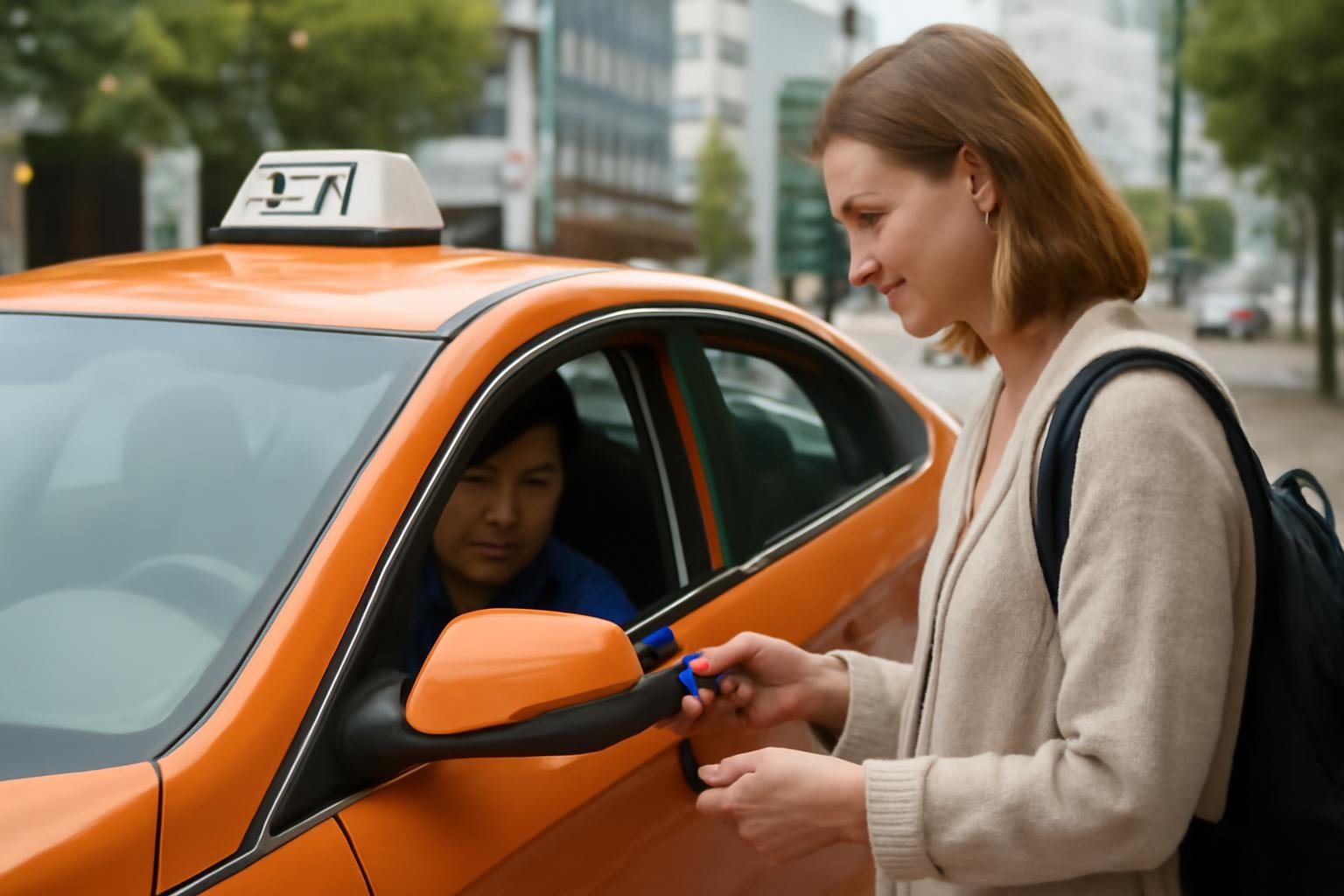
Most taxis in Seoul and other major Korean cities accept foreign-issued cards. At the end of a metered ride, ask the driver to charge your Visa, Mastercard, American Express, UnionPay, or JCB card through the taxi’s payment terminal. You can also pay with Korean won or, when supported, a transportation card such as T-money.
The most reliable setup is to carry one physical foreign card, keep some Korean won available, and check whether an app ride will be charged automatically or paid directly to the driver. Card acceptance is widespread, but a particular terminal, bank security block, weak connection, or regional taxi may still make a backup necessary.
Paying a taxi driver directly by foreign card
- Show the destination before departure. Use a Korean address, hotel name, map pin, or nearby subway station. A written Korean destination is often clearer than an English pronunciation.
- Let the meter run. Ordinary city taxis generally calculate the fare by meter. Airport or pre-booked services may instead use a fixed, zone-based, or app-displayed fare.
- Ask for card payment at the destination. Say 카드로 할게요 (kadeuro halgeyo, “I’ll pay by card”) or 해외 카드 돼요? (haeoe kadeu dwaeyo?, “Do you accept foreign cards?”).
- Check the amount on the terminal. If the machine offers a currency choice, select Korean won (KRW) rather than a conversion into your home currency when possible.
- Use chip insertion if contactless payment fails. Some foreign cards work more consistently when inserted and confirmed with a PIN.
- Take the receipt before leaving. Confirm that the transaction succeeded and that you have not paid through an app already.
Seoul’s official visitor guidance says taxi fares can be paid in cash, by credit card, or with a public transportation card. Seoul taxis are equipped with payment terminals, but this does not guarantee that every overseas card will succeed in every vehicle. ([english.seoul.go.kr](https://english.seoul.go.kr/service/movement/public-transportation/taxi/?utm_source=openai))
Which payment method should you use?
Physical foreign card
A physical card is usually the best primary option because it does not depend on a Korean phone number, app account, or mobile-data connection. Before traveling, enable overseas transactions, check your bank’s fraud controls, and make sure you know the card’s PIN. Carry a second card from a different network if possible.
Debit cards may work, but credit cards are often a safer travel choice because a taxi terminal may process the transaction in a way your bank treats differently from a normal online purchase. If your bank declines the charge, open its app or contact the issuer before trying repeatedly.
Taxi apps
Kakao T remains one of Korea’s major taxi platforms. If you can use the app but cannot register your foreign card for automatic payment, select Pay to the driver when that option appears. You can then pay the driver with your card, cash, or a supported transportation card.
k.ride is designed for international users and allows travelers to register an overseas card without relying on a KakaoTalk account. It supports multiple languages and sends pickup and destination details through the app. Before confirming a ride, read the payment label carefully: some trips are charged automatically, while others are settled inside the taxi. ([english.visitkorea.or.kr](https://english.visitkorea.or.kr/svc/contents/infoBscView.do?vcontsId=197907&utm_source=openai))
Do not pay twice. If the app shows that the fare has already been charged, show the completed-trip screen if necessary and do not hand over a second card or cash payment. If the app says “Pay to the driver,” the ride is not settled until you pay in the vehicle.
T-money and other transportation cards
Some taxis accept T-money or another transportation card, but the vehicle must support that payment method and the balance must cover the full fare. A standard physical T-money card is generally topped up with Korean won, so it is not a dependable replacement for a foreign card on a long or unexpected taxi trip. Keep a bank card available even if you normally use T-money on buses and subways.
What to do when your foreign card is declined
A declined payment does not automatically mean the driver is refusing foreign cards. The problem may be the terminal, contactless function, card network, overseas setting, or a temporary communications failure. Use this order:
- Ask the driver to try again. Try inserting the card instead of tapping it.
- Try a second card. A Visa or Mastercard may work when another network does not, or vice versa.
- Check your banking app. Approve a fraud alert or enable international transactions if your bank requests it.
- Use T-money if the balance is high enough and the taxi terminal supports it.
- Pay in Korean won. Cash is the most practical final fallback, particularly outside large cities.
You can say 잠시만요, 다른 카드로 해볼게요 (jamsimanyo, dareun kadeuro haebolgeyo, “One moment, I’ll try another card”). If you have no working payment method, explain the problem immediately rather than leaving the taxi. The driver may help you locate an ATM or contact the app or payment provider, but you remain responsible for settling the fare.
Card and transportation-card use is generally easiest in Seoul and other large urban areas. In smaller towns, rural districts, islands, or during a network outage, cash may be requested or may simply be the only method that works. Do not assume that an app’s national coverage means every local vehicle has identical payment equipment.
Airport taxis: confirm the fare and payment before moving
At Incheon International Airport, use the official taxi stands and avoid unsolicited offers inside the terminal. The airport specifically warns travelers about illegal solicitation and overcharging by people posing as taxi or call-van operators. Standard, deluxe, jumbo, international, and pre-booked taxi services may use different fare structures and pickup points. ([airport.kr](https://airport.kr/ap_en/1515/subview.do?utm_source=openai))
Before the vehicle leaves, confirm:
- whether the fare is metered, fixed, or zone-based;
- whether tolls or late-night and boundary surcharges are extra;
- that the driver accepts your foreign card;
- where the payment will occur if you booked through an app.
Seoul’s international taxi service offers multilingual support and may use a meter or an approved flat-rate arrangement. Incheon Airport also lists official international taxi and smart-taxi services for foreign passengers. These services can be useful when communication matters more than finding the lowest possible fare, but confirm the quoted amount and payment method before departure. ([english.seoul.go.kr](https://english.seoul.go.kr/service/movement/public-transportation/taxi/?utm_source=openai))
Receipts, fare checks, and what to confirm before leaving
Ask for a receipt with 영수증 주세요 (yeongsujeung juseyo). Keep it until you have checked your card notification and confirmed that you have all your belongings. A receipt can help identify the vehicle if you lose something or need to question the fare.
Before opening the door, verify three things:
- The payment status: approved, not merely attempted;
- The amount: including any clearly explained toll or surcharge;
- Your belongings: phone, passport, wallet, and luggage.
Keep the taxi’s license plate or app trip record if anything seems wrong. Seoul provides multilingual complaint channels and has introduced QR-based reporting for foreign passengers, so documenting the vehicle and time is more useful than relying on memory alone. ([english.seoul.go.kr](https://english.seoul.go.kr/seoul-cracks-down-on-taxi-overcharging-of-foreigners-with-english-receipts-and-other-service-improvements/?utm_source=openai))
For most international visitors, the simplest plan is: pay the driver directly with a physical foreign card, choose KRW at the terminal, carry backup cash, and use k.ride or Kakao T with Pay to the driver when you want app-based pickup without committing to automatic payment. Always confirm whether the ride is already paid before you leave the taxi.