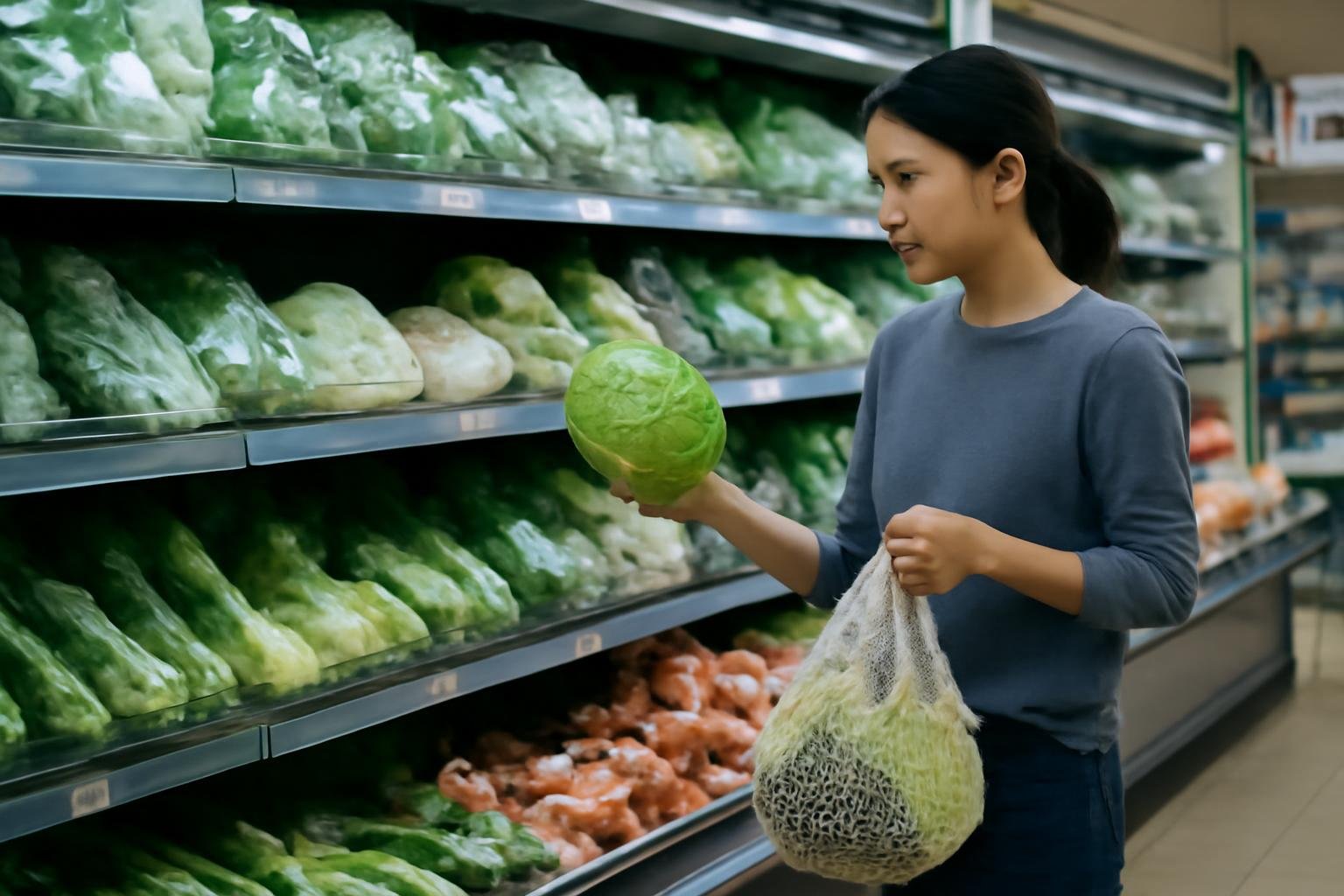
To buy loose produce in a Korean supermarket, first check whether that branch weighs fruit and vegetables in the produce section or at the checkout. Then confirm whether the item is priced by weight, by piece, or as a fixed package. You can carry sturdy produce loose in your cart, use a reusable mesh bag, or accept a store bag when food is wet or difficult to contain.
There is no single nationwide supermarket workflow. One store may ask you to weigh tomatoes and attach a printed label before reaching the register; another may have the cashier identify and weigh everything at checkout. Learning to recognize the system is more useful than memorizing one procedure.
Check the price basis before picking up loose produce
Start by looking at the sign beside the item. Korean produce may be sold in several ways:
- By weight: Look for kg, g, or 100g당, meaning “per 100 grams.”
- By piece: 개 (gae) means “item” or “piece.” 개당 means “per item.”
- By bag or pack: 봉 usually refers to a bag or packet, while 팩 refers to a packaged tray or pack.
- As a fixed package: Wrapped, boxed, or netted produce normally does not need to be weighed separately.
Useful words on signs include 가격표 (gagyeokpyo, price label), 무게 (muge, weight), and 저울 (jeoul, scale). If a sign is unclear, point to it and ask:
개당 가격이에요? (gaedang gagyeogieyo?)
“Is this the price per item?”
If you are still unsure, do not estimate from the appearance of the display. Similar-looking varieties can have different prices, and a cashier may need a precise product code.
Bring the right bags—or skip them when practical
A small reusable mesh bag is useful for cherry tomatoes, mushrooms, small fruit, and loose leafy vegetables. A washable cotton bag can work too, although an open or transparent bag makes it easier for staff to see and identify the contents.
Firm items such as apples, onions, potatoes, and cabbages can usually go directly into your cart or basket. This is often the simplest option if the store weighs them at checkout. Keep delicate produce away from heavy bottles and cans, and separate wet vegetables from dry groceries.
Bring a larger reusable shopping bag for the final purchase as well. A produce bag and a checkout bag serve different purposes: the first keeps loose food together, while the second carries the entire shop. Checkout bags may be sold rather than automatically provided, so having your own avoids an unnecessary purchase.
The thin bags placed near produce are generally for convenience and handling, not a requirement for every item. If you prefer not to use one, you can often place loose produce in your basket or reusable bag. Wet greens, muddy root vegetables, or food that could leak may be practical exceptions.
When you must weigh produce in the section
Some supermarkets provide a self-service scale and label printer in or near the produce area. Look for a scale, a small touchscreen, or a printer dispensing adhesive stickers. The screen may show photographs, categories, product names, or item numbers.
- Place the produce in a store bag or your reusable bag if the station permits it.
- Put the bag on the scale.
- Select the correct item from the screen or enter its product number.
- Wait for the price label to print.
- Attach the label where it can be scanned easily at checkout.
The difficult part is usually not the weighing itself but selecting the correct item. If several varieties appear similar, show the produce to an employee and ask:
이거 어떻게 달아요? (igeo eotteoke darayo?)
“How do I weigh this?”
You can also ask:
이거 어디서 달아요? (igeo eodiseo darayo?)
“Where do I weigh this?”
In shopping contexts, 달다 is commonly used for weighing. Pointing at the produce and the scale is perfectly acceptable; you do not need to explain that you are unfamiliar with the store.
If you use a reusable bag that you want to empty at home, ask whether the label should remain on the bag. Staff may prefer to see the produce separately at the register, particularly if the bag is opaque or contains different items.
When the cashier weighs everything
At other supermarkets, take loose produce to checkout without a sticker. The cashier may identify each item using a scale, barcode lookup, or product code. Put different varieties in separate groups so they are easy to recognize.
The cashier may ask you to remove produce from your reusable bag. This can be necessary to weigh the food accurately, distinguish different products, or check that the bag itself is not included in the weight. Keep loose items easy to take out rather than tightly packing them under other groceries.
If you want to avoid a disposable checkout bag, say:
비닐봉지 필요 없어요. (binilbongji piryo eopseoyo)
“I don’t need a plastic bag.”
You can also say:
봉투 없이 계산해 주세요. (bongtu eopsi gyesanhae juseyo)
“Please check me out without a bag.”
After payment, place the groceries in your reusable shopping bag. If you have forgotten one, ask:
재사용 봉투 있어요? (jaesayong bongtu isseoyo?)
“Do you have a reusable shopping bag?”
What to do when there is no obvious price label
A missing or hard-to-read label does not necessarily mean the item is free-choice pricing. The price may be printed on a nearby sign, displayed above the row, or handled entirely at checkout.
First, check the neighboring signs and look for a scale or product-number list. If you still cannot determine the process, show the item to an employee and ask:
이거 상품 번호가 뭐예요? (igeo sangpum beonhoga mwoyeyo?)
“What is the product number for this?”
To ask whether you should weigh it at the register:
계산할 때 달아요? (gyesanh al ttae darayo?)
“Do I weigh it at checkout?”
If language is a barrier, take a photo of the display sign and show it to an employee, or place the item in your cart and ask the cashier before payment. Guessing the product code can result in the wrong price, especially when several varieties are displayed together.
Common checkout problems and simple fixes
The scale does not list the item
Do not select a similar-looking product just to finish. Ask an employee for the correct product number or have the item weighed at checkout if that is the store’s procedure.
The cashier asks you to empty your reusable bag
Remove the produce and place it on the belt or scale. If necessary, explain:
재사용 봉투예요. (jaesayong bongtuyeyo)
“It’s a reusable bag.”
You are unsure whether a bag is required
Ask the employee where to place the item rather than assuming the thin bags are mandatory. In many cases, loose produce can remain in your basket until checkout.
You are charged for a bag you do not want
Say 봉투 필요 없어요 (“I don’t need a bag”) before payment is completed. If the cashier has already selected one, politely repeat the request and use your own bag.
A reliable routine for buying loose produce
- Bring a reusable shopping bag and one or two open produce bags.
- Check whether the branch has a produce scale and label printer.
- Read the sign for weight, piece, pack, or fixed-package pricing.
- Keep different produce varieties separate and easy to identify.
- Weigh and label the items only if that store requires it.
- At checkout, be ready to remove produce from your reusable bag.
- Say 비닐봉지 필요 없어요 if you do not want a disposable plastic bag.
The quickest way to learn a new branch is to observe the display before filling your bag. Once you know whether the store labels produce in the section or weighs it at the register, buying loose fruit and vegetables becomes a normal, low-waste part of supermarket shopping in Korea.