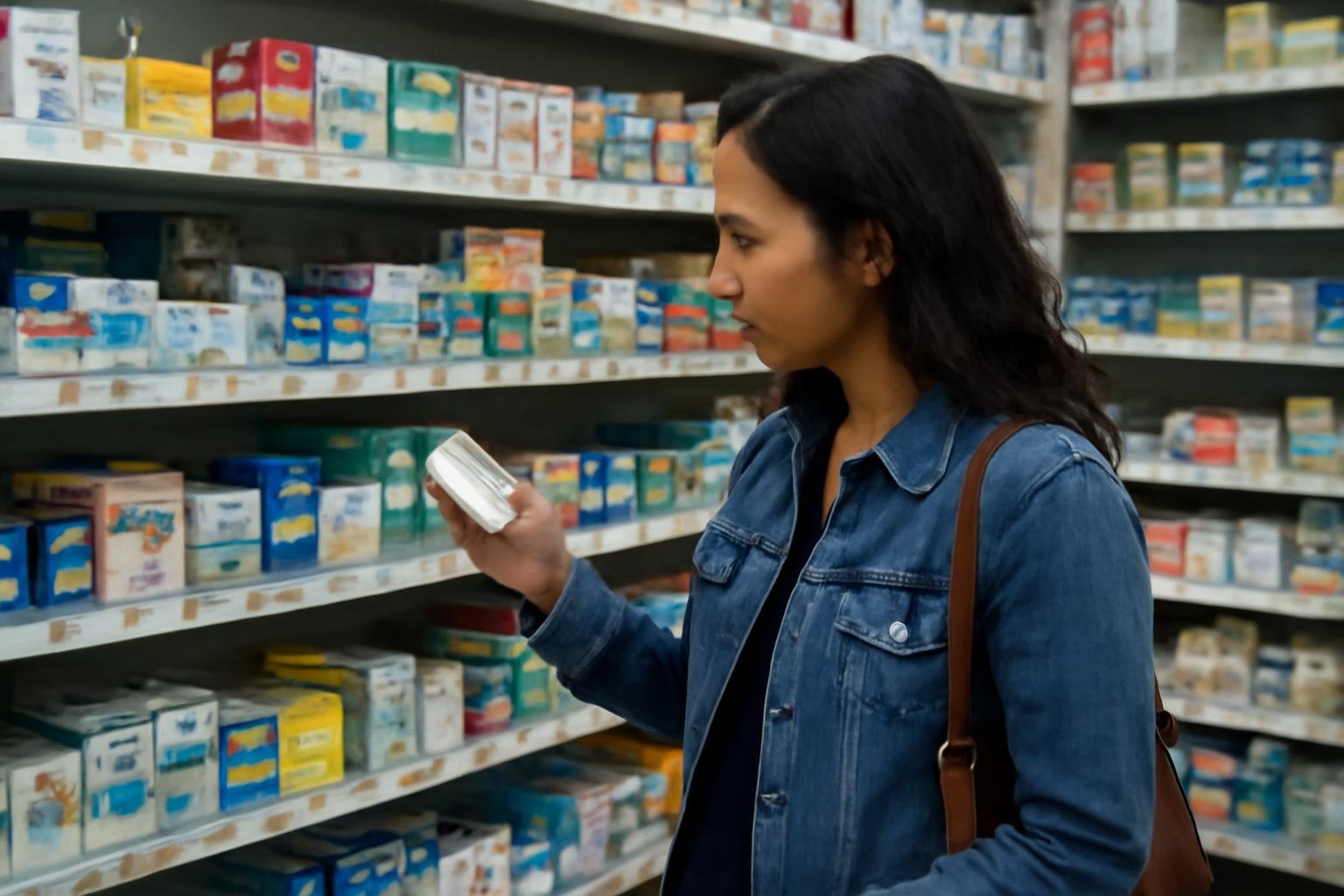
To buy over-the-counter medicine in Korea without reading Korean, go to a 약국 (yak-guk, pharmacy), show the pharmacist a translated description of your symptoms, and confirm the dose and warnings before paying. You do not need to read the packaging yourself, but you should not choose unfamiliar medicine from a shelf based only on its appearance or a translated product name.
Korean pharmacies are usually the safest and most practical place to get common medicine for symptoms such as a headache, fever, allergies, indigestion, a cough, or minor pain. Pharmacists may recommend a product, explain how to take it, or tell you when you need to see a doctor.
1. Find a pharmacy, not just a convenience store
Look for the green cross or the word 약국. In Korea, pharmacies are often small independent businesses, and the pharmacist normally provides the medicine after asking a few questions.
Some convenience stores sell a limited range of commonly used medicines, usually for basic symptoms and emergencies outside pharmacy hours. The selection is smaller, and staff may not be able to offer the same advice as a pharmacist. For anything more complicated—or if you take other medication—use a pharmacy.
Do not buy prescription medicine through an unofficial website, social-media seller, or overseas marketplace. Korea’s Ministry of Food and Drug Safety advises consumers to obtain medicine through proper pharmacies and warns that illegally distributed products may be counterfeit, degraded, or incorrectly labeled. source
2. Prepare the information before you enter
A translation app is useful, but a short written note is often better than trying to explain everything in real time. Prepare the following:
- Your main symptom and where it is located
- When it started and whether it is getting worse
- Your age and, if relevant, your child’s age and weight
- Known allergies
- Pregnancy or breastfeeding status
- Any medical conditions, such as high blood pressure, asthma, diabetes, ulcers, or kidney disease
- All medicine and supplements you are currently taking
If possible, take photographs of the boxes or bottles of your regular medicines. The active ingredient matters more than the brand name, and the same brand may not be sold in Korea.
A useful Korean note
감기 증상에 먹는 일반의약품을 찾고 있어요. 영어로 설명해 주세요.
Gam-gi jeung-sang-e meong-neun il-ban-ui-yak-pum-eul chat-go i-sseo-yo. Yeong-eo-ro seol-myeong-hae ju-se-yo.
“I’m looking for over-the-counter medicine for cold symptoms. Please explain it in English.”
일반의약품 (ilban-uiyakpum) means an over-the-counter medicine. You can also show the phrase 복용법을 영어로 써 주세요 (bogyongbeop-eul yeong-eo-ro sseo ju-se-yo, “Please write the directions in English”).
3. Say what you need in simple Korean
You do not need a long sentence. Pointing to a body area and using one or two keywords is often enough.
- 두통 (dutong) — headache
- 열 (yeol) — fever
- 콧물 (konmul) — runny nose
- 코막힘 (ko-mak-him) — blocked nose
- 기침 (gichim) — cough
- 목이 아파요 (mogi apayo) — my throat hurts
- 배가 아파요 (baega apayo) — my stomach hurts
- 설사 (seolsa) — diarrhea
- 소화불량 (sohwabullyang) — indigestion
- 알레르기 (allereugi) — allergy
- 가려워요 (garyeowoyo) — it is itchy
Useful questions include:
- 이 약은 무슨 약이에요? (I yageun museun yagi-eyo?) — What is this medicine for?
- 하루에 몇 번 먹어요? (Harue myeot beon meogeoyo?) — How many times a day do I take it?
- 몇 알 먹어요? (Myeot al meogeoyo?) — How many tablets do I take?
- 졸려요? (Jollyeoyo?) — Will it make me drowsy?
- 다른 약과 같이 먹어도 돼요? (Da-reun yak-gwa gachi meogeodo dwaeyo?) — Can I take it with my other medicine?
4. Let the pharmacist choose the product
In Korea, medicine that seems familiar from another country may have a different active ingredient, strength, or recommended age range. Even products for the same symptom can have different combinations. For example, a cold medicine may include a pain reliever, antihistamine, cough suppressant, or decongestant.
Show the pharmacist your symptom list and ask for one suitable product rather than buying several boxes. Tell them clearly if you have already taken medicine that day. This helps prevent accidentally combining products with the same ingredient.
If you have a serious allergy, say:
약물 알레르기가 있어요.
Yangmul allereugiga isseoyo.
“I have a drug allergy.”
If you are pregnant, say:
임신 중이에요.
Imsin jung-ieyo.
“I am pregnant.”
For a child, give the child’s exact age and weight. Do not assume that an adult product can simply be divided into a smaller dose.
5. Confirm the directions before you leave
Ask the pharmacist to write the instructions on the package or in your phone. Confirm:
- How many tablets, capsules, packets, or spoonfuls to take
- How often to take it
- Whether to take it with food
- How long to use it
- What to do if you miss a dose
- Whether it causes drowsiness or affects driving
- Whether alcohol should be avoided
The pharmacist may place the medicine in a small paper bag and write directions on it. Keep the original packaging and the receipt, especially if you may need to check the ingredients later.
You can use a translation app’s camera function to read the package, but treat machine translation as a backup, not as the final safety check. If the app gives an unclear result, ask the pharmacist to explain or write the key information.
When a Korean pharmacy is not enough
Ask for a clinic or hospital rather than self-treating if you have trouble breathing, chest pain, fainting, confusion, severe dehydration, a stiff neck, sudden weakness, heavy bleeding, a serious allergic reaction, or rapidly worsening symptoms. For a high fever, severe pain, symptoms after an injury, or symptoms that persist, the pharmacist may also recommend medical care.
Use 병원 (byeongwon, hospital/clinic) or 내과 (naegwa, internal-medicine clinic) when appropriate. For children, look for 소아과 (soagwa, pediatrics). In an emergency, call 119.
If communication breaks down
- Use a translation app to create a short Korean symptom note rather than translating a long conversation.
- Search for a pharmacy near an international hospital, foreigner-support center, or major neighborhood; these locations are more likely to have staff accustomed to non-Korean-speaking customers, although English service is never guaranteed.
- Ask your hotel, school, employer, or local friend to write the symptoms in Korean.
- Bring the medicine or supplement you already use so the pharmacist can inspect its label.
- If the pharmacist cannot understand your medical history safely, accept the referral to a clinic instead of guessing.
The most reliable strategy is simple: prepare a short symptom note, visit a real 약국, show the pharmacist every medicine you are already taking, and leave only after you understand the dose and major warnings. You do not need fluent Korean to buy ordinary medicine in Korea, but you do need enough information for the pharmacist to make a safe recommendation.