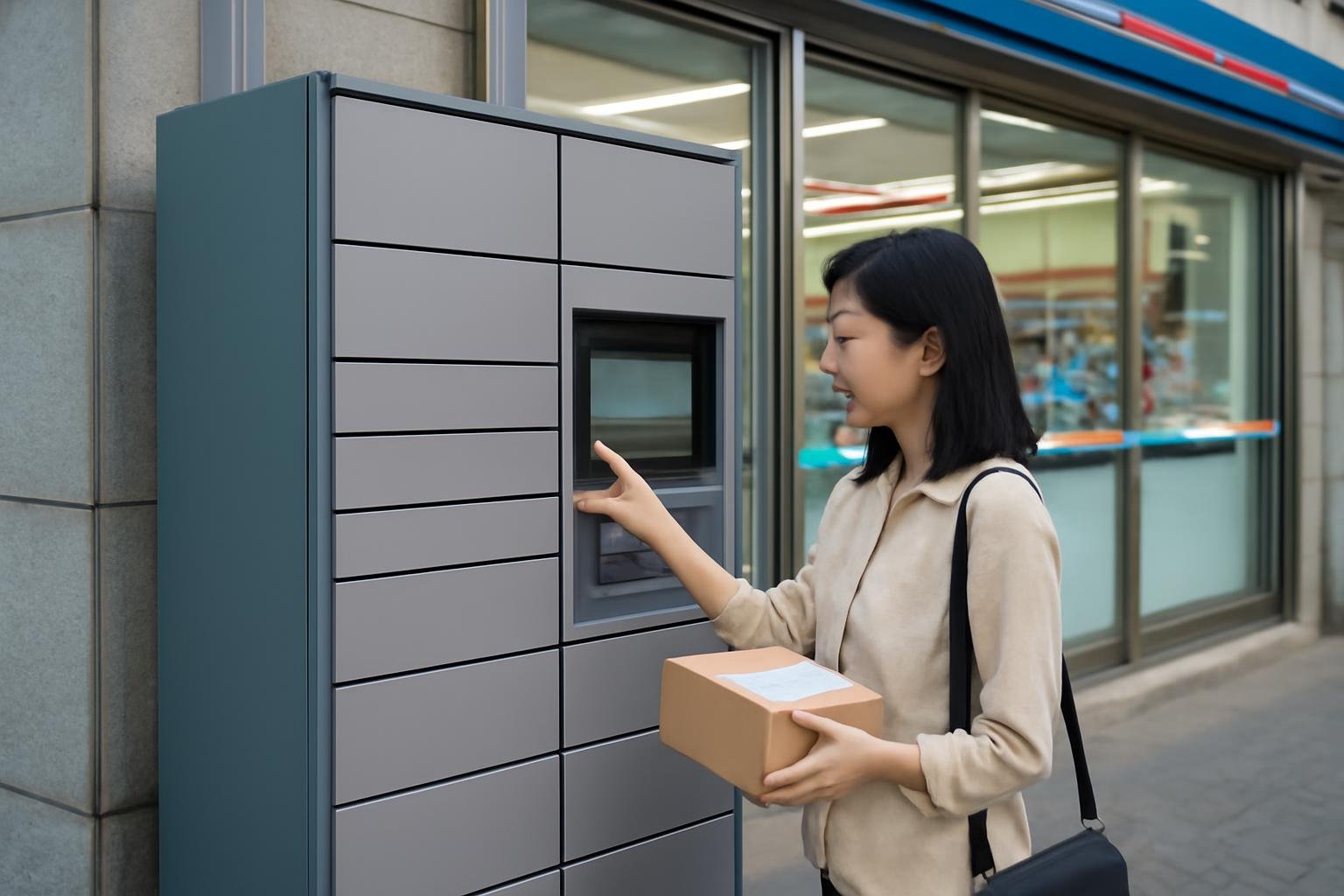
For many foreigners, the easiest way to receive a parcel in Korea is an unmanned locker at an apartment, officetel, university, subway-area facility, or public building. The basic process is simple: provide the correct Korean address and phone number, wait for the arrival notification, then use a PIN, verification code, QR code, or resident account to open the assigned compartment.
There is no single nationwide locker system, however. Each apartment complex, courier, local authority, or building operator can use different software and collection rules. Before ordering, confirm where the parcel will be placed, which phone number will receive the notification, and how long the item will be held.
Choose the right locker before ordering
“Parcel locker” can refer to several different arrangements in Korea. The most common options for residents and visitors are:
- Apartment or officetel locker: A locker in the lobby, entrance, parking area, or management office. The courier usually places the parcel there after delivering it to the building.
- Public or community locker: A locker installed at a subway-adjacent facility, public building, neighborhood center, university, or other shared location. Some are restricted to local residents, students, or registered users.
- Courier-operated locker: A locker connected to a delivery company’s app or booking system. Access may require an account, mobile verification, or a reservation number.
- Post-office unmanned locker: A Korea Post facility used when eligible mail cannot be handed over normally. Its rules are different from those of a private apartment locker.
Do not type a locker’s physical address into an online shopping form unless the seller or courier specifically tells you to. In many cases, the locker is selected through a delivery option, app, or building system. Otherwise, the courier may treat the address as incomplete or leave the parcel at a security office instead.
How to collect a parcel from an apartment locker
Apartment lockers are normally the most practical choice for foreign residents because the courier deposits the parcel for you. You generally do not reserve a compartment in advance.
- Enter the complete address. Include the Korean road-name address, building or dong number, floor, unit number, and any entrance information. If the order form has a delivery note field, write instructions in Korean when possible.
- Use a working phone number. The system may send the arrival alert and access code by SMS, automated message, building app, or push notification. A foreign number may not work with every locker.
- Add useful delivery instructions. Examples include “Please place it in the unmanned parcel locker” (무인택배함에 넣어 주세요) or “Please leave it at the management office” (관리실에 맡겨 주세요). These are requests, not guarantees; the courier may follow the building’s standard procedure instead.
- Wait for the locker notification. A tracking page showing “delivered” may mean the parcel is in a locker, security office, management office, or another designated location.
- Find the locker area. Ask the security desk or management office if you cannot locate it. Useful Korean terms include 무인택배함 (unmanned parcel locker), 택배 보관함 (parcel storage locker), and 보관함 (locker).
- Select the collection menu. Look for 택배 찾기 or 수령, meaning collect or receive. Do not choose 택배 맡기기, which means deposit or leave a parcel.
- Authenticate yourself. Depending on the system, enter a phone number, one-time password, resident account, unit information, or locker PIN. Some systems display a QR code in the resident app.
- Remove the parcel and close the door. Check the recipient name and tracking number before leaving.
Apartment systems often have their own storage deadline. Follow the date shown in the text message or on the locker screen rather than assuming that every building allows the same period. For comparison, Korea Post’s formal standard for certain unmanned postal lockers allows mail to be stored for three days before it may be returned, but that rule does not automatically apply to private apartment lockers.
Using a public or courier-operated locker
Public lockers can be convenient when you live in a building without its own system, but eligibility is more variable. Some facilities are open to anyone using the associated delivery service; others are intended for residents, students, women’s safety-delivery programs, or registered members.
Before selecting one
- Confirm that the locker accepts incoming deliveries, not only parcels that you send.
- Check whether the service requires an account, Korean mobile number, app, or identity verification.
- Confirm the exact locker location and whether you can reach it during the stated access hours.
- Check size and weight limits before ordering large or heavy items.
- Read the storage period and any overdue, return, or handling rules.
Some courier systems allow users to reserve a locker through an app by entering the sender, recipient, parcel details, and compartment size. In that situation, the reservation must usually be created before the parcel is handed to the courier. A normal online order addressed to the locker may not activate the reservation automatically.
At the locker
The collection screen may ask for a reservation number, phone number, password, barcode, or QR code. Keep the arrival message until the parcel is safely removed. If the locker requires a Korean phone number and you entered an overseas number, the system may not be able to send the code even if the delivery itself was accepted.
Why phone numbers cause problems for foreigners
The phone number is often more important than the payment card. Lockers and delivery platforms use it to send arrival alerts, verification codes, QR codes, and failed-delivery messages. A foreign credit card may be accepted by the shopping site while a foreign phone number is rejected by the pickup system.
Before placing the order, check whether you have:
- A Korean mobile number capable of receiving SMS or app notifications.
- The same number registered in the shopping account and delivery instructions.
- A Korean-format address and a recipient name that building staff can recognize.
- Access to the app or account connected to the locker.
If you do not have a Korean number, a hotel, serviced apartment, hostel, workplace, friend, or staffed reception desk may be more reliable. Ask first: some accommodations refuse outside parcels, while others require the reservation name, room number, and expected arrival date.
If the parcel is delivered but the locker will not open
Work through the problem in this order:
- Read the newest arrival message again and use the latest code.
- Confirm that you are at the correct building, entrance, and locker bank.
- Choose the collection option rather than the deposit option.
- Enter the phone number in the format requested by the screen.
- Check the resident app, blocked messages, spam folder, or delivery app for a replacement code.
- Ask the management office or security desk to check the locker record.
- Contact the courier with the tracking number if staff cannot locate the parcel.
A “delivered” status does not prove that the parcel is inside a locker. Search your notifications for 경비실 (security office), 관리실 (management office), 보관함 (locker), and 재배송 (redelivery). The courier may have used a staffed location because the locker was full, the parcel was too large, or the building’s access system was unavailable.
Missed pickup, expired storage, and wrong deliveries
Collect the parcel promptly. When the deadline passes, the item may be removed, returned to the sender, transferred to a management office, or subject to a separate storage procedure. Private buildings set their own policies, so contact the management office as soon as you realize you have missed the deadline.
If you are away, ask whether a trusted person can collect the parcel. Some systems support delegated pickup, while others require the original recipient’s code or account. Do not share a one-time code widely; send it only to the person collecting on your behalf.
If the compartment contains someone else’s parcel, close it without opening the package and report the mistake. If your parcel is damaged, photograph the packaging before opening it and keep the label, tracking number, and delivery notification. These details help the seller or courier investigate.
Practical Korean for locker problems
무인택배함이 어디에 있어요?
Mu-in taekbaehami eodie isseoyo?
Where is the unmanned parcel locker?택배가 보관함에 있다고 문자를 받았어요.
Taekbaega bogwanhame ittdago munjareul badasseoyo.
I received a text saying my parcel is in the locker.비밀번호가 안 돼요.
Bimilbeonhoga an dwaeyo.
The password does not work.택배가 어디에 보관됐는지 확인해 주세요.
Taekbaega eodie bogwandwaenneunji hwaginhae juseyo.
Please check where the parcel was stored.
The most reliable setup for using parcel lockers in Korea is a complete Korean address, a reachable phone number, clear delivery instructions, and immediate collection after the arrival alert. If any of those four pieces is missing, choose a staffed reception desk or another confirmed delivery address instead of relying on an untested locker.