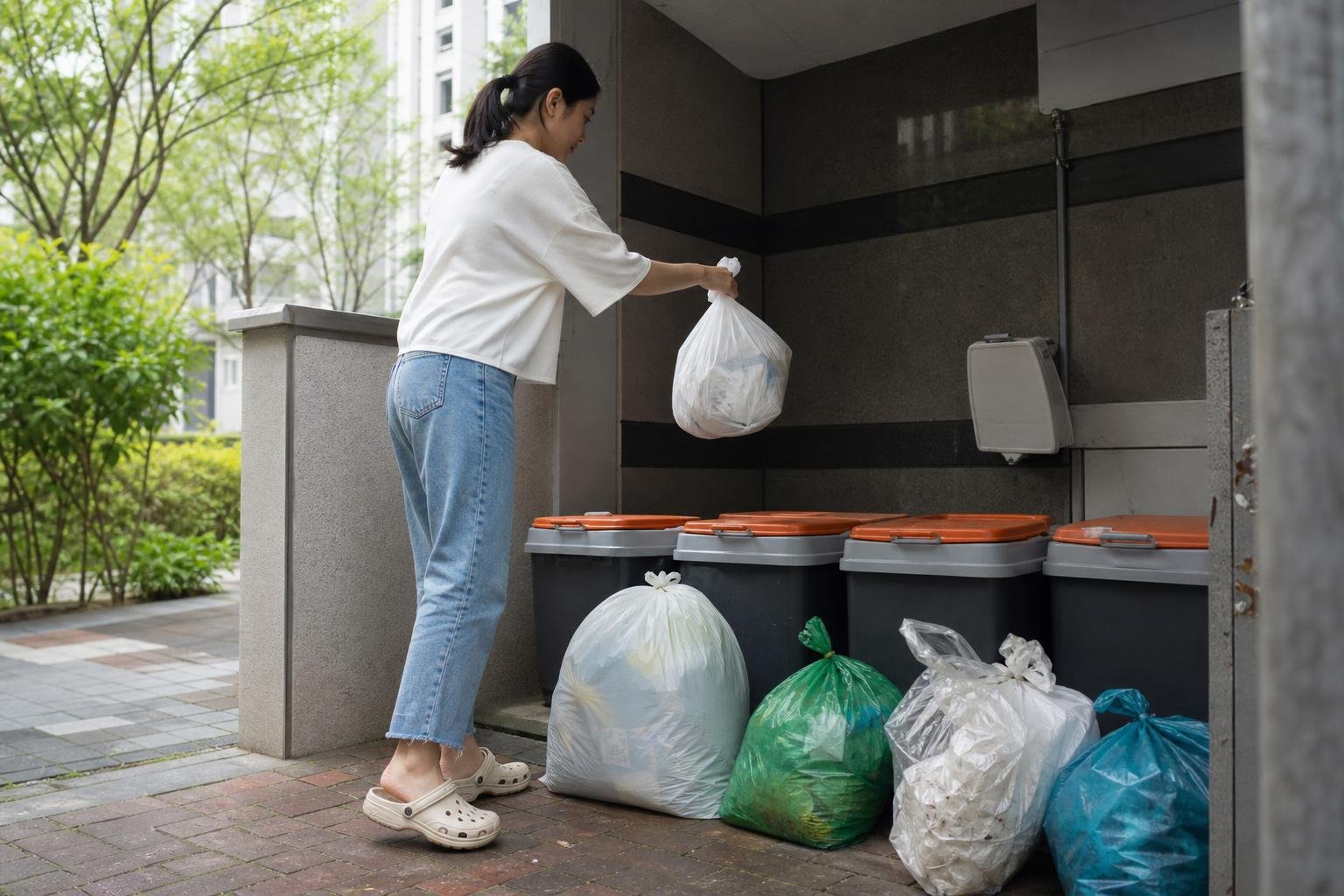
For ordinary household trash in South Korea, you generally need an official pay-as-you-throw bag called a 종량제봉투 (jongnyangje bongtu). Buy it from a designated retailer near your home, use the type printed for your waste category, and put it out according to your building or local government’s schedule. An ordinary shopping bag or generic bin liner is not a substitute.
The details are local. Municipal ordinances and instructions determine which bags are valid, what sizes are sold, how much they cost, where waste is collected, and whether non-burnable material requires a separate sack. Rules can differ between cities, counties, and Seoul districts—and sometimes between apartment complexes and nearby houses. source
Why Korea uses official garbage bags
South Korea introduced its nationwide volume-based waste-fee system on January 1, 1995. Instead of paying only through a flat local charge, households buy approved bags, with part of the collection and treatment fee included in the price. Using more bags therefore costs more, while properly separated recyclables are generally collected outside the paid general-waste bag. source
An official bag normally identifies the issuing local authority, its capacity in liters, and its intended use. Depending on the municipality, the label may say 일반용 (“general use”), 생활쓰레기 (“household waste”), or 소각용 (“for incineration”). Do not choose by color alone, because colors and categories are not uniform nationwide.
You may use a small liner inside your kitchen bin, but the outer bag placed at the collection point must be the correct official bag. Do not overfill it: the bag should close securely without tearing.
Where to buy official garbage bags in Korea
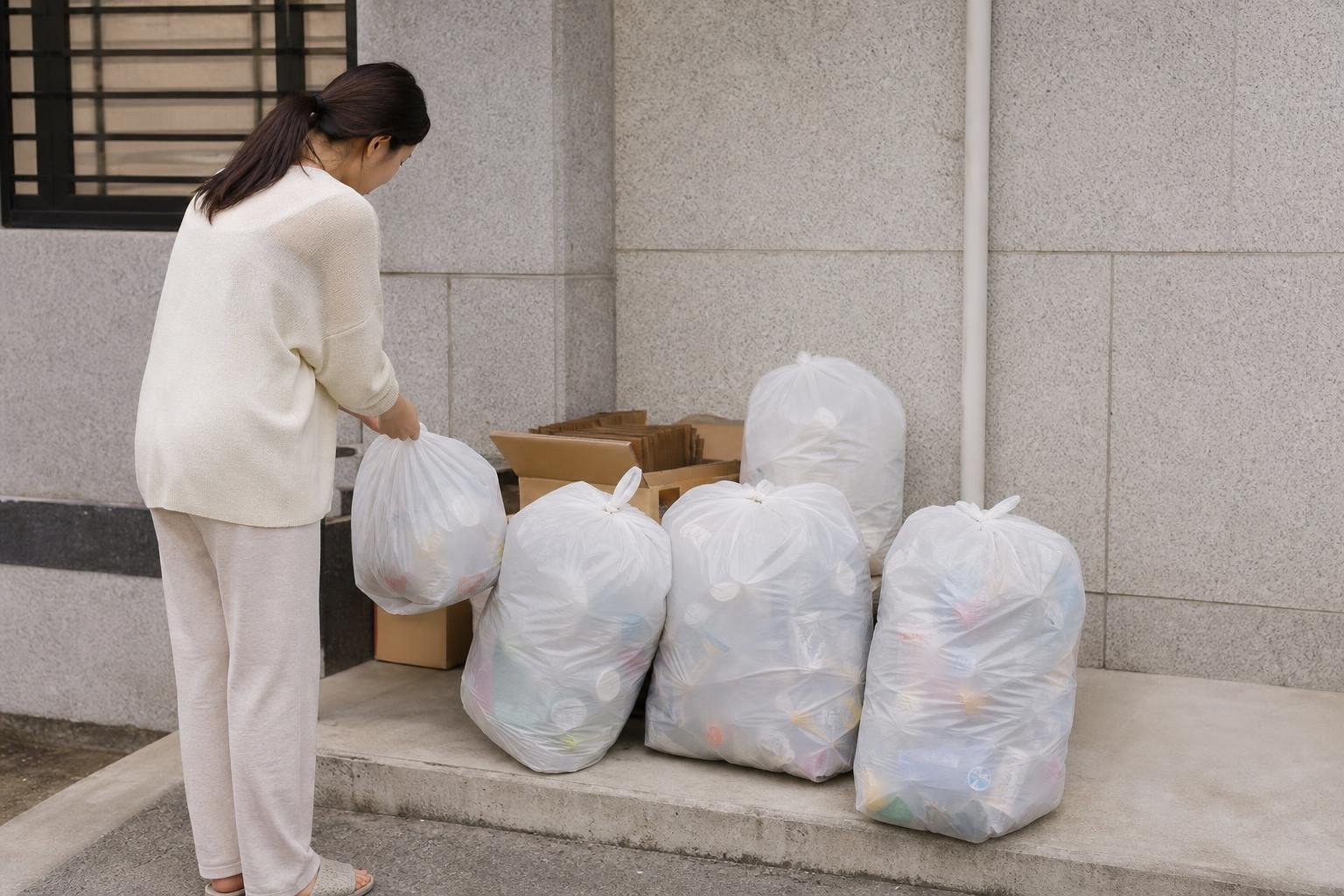
If you are searching for where to buy official garbage bags in Korea, try a nearby convenience store, supermarket, or neighborhood grocery shop. Only designated sellers carry them, so not every branch will have the bags you need. Local government websites often publish searchable lists or maps under 종량제봉투 판매소, meaning “authorized volume-based bag seller.” source
The bags are frequently kept behind the counter. Ask for the waste type and size rather than looking only on the shelves:
일반 쓰레기 종량제봉투 10리터짜리 한 묶음 주세요.
Ilban sseuregi jongnyangje bongtu sip riteojjari han mukkeum juseyo.
“A pack of 10-liter general-waste bags, please.”
Some shops sell individual bags as well as packs. Available capacities and prices vary locally; official listings show, for example, different sets of general, food-waste, and special sacks even among municipalities using similar collection systems. Choose a size that suits your household rather than assuming that every store stocks every capacity. source
Buy bags issued for your current area. If you move with unused bags, do not assume they have become worthless—or that you may automatically use them at the new address. National policy has encouraged local governments to accommodate movers through exchanges or certification stickers, but the procedure, quantity limit, and application period are local. Ask your new 주민센터 (jumin senteo, neighborhood administrative service center) or district office before putting out an old bag. source
What goes in a general-waste bag?
The general-waste bag is for household material that is not accepted as recycling or food waste under your local rules. Common examples include used tissues, diapers, toothbrushes, rubber gloves, small mixed-material products, dirty plastic film, and packaging whose food residue cannot reasonably be removed. National sorting guidance identifies many of these as difficult or unsuitable to recycle. source
Before using the general bag, ask whether the item can be emptied, cleaned, and separated by material. A clean plastic container may be recyclable; the same container filled with sauce or combined with materials that cannot be separated may not be. Printed recycling symbols can help identify the material, but they do not override your building’s collection instructions.
“General waste” does not always include every non-recyclable object. Some municipalities distinguish burnable waste from non-burnable material and sell a 특수규격봉투 or 특수마대, a special sack for items such as ceramics, plate glass, or small quantities of household repair debris. Requirements differ: one district may accept carefully wrapped broken glass in a general bag, while another directs it to a special sack. Check before disposing of glass, mirrors, crockery, cat litter, soil, bricks, or similar heavy material. source
Wrap sharp fragments in thick paper or place them in a sturdy container before following the local disposal method. This is not only about sorting; it helps protect collection workers from cuts.
Food waste uses a separate payment method
Food waste is 음식물쓰레기 (eumsikmul sseuregi). Depending on the area and housing type, residents may use official food-waste bags, a communal container with a paid tag or chip, or an RFID machine that identifies the household and charges by weight. Apartment residents should follow the management office’s instructions rather than buying food-waste bags without checking. source
Remove packaging and drain excess liquid before disposal. Food-waste processing can produce animal feed, compost, or biogas, so an item is not accepted merely because it was once edible. Hard, fibrous, or shell-like material that cannot be processed appropriately generally belongs outside the food-waste stream. source
Items commonly excluded from food waste include:
- Beef, pork, poultry, and fish bones
- Clam, oyster, snail, crab, and other hard shells
- Eggshells
- Peach and apricot pits, plus hard nut shells
- Dry onion, garlic, and ginger skins
- Green-onion roots, corn husks, and tough corn cobs or stalks
- Tea leaves, tea bags, coffee grounds, and medicinal-herb residue
- Toothpicks, foil, plastic packets, bottle caps, cutlery, and other foreign material
These exclusions appear in national guidance, but the required destination—such as a general bag or non-burnable sack—can still depend on the local ordinance. Read the notice attached to your building’s food-waste station when in doubt. source
Recycling stays out of the paid general bag
Recyclables are normally placed in labeled building containers or taken to a neighborhood collection point on the specified day. Common categories include paper, cardboard, metal cans, glass bottles, plastics, plastic film, foam packaging, and paper cartons, although buildings may subdivide them differently.
Empty containers and remove food residue. Separate removable parts made from different materials. For cardboard boxes, remove shipping labels, tape, and plastic padding, then flatten the boxes. For transparent beverage PET bottles, national guidance calls for emptying them, removing the label, crushing them, and placing them in the designated transparent-PET collection stream where one is provided. source
Apartment complexes usually have permanent recycling stations, while detached houses and smaller multi-unit buildings may use clear bags, tied bundles, or scheduled curbside collection. A pile seen on the street is not necessarily an everyday drop-off point.
Check the place and time before putting bags outside
Correct sorting is only part of the process. Local authorities set collection days, hours, and locations. Some neighborhoods require evening set-out before overnight collection; others have different windows or exclude particular days. Food waste and recycling may follow separate schedules. source
For an apartment, ask the 관리사무소 (gwalli samuso), or management office. In a villa, studio building, or house, ask the landlord and check signs near the entrance. A useful question is:
쓰레기는 언제 어디에 내놓으면 돼요?
Sseuregineun eonje eodie naenoeumyeon dwaeyo?
“When and where should I put the trash out?”
Bulky items and electronics need another route
Furniture, mattresses, large suitcases, and other objects that do not fit in the appropriate bag are generally handled as 대형폐기물 (daehyeong pyegimul), or bulky waste. The usual process is to report the item through the local government’s website, app, service center, or designated seller, pay the item-specific fee, and display a receipt, sticker, or collection number. The exact process is local, and some systems no longer require a printed sticker. source
Electrical products should not automatically be treated as ordinary bulky waste. Eligible large appliances can be booked through Korea’s free home-collection service, while small electronics may go into dedicated collection boxes or another municipal channel. Batteries and intact fluorescent or LED lamps also have designated collection streams; broken lamps require careful wrapping and disposal according to the local ordinance. source
The safest routine is simple: buy locally issued bags, follow the wording printed on them, keep food waste and recyclables separate, and confirm the schedule with your building. For anything sharp, heavy, electrical, or too large for the bag, check the municipality’s current instructions before setting it outside.